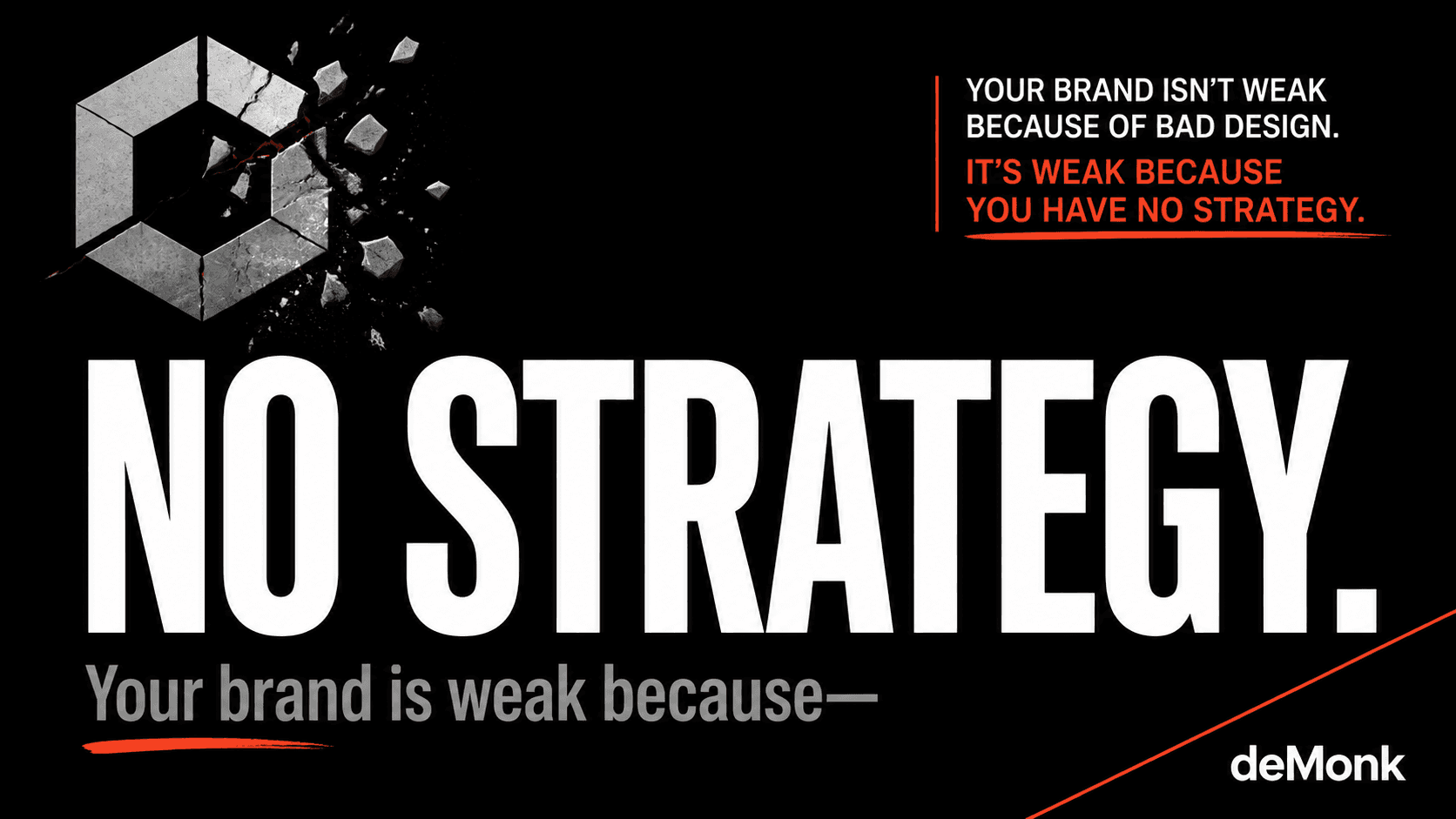
Your Brand Isn't Weak Because of Bad Design. It's Weak Because You Have No Strategy.
A better logo won't fix a confused founder.
You've probably heard it before — "We need to refresh our brand." So you hire a designer, get a new logo, update the color palette, and relaunch the website. Three months later, you're still not getting inquiries. The pitch deck still gets awkward silences. And somewhere in the back of your mind, you start wondering if the designer was just not good enough.
They were fine. The real problem was never the design.
The Real Problem Is Upstream
Most Indian startups treat branding as a finish line. You build the product, raise some money, and then — when the pitch needs to look polished — you call a designer.
But branding isn't decoration. It's decision-making made visible. Every visual choice, every message, every campaign your brand puts into the world is either communicating something clear or creating noise. And no amount of design skill can rescue a brand that hasn't figured out what it's actually trying to say.
Strategy is what you stand for, who you're for, and why anyone should care — before a single pixel gets placed. When that's missing, design becomes expensive guesswork.
This is the gap that kills Indian startups' market pull. Not bad aesthetics. No strategy.
What Founders Get Wrong About Branding
Mistake 1: Confusing Visual Identity With Brand
The logo is not the brand. The website is not the brand. The color system is not the brand.
These are expressions of the brand. The brand itself is a set of beliefs your audience holds about your business. It lives in their heads, not on your style guide. When someone sees your name and immediately thinks "oh, they're the ones who do X for Y kind of people" — that's brand. When they see your name and think "I think they do something with tech?" — that's the absence of brand.
A polished visual system applied to a confused positioning just looks like a well-dressed stranger. Nobody trusts a well-dressed stranger.
Mistake 2: Building for Aesthetics, Not for Audience Clarity
A common brief we receive at deMonk sounds like this: "We want something clean, modern, minimal — kind of like Apple but for our space."
That's an aesthetic direction. It tells us nothing about who the brand is serving, what problem it's solving, or what emotional relationship it wants to build with its audience.
Audience clarity means knowing exactly who you're building for — their specific frustrations, their existing beliefs, the language they use when they talk about your category. A brand that speaks directly to a specific person is always more powerful than one that's been designed to appeal to everyone. The more specific the positioning, the sharper the pull.
Mistake 3: Treating Narrative as Optional
Founders often think storytelling is for consumer brands, not B2B or SaaS. This is wrong.
Every founder who has ever closed a serious deal did it through narrative. They made someone believe that the problem they were solving was real, that their approach was credible, and that their team was the right one to back. That's brand narrative — and it works at every level of the funnel, from your LinkedIn about section to your Series A pitch.
Without a clear narrative architecture, your marketing content becomes a list of features. Features don't build loyalty. Stories do.
A better logo won't fix a confused founder.
You've probably heard it before — "We need to refresh our brand." So you hire a designer, get a new logo, update the color palette, and relaunch the website. Three months later, you're still not getting inquiries. The pitch deck still gets awkward silences. And somewhere in the back of your mind, you start wondering if the designer was just not good enough.
They were fine. The real problem was never the design.
The Real Problem Is Upstream
Most Indian startups treat branding as a finish line. You build the product, raise some money, and then — when the pitch needs to look polished — you call a designer.
But branding isn't decoration. It's decision-making made visible. Every visual choice, every message, every campaign your brand puts into the world is either communicating something clear or creating noise. And no amount of design skill can rescue a brand that hasn't figured out what it's actually trying to say.
Strategy is what you stand for, who you're for, and why anyone should care — before a single pixel gets placed. When that's missing, design becomes expensive guesswork.
This is the gap that kills Indian startups' market pull. Not bad aesthetics. No strategy.
What Founders Get Wrong About Branding
Mistake 1: Confusing Visual Identity With Brand
The logo is not the brand. The website is not the brand. The color system is not the brand.
These are expressions of the brand. The brand itself is a set of beliefs your audience holds about your business. It lives in their heads, not on your style guide. When someone sees your name and immediately thinks "oh, they're the ones who do X for Y kind of people" — that's brand. When they see your name and think "I think they do something with tech?" — that's the absence of brand.
A polished visual system applied to a confused positioning just looks like a well-dressed stranger. Nobody trusts a well-dressed stranger.
Mistake 2: Building for Aesthetics, Not for Audience Clarity
A common brief we receive at deMonk sounds like this: "We want something clean, modern, minimal — kind of like Apple but for our space."
That's an aesthetic direction. It tells us nothing about who the brand is serving, what problem it's solving, or what emotional relationship it wants to build with its audience.
Audience clarity means knowing exactly who you're building for — their specific frustrations, their existing beliefs, the language they use when they talk about your category. A brand that speaks directly to a specific person is always more powerful than one that's been designed to appeal to everyone. The more specific the positioning, the sharper the pull.
Mistake 3: Treating Narrative as Optional
Founders often think storytelling is for consumer brands, not B2B or SaaS. This is wrong.
Every founder who has ever closed a serious deal did it through narrative. They made someone believe that the problem they were solving was real, that their approach was credible, and that their team was the right one to back. That's brand narrative — and it works at every level of the funnel, from your LinkedIn about section to your Series A pitch.
Without a clear narrative architecture, your marketing content becomes a list of features. Features don't build loyalty. Stories do.
A better logo won't fix a confused founder.
You've probably heard it before — "We need to refresh our brand." So you hire a designer, get a new logo, update the color palette, and relaunch the website. Three months later, you're still not getting inquiries. The pitch deck still gets awkward silences. And somewhere in the back of your mind, you start wondering if the designer was just not good enough.
They were fine. The real problem was never the design.
The Real Problem Is Upstream
Most Indian startups treat branding as a finish line. You build the product, raise some money, and then — when the pitch needs to look polished — you call a designer.
But branding isn't decoration. It's decision-making made visible. Every visual choice, every message, every campaign your brand puts into the world is either communicating something clear or creating noise. And no amount of design skill can rescue a brand that hasn't figured out what it's actually trying to say.
Strategy is what you stand for, who you're for, and why anyone should care — before a single pixel gets placed. When that's missing, design becomes expensive guesswork.
This is the gap that kills Indian startups' market pull. Not bad aesthetics. No strategy.
What Founders Get Wrong About Branding
Mistake 1: Confusing Visual Identity With Brand
The logo is not the brand. The website is not the brand. The color system is not the brand.
These are expressions of the brand. The brand itself is a set of beliefs your audience holds about your business. It lives in their heads, not on your style guide. When someone sees your name and immediately thinks "oh, they're the ones who do X for Y kind of people" — that's brand. When they see your name and think "I think they do something with tech?" — that's the absence of brand.
A polished visual system applied to a confused positioning just looks like a well-dressed stranger. Nobody trusts a well-dressed stranger.
Mistake 2: Building for Aesthetics, Not for Audience Clarity
A common brief we receive at deMonk sounds like this: "We want something clean, modern, minimal — kind of like Apple but for our space."
That's an aesthetic direction. It tells us nothing about who the brand is serving, what problem it's solving, or what emotional relationship it wants to build with its audience.
Audience clarity means knowing exactly who you're building for — their specific frustrations, their existing beliefs, the language they use when they talk about your category. A brand that speaks directly to a specific person is always more powerful than one that's been designed to appeal to everyone. The more specific the positioning, the sharper the pull.
Mistake 3: Treating Narrative as Optional
Founders often think storytelling is for consumer brands, not B2B or SaaS. This is wrong.
Every founder who has ever closed a serious deal did it through narrative. They made someone believe that the problem they were solving was real, that their approach was credible, and that their team was the right one to back. That's brand narrative — and it works at every level of the funnel, from your LinkedIn about section to your Series A pitch.
Without a clear narrative architecture, your marketing content becomes a list of features. Features don't build loyalty. Stories do.
What Brand Strategy Actually Involves
Let's get specific. Brand strategy is not a mood board. It is not a tagline. It is a structured set of decisions made before design begins.
Positioning
Positioning answers one question: "Why you, and not the three other companies doing the same thing?"
Effective positioning is not about being different in every possible way. It's about being distinctly right for a very specific audience in a very specific context. The best positioning statements are almost uncomfortably narrow. They exclude people. That exclusion is intentional — it makes the people you're targeting feel like the brand was built specifically for them.
For Indian startups, the temptation is to position broad. "We serve all businesses across India." This sounds ambitious. It reads as generic. The moment you try to appeal to everyone, you stop being compelling to anyone.
The businesses that build real market pull are the ones that can say: "We are the only X that does Y for Z." And mean it.
Audience Clarity
Audience clarity goes deeper than a demographic profile. Age, city, income bracket — those are filters, not insights.
Real audience clarity means knowing what your audience believes before they encounter you. What do they think about your category? What have they already tried? Where have they been disappointed? What would need to be true for them to trust you over their current solution?
This level of understanding doesn't come from surveys. It comes from founder conversations, sales call patterns, and strategic analysis of where competitors are losing customers. When you build brand strategy on this foundation, every communication decision becomes obvious rather than debated.
Narrative Architecture
Narrative architecture is the logical structure of your brand's story across all touchpoints.
It starts with your brand's origin tension — the problem in the world that made your business necessary. Then it moves to your belief — what you think is true about how this problem should be solved that others aren't acting on. Then it articulates your method — the approach you take that is specific to your belief. And finally, it describes the transformation — what becomes possible for your audience because you exist.
This is not copywriting. It's the skeleton that all copywriting hangs on. Without it, your website headline and your pitch deck and your social content all feel disconnected — because they are.
The Cost of Skipping Strategy
Here's a number that should make you pause: the average Indian SME spends between ₹1.5 lakh and ₹5 lakh on their first brand identity. Logo, website, some social assets, maybe a brand guide.
A year later, a significant portion of them are back at the table wanting to change it. Not because the design was bad. Because the business had no idea who it was when the design was built, so the design captured the wrong thing. Now the brand doesn't reflect where the business has actually landed. It feels off.
You didn't get unlucky. You skipped the strategy, and design filled the void with assumptions.
Rebuilding a brand costs more than building it right the first time — in money, in time, and in the internal confusion it creates. Every rebrand is a message to your market that says "we're still figuring it out." Sometimes that's honest. But it's always expensive.
What Brand Strategy Actually Involves
Let's get specific. Brand strategy is not a mood board. It is not a tagline. It is a structured set of decisions made before design begins.
Positioning
Positioning answers one question: "Why you, and not the three other companies doing the same thing?"
Effective positioning is not about being different in every possible way. It's about being distinctly right for a very specific audience in a very specific context. The best positioning statements are almost uncomfortably narrow. They exclude people. That exclusion is intentional — it makes the people you're targeting feel like the brand was built specifically for them.
For Indian startups, the temptation is to position broad. "We serve all businesses across India." This sounds ambitious. It reads as generic. The moment you try to appeal to everyone, you stop being compelling to anyone.
The businesses that build real market pull are the ones that can say: "We are the only X that does Y for Z." And mean it.
Audience Clarity
Audience clarity goes deeper than a demographic profile. Age, city, income bracket — those are filters, not insights.
Real audience clarity means knowing what your audience believes before they encounter you. What do they think about your category? What have they already tried? Where have they been disappointed? What would need to be true for them to trust you over their current solution?
This level of understanding doesn't come from surveys. It comes from founder conversations, sales call patterns, and strategic analysis of where competitors are losing customers. When you build brand strategy on this foundation, every communication decision becomes obvious rather than debated.
Narrative Architecture
Narrative architecture is the logical structure of your brand's story across all touchpoints.
It starts with your brand's origin tension — the problem in the world that made your business necessary. Then it moves to your belief — what you think is true about how this problem should be solved that others aren't acting on. Then it articulates your method — the approach you take that is specific to your belief. And finally, it describes the transformation — what becomes possible for your audience because you exist.
This is not copywriting. It's the skeleton that all copywriting hangs on. Without it, your website headline and your pitch deck and your social content all feel disconnected — because they are.
The Cost of Skipping Strategy
Here's a number that should make you pause: the average Indian SME spends between ₹1.5 lakh and ₹5 lakh on their first brand identity. Logo, website, some social assets, maybe a brand guide.
A year later, a significant portion of them are back at the table wanting to change it. Not because the design was bad. Because the business had no idea who it was when the design was built, so the design captured the wrong thing. Now the brand doesn't reflect where the business has actually landed. It feels off.
You didn't get unlucky. You skipped the strategy, and design filled the void with assumptions.
Rebuilding a brand costs more than building it right the first time — in money, in time, and in the internal confusion it creates. Every rebrand is a message to your market that says "we're still figuring it out." Sometimes that's honest. But it's always expensive.
What Brand Strategy Actually Involves
Let's get specific. Brand strategy is not a mood board. It is not a tagline. It is a structured set of decisions made before design begins.
Positioning
Positioning answers one question: "Why you, and not the three other companies doing the same thing?"
Effective positioning is not about being different in every possible way. It's about being distinctly right for a very specific audience in a very specific context. The best positioning statements are almost uncomfortably narrow. They exclude people. That exclusion is intentional — it makes the people you're targeting feel like the brand was built specifically for them.
For Indian startups, the temptation is to position broad. "We serve all businesses across India." This sounds ambitious. It reads as generic. The moment you try to appeal to everyone, you stop being compelling to anyone.
The businesses that build real market pull are the ones that can say: "We are the only X that does Y for Z." And mean it.
Audience Clarity
Audience clarity goes deeper than a demographic profile. Age, city, income bracket — those are filters, not insights.
Real audience clarity means knowing what your audience believes before they encounter you. What do they think about your category? What have they already tried? Where have they been disappointed? What would need to be true for them to trust you over their current solution?
This level of understanding doesn't come from surveys. It comes from founder conversations, sales call patterns, and strategic analysis of where competitors are losing customers. When you build brand strategy on this foundation, every communication decision becomes obvious rather than debated.
Narrative Architecture
Narrative architecture is the logical structure of your brand's story across all touchpoints.
It starts with your brand's origin tension — the problem in the world that made your business necessary. Then it moves to your belief — what you think is true about how this problem should be solved that others aren't acting on. Then it articulates your method — the approach you take that is specific to your belief. And finally, it describes the transformation — what becomes possible for your audience because you exist.
This is not copywriting. It's the skeleton that all copywriting hangs on. Without it, your website headline and your pitch deck and your social content all feel disconnected — because they are.
The Cost of Skipping Strategy
Here's a number that should make you pause: the average Indian SME spends between ₹1.5 lakh and ₹5 lakh on their first brand identity. Logo, website, some social assets, maybe a brand guide.
A year later, a significant portion of them are back at the table wanting to change it. Not because the design was bad. Because the business had no idea who it was when the design was built, so the design captured the wrong thing. Now the brand doesn't reflect where the business has actually landed. It feels off.
You didn't get unlucky. You skipped the strategy, and design filled the void with assumptions.
Rebuilding a brand costs more than building it right the first time — in money, in time, and in the internal confusion it creates. Every rebrand is a message to your market that says "we're still figuring it out." Sometimes that's honest. But it's always expensive.
How deMonk Approaches Brand Strategy
At deMonk, we don't start with logos. We start with a question: What does this business actually need to become in the minds of its market?
That question sounds simple. Getting the answer right takes discipline.
The Brand Strategy Review
Before any visual work begins, we run a brand strategy review. This is a structured diagnostic that covers:
Business context: Where is the founder trying to take this in 12 to 24 months? What's the actual growth ambition, not the safe answer?
Competitive landscape: How are competitors positioning themselves? Where are the white spaces they've left unclaimed?
Audience mapping: Who buys from you today? Who should be buying from you if your positioning was sharper? What does that audience believe about your category right now?
Narrative audit: What story are you currently telling, across website, pitch, social, and sales conversations? Is it coherent? Is it accurate? Is it compelling?
This review surfaces the real gaps. Often, founders discover that the problem isn't their visual identity at all — it's that their positioning is too generic, or their audience definition is so broad that no message lands cleanly.
From Diagnosis to Direction
Once the strategy review is complete, we move to brand positioning and narrative architecture — in that order. Positioning defines the competitive space. Narrative architecture defines the story. Visual identity comes last, as the expression of both.
This sequence matters because it ensures that the design is doing real work. Every visual decision — typography, color, layout logic, iconography — is made in service of the strategic position the brand needs to hold. The result is a brand that doesn't just look coherent. It is coherent. Because every layer was built on the same foundation.
A Framework for Founders
If you want to audit your own brand positioning before engaging a studio, use these four questions:
1. Can you describe your brand's position in one sentence that couldn't apply to a competitor?
If your answer contains words like "quality," "customer-centric," or "innovative," start over. Those words describe what every business claims. You need words that describe what only you do, for who, in what specific way.
2. Who is your brand NOT for?
Positioning that can't exclude anyone hasn't positioned anything. Name three types of customers who should look elsewhere. If this feels uncomfortable, that discomfort is the problem.
3. What does your brand believe that most people in your industry would argue with?
Every strong brand has a point of view that creates some friction. If your brand's worldview is entirely uncontroversial, it's entirely forgettable.
4. Does your visual identity match the brand you described in questions 1–3?
This is the final test. If the design was built before you had clear answers to the first three questions, the design is built on sand.
Authority Comes From Clarity, Not Spend
This is worth saying directly: brand authority is not purchased. It is not a function of how much you spend on marketing, how many influencers you work with, or how often you post.
Brand authority is the accumulation of consistent, clear, credible communication over time. Every touchpoint — from how your team answers emails to how your website explains your service — either builds or erodes that authority. And the only way to be consistent over time is to have a strategy that every decision is anchored to.
The Indian startups that are building real market pull right now are not the ones with the biggest marketing budgets. They are the ones where every piece of communication says the same thing, to the same person, in a voice that is unmistakably theirs. That coherence is the product of strategy — and it compounds.
The Difference a Year Makes
Consider two startups at the same stage: similar product, similar market, similar team quality.
The first one invests in brand strategy before design. They spend three to four weeks getting positioning right, defining their audience precisely, building a narrative architecture. Their design takes the same time and budget as the second startup's.
The second one goes straight to design. They build a beautiful brand identity. But underneath it, the positioning is vague, the audience definition is broad, and the narrative is "we're a better version of what you already know."
Twelve months later, the first startup has a consistent content strategy that's converting. Their sales conversations are shorter because prospects arrive pre-educated. Their team can onboard new members faster because the brand direction is clear. Their design is still working for them.
The second startup is talking about a rebrand.
The difference is not design quality. It is sequence. Strategy first, always.
How deMonk Can Help
If any part of this article made you uncomfortable — if you read the four-question framework and couldn't answer cleanly — that's useful data.
It means your brand is working harder than it should to communicate something that should be simple. Every sales call that requires too much explanation, every pitch that needs a follow-up email to clarify "what you actually do," every campaign that doesn't convert despite decent creative — these are the symptoms of a strategy gap, not a design gap.
A brand strategy review with deMonk is not a rebranding project. It's a diagnostic. We look at where your brand is positioned today, where you need it to be for the next phase of growth, and what has to change — at the strategy level — to close that gap. Some founders come out of this knowing they need a full rebrand. Others come out knowing they need a better positioning statement and a tighter website narrative. Either outcome is more valuable than another logo redesign.
How deMonk Approaches Brand Strategy
At deMonk, we don't start with logos. We start with a question: What does this business actually need to become in the minds of its market?
That question sounds simple. Getting the answer right takes discipline.
The Brand Strategy Review
Before any visual work begins, we run a brand strategy review. This is a structured diagnostic that covers:
Business context: Where is the founder trying to take this in 12 to 24 months? What's the actual growth ambition, not the safe answer?
Competitive landscape: How are competitors positioning themselves? Where are the white spaces they've left unclaimed?
Audience mapping: Who buys from you today? Who should be buying from you if your positioning was sharper? What does that audience believe about your category right now?
Narrative audit: What story are you currently telling, across website, pitch, social, and sales conversations? Is it coherent? Is it accurate? Is it compelling?
This review surfaces the real gaps. Often, founders discover that the problem isn't their visual identity at all — it's that their positioning is too generic, or their audience definition is so broad that no message lands cleanly.
From Diagnosis to Direction
Once the strategy review is complete, we move to brand positioning and narrative architecture — in that order. Positioning defines the competitive space. Narrative architecture defines the story. Visual identity comes last, as the expression of both.
This sequence matters because it ensures that the design is doing real work. Every visual decision — typography, color, layout logic, iconography — is made in service of the strategic position the brand needs to hold. The result is a brand that doesn't just look coherent. It is coherent. Because every layer was built on the same foundation.
A Framework for Founders
If you want to audit your own brand positioning before engaging a studio, use these four questions:
1. Can you describe your brand's position in one sentence that couldn't apply to a competitor?
If your answer contains words like "quality," "customer-centric," or "innovative," start over. Those words describe what every business claims. You need words that describe what only you do, for who, in what specific way.
2. Who is your brand NOT for?
Positioning that can't exclude anyone hasn't positioned anything. Name three types of customers who should look elsewhere. If this feels uncomfortable, that discomfort is the problem.
3. What does your brand believe that most people in your industry would argue with?
Every strong brand has a point of view that creates some friction. If your brand's worldview is entirely uncontroversial, it's entirely forgettable.
4. Does your visual identity match the brand you described in questions 1–3?
This is the final test. If the design was built before you had clear answers to the first three questions, the design is built on sand.
Authority Comes From Clarity, Not Spend
This is worth saying directly: brand authority is not purchased. It is not a function of how much you spend on marketing, how many influencers you work with, or how often you post.
Brand authority is the accumulation of consistent, clear, credible communication over time. Every touchpoint — from how your team answers emails to how your website explains your service — either builds or erodes that authority. And the only way to be consistent over time is to have a strategy that every decision is anchored to.
The Indian startups that are building real market pull right now are not the ones with the biggest marketing budgets. They are the ones where every piece of communication says the same thing, to the same person, in a voice that is unmistakably theirs. That coherence is the product of strategy — and it compounds.
The Difference a Year Makes
Consider two startups at the same stage: similar product, similar market, similar team quality.
The first one invests in brand strategy before design. They spend three to four weeks getting positioning right, defining their audience precisely, building a narrative architecture. Their design takes the same time and budget as the second startup's.
The second one goes straight to design. They build a beautiful brand identity. But underneath it, the positioning is vague, the audience definition is broad, and the narrative is "we're a better version of what you already know."
Twelve months later, the first startup has a consistent content strategy that's converting. Their sales conversations are shorter because prospects arrive pre-educated. Their team can onboard new members faster because the brand direction is clear. Their design is still working for them.
The second startup is talking about a rebrand.
The difference is not design quality. It is sequence. Strategy first, always.
How deMonk Can Help
If any part of this article made you uncomfortable — if you read the four-question framework and couldn't answer cleanly — that's useful data.
It means your brand is working harder than it should to communicate something that should be simple. Every sales call that requires too much explanation, every pitch that needs a follow-up email to clarify "what you actually do," every campaign that doesn't convert despite decent creative — these are the symptoms of a strategy gap, not a design gap.
A brand strategy review with deMonk is not a rebranding project. It's a diagnostic. We look at where your brand is positioned today, where you need it to be for the next phase of growth, and what has to change — at the strategy level — to close that gap. Some founders come out of this knowing they need a full rebrand. Others come out knowing they need a better positioning statement and a tighter website narrative. Either outcome is more valuable than another logo redesign.
How deMonk Approaches Brand Strategy
At deMonk, we don't start with logos. We start with a question: What does this business actually need to become in the minds of its market?
That question sounds simple. Getting the answer right takes discipline.
The Brand Strategy Review
Before any visual work begins, we run a brand strategy review. This is a structured diagnostic that covers:
Business context: Where is the founder trying to take this in 12 to 24 months? What's the actual growth ambition, not the safe answer?
Competitive landscape: How are competitors positioning themselves? Where are the white spaces they've left unclaimed?
Audience mapping: Who buys from you today? Who should be buying from you if your positioning was sharper? What does that audience believe about your category right now?
Narrative audit: What story are you currently telling, across website, pitch, social, and sales conversations? Is it coherent? Is it accurate? Is it compelling?
This review surfaces the real gaps. Often, founders discover that the problem isn't their visual identity at all — it's that their positioning is too generic, or their audience definition is so broad that no message lands cleanly.
From Diagnosis to Direction
Once the strategy review is complete, we move to brand positioning and narrative architecture — in that order. Positioning defines the competitive space. Narrative architecture defines the story. Visual identity comes last, as the expression of both.
This sequence matters because it ensures that the design is doing real work. Every visual decision — typography, color, layout logic, iconography — is made in service of the strategic position the brand needs to hold. The result is a brand that doesn't just look coherent. It is coherent. Because every layer was built on the same foundation.
A Framework for Founders
If you want to audit your own brand positioning before engaging a studio, use these four questions:
1. Can you describe your brand's position in one sentence that couldn't apply to a competitor?
If your answer contains words like "quality," "customer-centric," or "innovative," start over. Those words describe what every business claims. You need words that describe what only you do, for who, in what specific way.
2. Who is your brand NOT for?
Positioning that can't exclude anyone hasn't positioned anything. Name three types of customers who should look elsewhere. If this feels uncomfortable, that discomfort is the problem.
3. What does your brand believe that most people in your industry would argue with?
Every strong brand has a point of view that creates some friction. If your brand's worldview is entirely uncontroversial, it's entirely forgettable.
4. Does your visual identity match the brand you described in questions 1–3?
This is the final test. If the design was built before you had clear answers to the first three questions, the design is built on sand.
Authority Comes From Clarity, Not Spend
This is worth saying directly: brand authority is not purchased. It is not a function of how much you spend on marketing, how many influencers you work with, or how often you post.
Brand authority is the accumulation of consistent, clear, credible communication over time. Every touchpoint — from how your team answers emails to how your website explains your service — either builds or erodes that authority. And the only way to be consistent over time is to have a strategy that every decision is anchored to.
The Indian startups that are building real market pull right now are not the ones with the biggest marketing budgets. They are the ones where every piece of communication says the same thing, to the same person, in a voice that is unmistakably theirs. That coherence is the product of strategy — and it compounds.
The Difference a Year Makes
Consider two startups at the same stage: similar product, similar market, similar team quality.
The first one invests in brand strategy before design. They spend three to four weeks getting positioning right, defining their audience precisely, building a narrative architecture. Their design takes the same time and budget as the second startup's.
The second one goes straight to design. They build a beautiful brand identity. But underneath it, the positioning is vague, the audience definition is broad, and the narrative is "we're a better version of what you already know."
Twelve months later, the first startup has a consistent content strategy that's converting. Their sales conversations are shorter because prospects arrive pre-educated. Their team can onboard new members faster because the brand direction is clear. Their design is still working for them.
The second startup is talking about a rebrand.
The difference is not design quality. It is sequence. Strategy first, always.
How deMonk Can Help
If any part of this article made you uncomfortable — if you read the four-question framework and couldn't answer cleanly — that's useful data.
It means your brand is working harder than it should to communicate something that should be simple. Every sales call that requires too much explanation, every pitch that needs a follow-up email to clarify "what you actually do," every campaign that doesn't convert despite decent creative — these are the symptoms of a strategy gap, not a design gap.
A brand strategy review with deMonk is not a rebranding project. It's a diagnostic. We look at where your brand is positioned today, where you need it to be for the next phase of growth, and what has to change — at the strategy level — to close that gap. Some founders come out of this knowing they need a full rebrand. Others come out knowing they need a better positioning statement and a tighter website narrative. Either outcome is more valuable than another logo redesign.
FAQ
What's the difference between brand strategy and brand identity?
Brand strategy is the set of decisions that define your position, audience, and narrative. Brand identity is the visual and verbal system that expresses those decisions. Strategy comes first. Identity is built on top of it.
How long does a brand strategy review take?
At deMonk, a brand strategy review typically takes two to three weeks. It involves discovery sessions, competitive analysis, audience mapping, and narrative architecture development. It's a working process, not a presentation.
Can a startup skip brand strategy if they're pre-revenue?
No — especially not pre-revenue. Your brand is doing the heaviest lifting when you have nothing else to point to. Investors, early customers, and potential hires are all making decisions based on brand perception. Getting the strategy right early costs far less than fixing it after you've built a market presence on a shaky foundation.
Do we need to throw away our current design if we do a strategy review?
Not necessarily. Sometimes the visual identity is fine but the positioning and narrative need sharpening. The review tells us what's working and what isn't. We don't change things for the sake of it.
How is deMonk's approach different from a regular branding agency?
Most agencies start with a creative brief and go straight to design. We start with a business brief and go to strategy first. Design is the last step, not the first. This means the work we produce is built to do something specific — not just look good.
Ready to find out what your brand is actually saying?
Book a brand strategy review with Studio deMonk. We'll diagnose your current positioning, identify the gaps, and give you a clear picture of what needs to change before any design work begins.
FAQ
What's the difference between brand strategy and brand identity?
Brand strategy is the set of decisions that define your position, audience, and narrative. Brand identity is the visual and verbal system that expresses those decisions. Strategy comes first. Identity is built on top of it.
How long does a brand strategy review take?
At deMonk, a brand strategy review typically takes two to three weeks. It involves discovery sessions, competitive analysis, audience mapping, and narrative architecture development. It's a working process, not a presentation.
Can a startup skip brand strategy if they're pre-revenue?
No — especially not pre-revenue. Your brand is doing the heaviest lifting when you have nothing else to point to. Investors, early customers, and potential hires are all making decisions based on brand perception. Getting the strategy right early costs far less than fixing it after you've built a market presence on a shaky foundation.
Do we need to throw away our current design if we do a strategy review?
Not necessarily. Sometimes the visual identity is fine but the positioning and narrative need sharpening. The review tells us what's working and what isn't. We don't change things for the sake of it.
How is deMonk's approach different from a regular branding agency?
Most agencies start with a creative brief and go straight to design. We start with a business brief and go to strategy first. Design is the last step, not the first. This means the work we produce is built to do something specific — not just look good.
Ready to find out what your brand is actually saying?
Book a brand strategy review with Studio deMonk. We'll diagnose your current positioning, identify the gaps, and give you a clear picture of what needs to change before any design work begins.
FAQ
What's the difference between brand strategy and brand identity?
Brand strategy is the set of decisions that define your position, audience, and narrative. Brand identity is the visual and verbal system that expresses those decisions. Strategy comes first. Identity is built on top of it.
How long does a brand strategy review take?
At deMonk, a brand strategy review typically takes two to three weeks. It involves discovery sessions, competitive analysis, audience mapping, and narrative architecture development. It's a working process, not a presentation.
Can a startup skip brand strategy if they're pre-revenue?
No — especially not pre-revenue. Your brand is doing the heaviest lifting when you have nothing else to point to. Investors, early customers, and potential hires are all making decisions based on brand perception. Getting the strategy right early costs far less than fixing it after you've built a market presence on a shaky foundation.
Do we need to throw away our current design if we do a strategy review?
Not necessarily. Sometimes the visual identity is fine but the positioning and narrative need sharpening. The review tells us what's working and what isn't. We don't change things for the sake of it.
How is deMonk's approach different from a regular branding agency?
Most agencies start with a creative brief and go straight to design. We start with a business brief and go to strategy first. Design is the last step, not the first. This means the work we produce is built to do something specific — not just look good.
Ready to find out what your brand is actually saying?
Book a brand strategy review with Studio deMonk. We'll diagnose your current positioning, identify the gaps, and give you a clear picture of what needs to change before any design work begins.