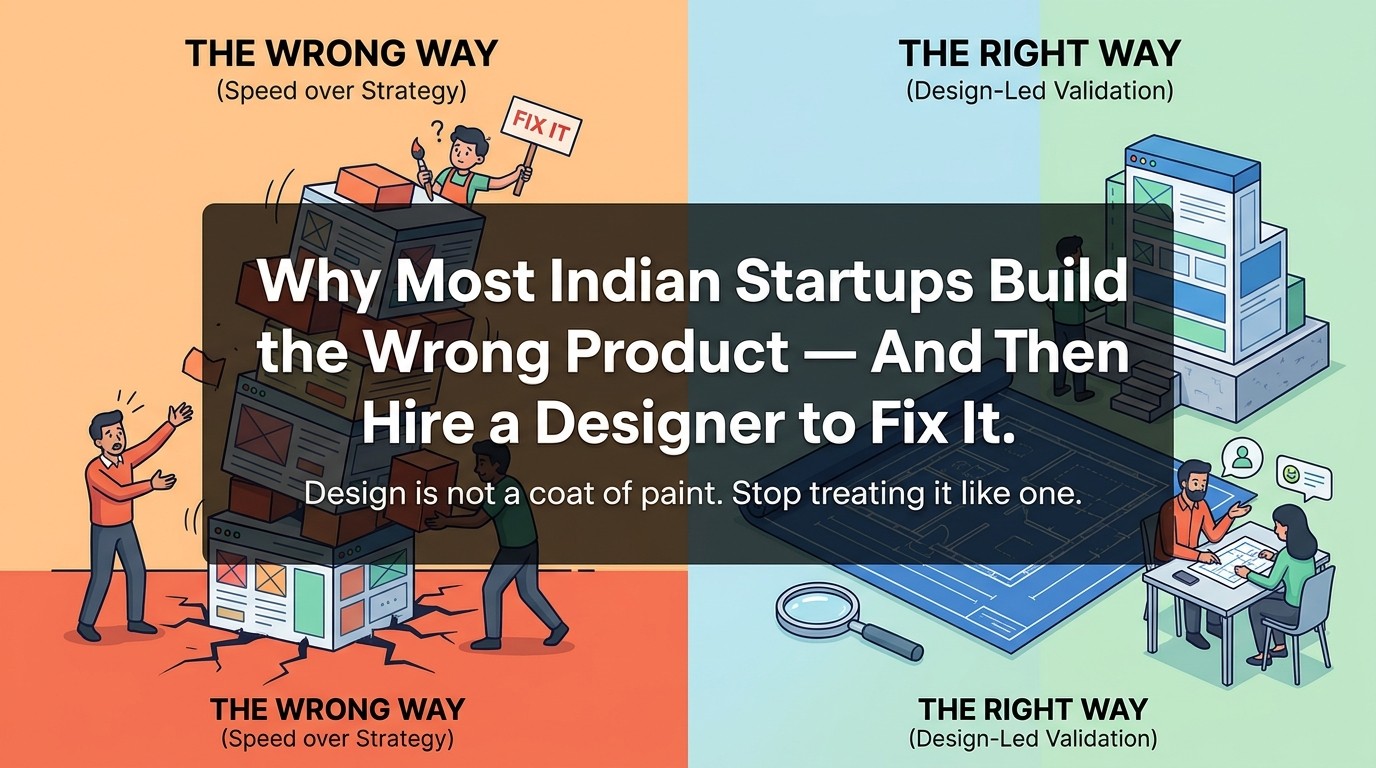
Why Most Indian Startups Build the Wrong Product — And Then Hire a Designer to Fix It.
Design is not a coat of paint. Stop treating it like one.
Here's a scene that plays out in design studios across India every few months. A founder walks in — or books a call — with a product that's been in development for 8 to 14 months. There's a working prototype, sometimes even a live version with early users. The pitch is straightforward: "We just need to make it look better and fix the UX a bit."
Two weeks into the project, it becomes clear the problem isn't the interface. The problem is that the product is solving the wrong thing, for the wrong person, in a flow that no amount of visual refinement will make intuitive.
The design can't fix this. Nobody can, without going back to the beginning.
This is the most expensive mistake in Indian startup product development. And it happens constantly.
Why This Keeps Happening
Indian startup culture has a speed bias. Move fast, ship fast, iterate fast. This is not inherently wrong — speed has real strategic value in early-stage companies. But somewhere along the way, "move fast" got conflated with "skip validation."
The result is a pattern that looks like this: founder has an idea, hires developers, builds for six months, shows it to users, gets confused feedback, hires a designer to "clean it up," and then discovers the structural problems are too deep for a design pass to fix.
Design gets called in as a rescue operation rather than as a founding discipline. And rescue operations are always more expensive — in time, in money, and in the morale cost of realising that significant work needs to be undone.
The root cause isn't laziness or incompetence. It's a fundamental misunderstanding of what design actually does in a product.
What Design Actually Is
Design is not the way a product looks. Design is the way a product works — and the decisions made about what it should do, for whom, and in what sequence before a single screen is built.
When design is brought in at the beginning of a product process, it does three things that development cannot:
It defines the problem precisely. Most founders have a solution looking for a problem. Design thinking forces the question backwards: what is the exact frustration the user experiences, in what specific context, and what is the minimum intervention that resolves it? This is harder than it sounds. It requires research, not assumptions.
It validates before committing. A designed prototype — even a low-fidelity one — can be tested with real users in days, not months. You learn whether people understand the product, whether they can use it without guidance, and whether it solves the problem you think it solves. This learning, gathered before development begins, is worth more than any amount of post-launch iteration.
It creates structural logic. Information architecture, user flows, interaction patterns — these are design decisions, not development decisions. When they're made by developers in the absence of a designer, they're made for technical convenience, not user clarity. The result is a product that works logically from a code perspective and confusingly from a human one.
Design is not a coat of paint. Stop treating it like one.
Here's a scene that plays out in design studios across India every few months. A founder walks in — or books a call — with a product that's been in development for 8 to 14 months. There's a working prototype, sometimes even a live version with early users. The pitch is straightforward: "We just need to make it look better and fix the UX a bit."
Two weeks into the project, it becomes clear the problem isn't the interface. The problem is that the product is solving the wrong thing, for the wrong person, in a flow that no amount of visual refinement will make intuitive.
The design can't fix this. Nobody can, without going back to the beginning.
This is the most expensive mistake in Indian startup product development. And it happens constantly.
Why This Keeps Happening
Indian startup culture has a speed bias. Move fast, ship fast, iterate fast. This is not inherently wrong — speed has real strategic value in early-stage companies. But somewhere along the way, "move fast" got conflated with "skip validation."
The result is a pattern that looks like this: founder has an idea, hires developers, builds for six months, shows it to users, gets confused feedback, hires a designer to "clean it up," and then discovers the structural problems are too deep for a design pass to fix.
Design gets called in as a rescue operation rather than as a founding discipline. And rescue operations are always more expensive — in time, in money, and in the morale cost of realising that significant work needs to be undone.
The root cause isn't laziness or incompetence. It's a fundamental misunderstanding of what design actually does in a product.
What Design Actually Is
Design is not the way a product looks. Design is the way a product works — and the decisions made about what it should do, for whom, and in what sequence before a single screen is built.
When design is brought in at the beginning of a product process, it does three things that development cannot:
It defines the problem precisely. Most founders have a solution looking for a problem. Design thinking forces the question backwards: what is the exact frustration the user experiences, in what specific context, and what is the minimum intervention that resolves it? This is harder than it sounds. It requires research, not assumptions.
It validates before committing. A designed prototype — even a low-fidelity one — can be tested with real users in days, not months. You learn whether people understand the product, whether they can use it without guidance, and whether it solves the problem you think it solves. This learning, gathered before development begins, is worth more than any amount of post-launch iteration.
It creates structural logic. Information architecture, user flows, interaction patterns — these are design decisions, not development decisions. When they're made by developers in the absence of a designer, they're made for technical convenience, not user clarity. The result is a product that works logically from a code perspective and confusingly from a human one.
Design is not a coat of paint. Stop treating it like one.
Here's a scene that plays out in design studios across India every few months. A founder walks in — or books a call — with a product that's been in development for 8 to 14 months. There's a working prototype, sometimes even a live version with early users. The pitch is straightforward: "We just need to make it look better and fix the UX a bit."
Two weeks into the project, it becomes clear the problem isn't the interface. The problem is that the product is solving the wrong thing, for the wrong person, in a flow that no amount of visual refinement will make intuitive.
The design can't fix this. Nobody can, without going back to the beginning.
This is the most expensive mistake in Indian startup product development. And it happens constantly.
Why This Keeps Happening
Indian startup culture has a speed bias. Move fast, ship fast, iterate fast. This is not inherently wrong — speed has real strategic value in early-stage companies. But somewhere along the way, "move fast" got conflated with "skip validation."
The result is a pattern that looks like this: founder has an idea, hires developers, builds for six months, shows it to users, gets confused feedback, hires a designer to "clean it up," and then discovers the structural problems are too deep for a design pass to fix.
Design gets called in as a rescue operation rather than as a founding discipline. And rescue operations are always more expensive — in time, in money, and in the morale cost of realising that significant work needs to be undone.
The root cause isn't laziness or incompetence. It's a fundamental misunderstanding of what design actually does in a product.
What Design Actually Is
Design is not the way a product looks. Design is the way a product works — and the decisions made about what it should do, for whom, and in what sequence before a single screen is built.
When design is brought in at the beginning of a product process, it does three things that development cannot:
It defines the problem precisely. Most founders have a solution looking for a problem. Design thinking forces the question backwards: what is the exact frustration the user experiences, in what specific context, and what is the minimum intervention that resolves it? This is harder than it sounds. It requires research, not assumptions.
It validates before committing. A designed prototype — even a low-fidelity one — can be tested with real users in days, not months. You learn whether people understand the product, whether they can use it without guidance, and whether it solves the problem you think it solves. This learning, gathered before development begins, is worth more than any amount of post-launch iteration.
It creates structural logic. Information architecture, user flows, interaction patterns — these are design decisions, not development decisions. When they're made by developers in the absence of a designer, they're made for technical convenience, not user clarity. The result is a product that works logically from a code perspective and confusingly from a human one.
The Three Stages Founders Skip
Stage 1: Problem Definition
Most product briefs start with a feature list. "We need a dashboard, an onboarding flow, a notification system, and a settings page." This is not a problem definition. This is a solution assumption.
A real problem definition sounds different: "Our target user is a procurement manager at a mid-size manufacturing firm. Right now, they track vendor payments in a spreadsheet that three people edit simultaneously. This creates reconciliation errors every month-end that take two days to fix. We want to eliminate that problem."
That definition tells you who the user is, what their current behaviour is, where it fails, and what a successful product outcome looks like. Every design decision that follows — every screen, every flow, every label — can be evaluated against it.
Without this definition, you're building for a fictional user. And fictional users don't pay for products.
Stage 2: Design Validation Before UI
Validation is the step that saves the most money and gets skipped the most often.
Before any UI design begins — before colours, typography, component libraries — the product flow should be tested as a rough prototype. Paper sketches. Low-fidelity Figma frames. A clickable wireframe that a real user can navigate.
The goal is not to test aesthetics. The goal is to test logic. Can a user get from point A to point B without help? Do they understand what each screen is asking them to do? Where do they hesitate? Where do they go wrong?
Five user tests on a low-fidelity prototype will surface more actionable insight than six months of post-launch analytics. And changing a wireframe takes hours. Changing a built product takes weeks.
Stage 3: Design Systems Before Screens
A design system is the structural foundation that every screen is built on. It defines the components, the spacing logic, the typography scale, the interaction patterns — the repeating elements that make a product feel coherent rather than assembled.
Most startups skip this and go straight to designing individual screens. The result is a product where every screen was designed in isolation — slightly different button styles here, inconsistent spacing there, a modal that behaves differently on page three than it does on page seven.
Users feel this inconsistency even when they can't articulate it. It registers as friction. It makes the product feel unfinished. And it creates a technical debt problem, because developers implement slightly different versions of the same components every time.
A design system isn't a luxury for when you scale. It's the foundation you build from day one, even at its simplest. An early-stage design system can be lightweight — a dozen core components, a clear type scale, a spacing grid. It takes a few days to establish and saves weeks of rework later.
The Real Cost of Getting This Wrong
Let's talk numbers, because this conversation often stays too abstract.
A typical Indian startup that skips design validation and goes straight to development spends somewhere between ₹8 lakh and ₹25 lakh building a first version of the product. This includes development time, infrastructure, and the founder's own time cost.
When that product fails to gain traction — and the failure is structural, rooted in a problem definition that was wrong — the startup faces one of two choices: rebuild or pivot. Both are expensive. The rebuild typically costs 60–80% of the original build cost, because now you're not just building, you're also unwinding existing decisions that are baked into the code.
The design validation that would have prevented this costs a fraction of the development budget. A thorough problem definition and prototype validation process — done properly with user research and iteration — typically costs 10–15% of the total product build cost. The potential savings are not marginal. They are transformational.
The math is not complicated. The habit of skipping validation is.
The Three Stages Founders Skip
Stage 1: Problem Definition
Most product briefs start with a feature list. "We need a dashboard, an onboarding flow, a notification system, and a settings page." This is not a problem definition. This is a solution assumption.
A real problem definition sounds different: "Our target user is a procurement manager at a mid-size manufacturing firm. Right now, they track vendor payments in a spreadsheet that three people edit simultaneously. This creates reconciliation errors every month-end that take two days to fix. We want to eliminate that problem."
That definition tells you who the user is, what their current behaviour is, where it fails, and what a successful product outcome looks like. Every design decision that follows — every screen, every flow, every label — can be evaluated against it.
Without this definition, you're building for a fictional user. And fictional users don't pay for products.
Stage 2: Design Validation Before UI
Validation is the step that saves the most money and gets skipped the most often.
Before any UI design begins — before colours, typography, component libraries — the product flow should be tested as a rough prototype. Paper sketches. Low-fidelity Figma frames. A clickable wireframe that a real user can navigate.
The goal is not to test aesthetics. The goal is to test logic. Can a user get from point A to point B without help? Do they understand what each screen is asking them to do? Where do they hesitate? Where do they go wrong?
Five user tests on a low-fidelity prototype will surface more actionable insight than six months of post-launch analytics. And changing a wireframe takes hours. Changing a built product takes weeks.
Stage 3: Design Systems Before Screens
A design system is the structural foundation that every screen is built on. It defines the components, the spacing logic, the typography scale, the interaction patterns — the repeating elements that make a product feel coherent rather than assembled.
Most startups skip this and go straight to designing individual screens. The result is a product where every screen was designed in isolation — slightly different button styles here, inconsistent spacing there, a modal that behaves differently on page three than it does on page seven.
Users feel this inconsistency even when they can't articulate it. It registers as friction. It makes the product feel unfinished. And it creates a technical debt problem, because developers implement slightly different versions of the same components every time.
A design system isn't a luxury for when you scale. It's the foundation you build from day one, even at its simplest. An early-stage design system can be lightweight — a dozen core components, a clear type scale, a spacing grid. It takes a few days to establish and saves weeks of rework later.
The Real Cost of Getting This Wrong
Let's talk numbers, because this conversation often stays too abstract.
A typical Indian startup that skips design validation and goes straight to development spends somewhere between ₹8 lakh and ₹25 lakh building a first version of the product. This includes development time, infrastructure, and the founder's own time cost.
When that product fails to gain traction — and the failure is structural, rooted in a problem definition that was wrong — the startup faces one of two choices: rebuild or pivot. Both are expensive. The rebuild typically costs 60–80% of the original build cost, because now you're not just building, you're also unwinding existing decisions that are baked into the code.
The design validation that would have prevented this costs a fraction of the development budget. A thorough problem definition and prototype validation process — done properly with user research and iteration — typically costs 10–15% of the total product build cost. The potential savings are not marginal. They are transformational.
The math is not complicated. The habit of skipping validation is.
The Three Stages Founders Skip
Stage 1: Problem Definition
Most product briefs start with a feature list. "We need a dashboard, an onboarding flow, a notification system, and a settings page." This is not a problem definition. This is a solution assumption.
A real problem definition sounds different: "Our target user is a procurement manager at a mid-size manufacturing firm. Right now, they track vendor payments in a spreadsheet that three people edit simultaneously. This creates reconciliation errors every month-end that take two days to fix. We want to eliminate that problem."
That definition tells you who the user is, what their current behaviour is, where it fails, and what a successful product outcome looks like. Every design decision that follows — every screen, every flow, every label — can be evaluated against it.
Without this definition, you're building for a fictional user. And fictional users don't pay for products.
Stage 2: Design Validation Before UI
Validation is the step that saves the most money and gets skipped the most often.
Before any UI design begins — before colours, typography, component libraries — the product flow should be tested as a rough prototype. Paper sketches. Low-fidelity Figma frames. A clickable wireframe that a real user can navigate.
The goal is not to test aesthetics. The goal is to test logic. Can a user get from point A to point B without help? Do they understand what each screen is asking them to do? Where do they hesitate? Where do they go wrong?
Five user tests on a low-fidelity prototype will surface more actionable insight than six months of post-launch analytics. And changing a wireframe takes hours. Changing a built product takes weeks.
Stage 3: Design Systems Before Screens
A design system is the structural foundation that every screen is built on. It defines the components, the spacing logic, the typography scale, the interaction patterns — the repeating elements that make a product feel coherent rather than assembled.
Most startups skip this and go straight to designing individual screens. The result is a product where every screen was designed in isolation — slightly different button styles here, inconsistent spacing there, a modal that behaves differently on page three than it does on page seven.
Users feel this inconsistency even when they can't articulate it. It registers as friction. It makes the product feel unfinished. And it creates a technical debt problem, because developers implement slightly different versions of the same components every time.
A design system isn't a luxury for when you scale. It's the foundation you build from day one, even at its simplest. An early-stage design system can be lightweight — a dozen core components, a clear type scale, a spacing grid. It takes a few days to establish and saves weeks of rework later.
The Real Cost of Getting This Wrong
Let's talk numbers, because this conversation often stays too abstract.
A typical Indian startup that skips design validation and goes straight to development spends somewhere between ₹8 lakh and ₹25 lakh building a first version of the product. This includes development time, infrastructure, and the founder's own time cost.
When that product fails to gain traction — and the failure is structural, rooted in a problem definition that was wrong — the startup faces one of two choices: rebuild or pivot. Both are expensive. The rebuild typically costs 60–80% of the original build cost, because now you're not just building, you're also unwinding existing decisions that are baked into the code.
The design validation that would have prevented this costs a fraction of the development budget. A thorough problem definition and prototype validation process — done properly with user research and iteration — typically costs 10–15% of the total product build cost. The potential savings are not marginal. They are transformational.
The math is not complicated. The habit of skipping validation is.
What Good Product Design Process Looks Like
At deMonk, product design engagements don't begin with Figma. They begin with questions.
Discovery: Understanding the Problem
Before any design work, we spend time with the founder and any available users understanding the actual problem being solved. We want to know: who is the primary user, what is their current behaviour, where does that behaviour fail them, and what does success look like after the product exists?
This discovery phase often surfaces misalignments between what the founder thinks the problem is and what users actually experience. These misalignments, caught here, cost nothing to resolve. Caught after six months of development, they cost everything.
Problem Framing: Defining Before Designing
We don't wireframe until the problem is precisely framed. This means a clear user definition, a validated problem statement, and an agreed success metric. These three things become the filter for every design decision that follows.
When a feature debate comes up — and it always does — the framing document answers it. Does this feature serve the defined user? Does it address the validated problem? Does it move the metric we've agreed on? If yes, it's in scope. If no, it isn't.
Prototype and Validate: Before Development Begins
We build testable prototypes before a single line of production code is written. These range from low-fidelity flow prototypes (to test logic) to high-fidelity interactive prototypes (to test usability and desirability). Both are tested with real users in the target profile.
The insight from this testing directly shapes the final design. Features that users don't understand get simplified or removed. Flows that cause confusion get restructured. Labels that mean nothing to users get replaced with their own language.
By the time the design goes to development, it has been validated. Not by the founder's intuition — by real user behaviour.
Design System First, Screens Second
We establish the design system before designing any final screens. This ensures that every screen is built from the same foundation, that the product feels coherent across its entire surface, and that the handoff to development is clean and unambiguous.
A well-structured design system also makes the product significantly easier to maintain and scale. When new features are added, they're assembled from existing components rather than invented from scratch. This keeps visual consistency intact as the product grows.
A Framework for Founders: The Validation Checklist
Before you commission UI design or begin development, work through these five questions:
1. Can you describe your primary user in one paragraph — not a demographic, but a specific person with a specific problem in a specific context?
If you can't, you don't have enough problem clarity to start building.
2. Have you observed at least five real users attempting to do the thing your product will help them do — using their current tools?
User observation is irreplaceable. Reading about user pain is not the same as watching someone experience it.
3. Have you built a prototype — even a rough one — and watched someone who wasn't coached try to use it?
The first time you watch an uncached user attempt to navigate your product is the most valuable design session you'll ever have.
4. Do you have a single, measurable definition of what product success looks like in 90 days?
"Users like it" is not measurable. "60% of users complete onboarding in one session" is measurable. Know your metric before you build.
5. Does your design translate to the constraints of the device your user actually uses?
In India, this almost always means a mid-range Android phone on a variable network connection. Have you tested on that device, in those conditions?
The Hiring-a-Designer-Too-Late Problem
There's a specific version of this mistake worth naming directly: hiring a designer after the product is built to "make it look good before launch."
This is the design equivalent of hiring an architect after the building is constructed. The designer can paint the walls and choose the furniture, but they cannot move the load-bearing columns. The structural decisions have already been made — by people who were not thinking structurally about user experience.
The result is a product that looks polished and works poorly. Users will feel the structural problems even if they can't see them. Onboarding drop-off, feature abandonment, support ticket volume — these are the metrics that reveal structural design problems, and no visual refinement pass will fix them.
The right time to hire a product designer is before the problem is fully defined. Not after the solution is built.
How deMonk Handles Product Design Differently
Most design studios take a brief and produce screens. We take a problem and produce a validated product.
The distinction is significant. When a founder briefs us on a product, we do not begin by asking "how should this look?" We begin by asking "does this need to exist in the way you've described it?" That question is harder to sit with. But it's the only question that matters.
Our product design engagements are structured around three outcomes: a validated problem definition, a tested product prototype, and a design system that development can build from with confidence. The visual design — the part most founders want to see first — is the last step. It's built on top of a foundation that has been tested and confirmed to work.
This is why products designed this way don't get rebuilt six months after launch. The structural decisions were made correctly the first time.
What Good Product Design Process Looks Like
At deMonk, product design engagements don't begin with Figma. They begin with questions.
Discovery: Understanding the Problem
Before any design work, we spend time with the founder and any available users understanding the actual problem being solved. We want to know: who is the primary user, what is their current behaviour, where does that behaviour fail them, and what does success look like after the product exists?
This discovery phase often surfaces misalignments between what the founder thinks the problem is and what users actually experience. These misalignments, caught here, cost nothing to resolve. Caught after six months of development, they cost everything.
Problem Framing: Defining Before Designing
We don't wireframe until the problem is precisely framed. This means a clear user definition, a validated problem statement, and an agreed success metric. These three things become the filter for every design decision that follows.
When a feature debate comes up — and it always does — the framing document answers it. Does this feature serve the defined user? Does it address the validated problem? Does it move the metric we've agreed on? If yes, it's in scope. If no, it isn't.
Prototype and Validate: Before Development Begins
We build testable prototypes before a single line of production code is written. These range from low-fidelity flow prototypes (to test logic) to high-fidelity interactive prototypes (to test usability and desirability). Both are tested with real users in the target profile.
The insight from this testing directly shapes the final design. Features that users don't understand get simplified or removed. Flows that cause confusion get restructured. Labels that mean nothing to users get replaced with their own language.
By the time the design goes to development, it has been validated. Not by the founder's intuition — by real user behaviour.
Design System First, Screens Second
We establish the design system before designing any final screens. This ensures that every screen is built from the same foundation, that the product feels coherent across its entire surface, and that the handoff to development is clean and unambiguous.
A well-structured design system also makes the product significantly easier to maintain and scale. When new features are added, they're assembled from existing components rather than invented from scratch. This keeps visual consistency intact as the product grows.
A Framework for Founders: The Validation Checklist
Before you commission UI design or begin development, work through these five questions:
1. Can you describe your primary user in one paragraph — not a demographic, but a specific person with a specific problem in a specific context?
If you can't, you don't have enough problem clarity to start building.
2. Have you observed at least five real users attempting to do the thing your product will help them do — using their current tools?
User observation is irreplaceable. Reading about user pain is not the same as watching someone experience it.
3. Have you built a prototype — even a rough one — and watched someone who wasn't coached try to use it?
The first time you watch an uncached user attempt to navigate your product is the most valuable design session you'll ever have.
4. Do you have a single, measurable definition of what product success looks like in 90 days?
"Users like it" is not measurable. "60% of users complete onboarding in one session" is measurable. Know your metric before you build.
5. Does your design translate to the constraints of the device your user actually uses?
In India, this almost always means a mid-range Android phone on a variable network connection. Have you tested on that device, in those conditions?
The Hiring-a-Designer-Too-Late Problem
There's a specific version of this mistake worth naming directly: hiring a designer after the product is built to "make it look good before launch."
This is the design equivalent of hiring an architect after the building is constructed. The designer can paint the walls and choose the furniture, but they cannot move the load-bearing columns. The structural decisions have already been made — by people who were not thinking structurally about user experience.
The result is a product that looks polished and works poorly. Users will feel the structural problems even if they can't see them. Onboarding drop-off, feature abandonment, support ticket volume — these are the metrics that reveal structural design problems, and no visual refinement pass will fix them.
The right time to hire a product designer is before the problem is fully defined. Not after the solution is built.
How deMonk Handles Product Design Differently
Most design studios take a brief and produce screens. We take a problem and produce a validated product.
The distinction is significant. When a founder briefs us on a product, we do not begin by asking "how should this look?" We begin by asking "does this need to exist in the way you've described it?" That question is harder to sit with. But it's the only question that matters.
Our product design engagements are structured around three outcomes: a validated problem definition, a tested product prototype, and a design system that development can build from with confidence. The visual design — the part most founders want to see first — is the last step. It's built on top of a foundation that has been tested and confirmed to work.
This is why products designed this way don't get rebuilt six months after launch. The structural decisions were made correctly the first time.
What Good Product Design Process Looks Like
At deMonk, product design engagements don't begin with Figma. They begin with questions.
Discovery: Understanding the Problem
Before any design work, we spend time with the founder and any available users understanding the actual problem being solved. We want to know: who is the primary user, what is their current behaviour, where does that behaviour fail them, and what does success look like after the product exists?
This discovery phase often surfaces misalignments between what the founder thinks the problem is and what users actually experience. These misalignments, caught here, cost nothing to resolve. Caught after six months of development, they cost everything.
Problem Framing: Defining Before Designing
We don't wireframe until the problem is precisely framed. This means a clear user definition, a validated problem statement, and an agreed success metric. These three things become the filter for every design decision that follows.
When a feature debate comes up — and it always does — the framing document answers it. Does this feature serve the defined user? Does it address the validated problem? Does it move the metric we've agreed on? If yes, it's in scope. If no, it isn't.
Prototype and Validate: Before Development Begins
We build testable prototypes before a single line of production code is written. These range from low-fidelity flow prototypes (to test logic) to high-fidelity interactive prototypes (to test usability and desirability). Both are tested with real users in the target profile.
The insight from this testing directly shapes the final design. Features that users don't understand get simplified or removed. Flows that cause confusion get restructured. Labels that mean nothing to users get replaced with their own language.
By the time the design goes to development, it has been validated. Not by the founder's intuition — by real user behaviour.
Design System First, Screens Second
We establish the design system before designing any final screens. This ensures that every screen is built from the same foundation, that the product feels coherent across its entire surface, and that the handoff to development is clean and unambiguous.
A well-structured design system also makes the product significantly easier to maintain and scale. When new features are added, they're assembled from existing components rather than invented from scratch. This keeps visual consistency intact as the product grows.
A Framework for Founders: The Validation Checklist
Before you commission UI design or begin development, work through these five questions:
1. Can you describe your primary user in one paragraph — not a demographic, but a specific person with a specific problem in a specific context?
If you can't, you don't have enough problem clarity to start building.
2. Have you observed at least five real users attempting to do the thing your product will help them do — using their current tools?
User observation is irreplaceable. Reading about user pain is not the same as watching someone experience it.
3. Have you built a prototype — even a rough one — and watched someone who wasn't coached try to use it?
The first time you watch an uncached user attempt to navigate your product is the most valuable design session you'll ever have.
4. Do you have a single, measurable definition of what product success looks like in 90 days?
"Users like it" is not measurable. "60% of users complete onboarding in one session" is measurable. Know your metric before you build.
5. Does your design translate to the constraints of the device your user actually uses?
In India, this almost always means a mid-range Android phone on a variable network connection. Have you tested on that device, in those conditions?
The Hiring-a-Designer-Too-Late Problem
There's a specific version of this mistake worth naming directly: hiring a designer after the product is built to "make it look good before launch."
This is the design equivalent of hiring an architect after the building is constructed. The designer can paint the walls and choose the furniture, but they cannot move the load-bearing columns. The structural decisions have already been made — by people who were not thinking structurally about user experience.
The result is a product that looks polished and works poorly. Users will feel the structural problems even if they can't see them. Onboarding drop-off, feature abandonment, support ticket volume — these are the metrics that reveal structural design problems, and no visual refinement pass will fix them.
The right time to hire a product designer is before the problem is fully defined. Not after the solution is built.
How deMonk Handles Product Design Differently
Most design studios take a brief and produce screens. We take a problem and produce a validated product.
The distinction is significant. When a founder briefs us on a product, we do not begin by asking "how should this look?" We begin by asking "does this need to exist in the way you've described it?" That question is harder to sit with. But it's the only question that matters.
Our product design engagements are structured around three outcomes: a validated problem definition, a tested product prototype, and a design system that development can build from with confidence. The visual design — the part most founders want to see first — is the last step. It's built on top of a foundation that has been tested and confirmed to work.
This is why products designed this way don't get rebuilt six months after launch. The structural decisions were made correctly the first time.
FAQ
At what stage should a startup bring in a product designer?
Ideally before any development begins — during problem definition and validation. If development has already started, bring in a designer immediately, before more is built on a potentially flawed foundation. The earlier the engagement, the lower the cost of correction.
Can a good UI designer do product strategy too?
Rarely. UI design and product strategy are distinct disciplines. A UI designer makes interfaces usable and attractive. A product strategist defines what the product should do and validates that it solves the right problem. You need both, and they should be sequenced correctly — strategy first, UI second.
How long does product design validation take before development?
A thorough problem definition and prototype validation process typically takes three to six weeks, depending on the complexity of the product and the accessibility of target users. This is a small investment relative to the development timeline it precedes.
What if we've already built the product and it's not working?
Start with a product design audit. This identifies whether the issues are structural (wrong problem, wrong user, wrong flow) or surface-level (confusing UI, missing copy, friction points). The audit determines whether a targeted redesign can fix the problems or whether deeper rethinking is needed.
Why do design systems matter for early-stage products?
Because early-stage products grow. Every component you build without a system is a component that will need to be standardised later — at greater cost and disruption. A lightweight design system established early scales far more efficiently than a visual language invented screen by screen.
Build the right product once. Not the wrong product three times.
Book a product design consultation with Studio deMonk. We'll help you define the problem correctly, validate before you build, and design a product that works from the first version — not the third.
FAQ
At what stage should a startup bring in a product designer?
Ideally before any development begins — during problem definition and validation. If development has already started, bring in a designer immediately, before more is built on a potentially flawed foundation. The earlier the engagement, the lower the cost of correction.
Can a good UI designer do product strategy too?
Rarely. UI design and product strategy are distinct disciplines. A UI designer makes interfaces usable and attractive. A product strategist defines what the product should do and validates that it solves the right problem. You need both, and they should be sequenced correctly — strategy first, UI second.
How long does product design validation take before development?
A thorough problem definition and prototype validation process typically takes three to six weeks, depending on the complexity of the product and the accessibility of target users. This is a small investment relative to the development timeline it precedes.
What if we've already built the product and it's not working?
Start with a product design audit. This identifies whether the issues are structural (wrong problem, wrong user, wrong flow) or surface-level (confusing UI, missing copy, friction points). The audit determines whether a targeted redesign can fix the problems or whether deeper rethinking is needed.
Why do design systems matter for early-stage products?
Because early-stage products grow. Every component you build without a system is a component that will need to be standardised later — at greater cost and disruption. A lightweight design system established early scales far more efficiently than a visual language invented screen by screen.
Build the right product once. Not the wrong product three times.
Book a product design consultation with Studio deMonk. We'll help you define the problem correctly, validate before you build, and design a product that works from the first version — not the third.
FAQ
At what stage should a startup bring in a product designer?
Ideally before any development begins — during problem definition and validation. If development has already started, bring in a designer immediately, before more is built on a potentially flawed foundation. The earlier the engagement, the lower the cost of correction.
Can a good UI designer do product strategy too?
Rarely. UI design and product strategy are distinct disciplines. A UI designer makes interfaces usable and attractive. A product strategist defines what the product should do and validates that it solves the right problem. You need both, and they should be sequenced correctly — strategy first, UI second.
How long does product design validation take before development?
A thorough problem definition and prototype validation process typically takes three to six weeks, depending on the complexity of the product and the accessibility of target users. This is a small investment relative to the development timeline it precedes.
What if we've already built the product and it's not working?
Start with a product design audit. This identifies whether the issues are structural (wrong problem, wrong user, wrong flow) or surface-level (confusing UI, missing copy, friction points). The audit determines whether a targeted redesign can fix the problems or whether deeper rethinking is needed.
Why do design systems matter for early-stage products?
Because early-stage products grow. Every component you build without a system is a component that will need to be standardised later — at greater cost and disruption. A lightweight design system established early scales far more efficiently than a visual language invented screen by screen.
Build the right product once. Not the wrong product three times.
Book a product design consultation with Studio deMonk. We'll help you define the problem correctly, validate before you build, and design a product that works from the first version — not the third.