Why Brand Strategy Comes Before Design
Founders usually ask for a logo, a website, or a visual identity first. That feels like progress, but most of the time it solves the wrong problem. A business does not become clear because it looks polished. It becomes clear when it knows what it is, who it is for, what tension it is solving, and why people should trust it.
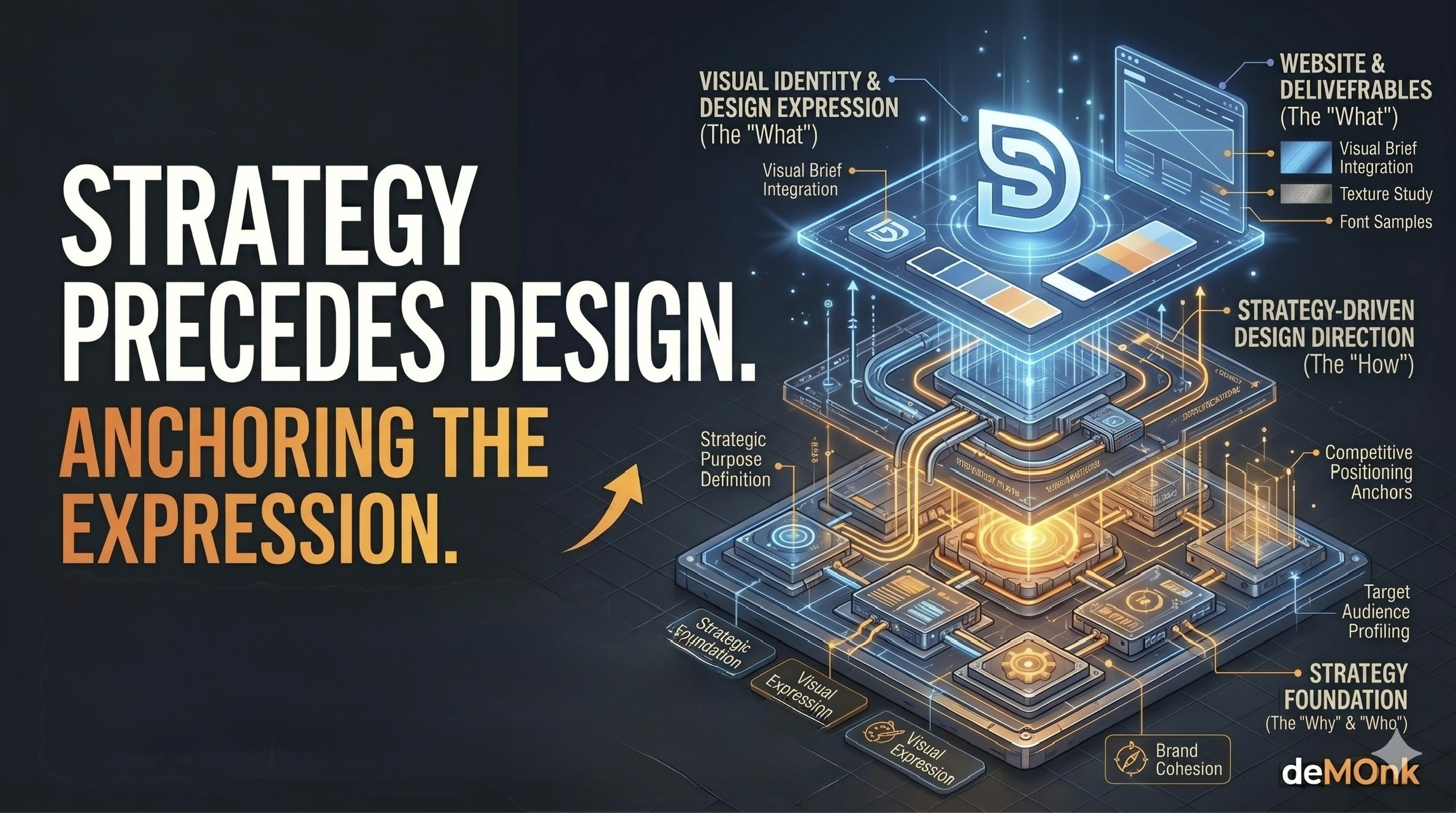
That is why brand strategy comes before design. Strategy gives design a job. Without it, design becomes decoration. With it, design becomes a business tool.
For Studio deMonk, this is not theory. It is visible in how Triwise was built. Before the brand could look distinctive, it had to be defined properly: what category it belongs to, what market gap it addresses, who it serves, how it should feel, and what makes it meaningfully different.
The real problem is not bad design
Most early-stage and growing brands do not suffer from a lack of visuals. They suffer from a lack of strategic clarity. They launch with a decent logo, a modern website, and social media content, yet still struggle to explain what they actually do in one sharp sentence.
That problem usually shows up in familiar ways:
The brand looks professional, but sounds generic.
Marketing changes tone every few weeks.
Customers understand pieces of the offer, but not the full value.
The business starts blending into competitors that make similar claims.
This is exactly why brand strategy has to lead. Design can amplify a position, but it cannot invent one.
What brand strategy actually does
Brand strategy is the layer that defines the business before it gets expressed visually. It answers the difficult questions that most teams skip in the rush to launch:
What is the actual purpose of the brand?
Who is the priority audience?
What real problem are they facing?
What is the brand promising them?
How should the brand feel in their mind?
What should make this brand different from everything around it?
These questions sound simple, but they shape everything that follows. Once the answers are clear, design gets direction. Messaging gets consistency. Marketing gets focus. Product decisions start aligning around the same idea.
Founders usually ask for a logo, a website, or a visual identity first. That feels like progress, but most of the time it solves the wrong problem. A business does not become clear because it looks polished. It becomes clear when it knows what it is, who it is for, what tension it is solving, and why people should trust it.
That is why brand strategy comes before design. Strategy gives design a job. Without it, design becomes decoration. With it, design becomes a business tool.
For Studio deMonk, this is not theory. It is visible in how Triwise was built. Before the brand could look distinctive, it had to be defined properly: what category it belongs to, what market gap it addresses, who it serves, how it should feel, and what makes it meaningfully different.
The real problem is not bad design
Most early-stage and growing brands do not suffer from a lack of visuals. They suffer from a lack of strategic clarity. They launch with a decent logo, a modern website, and social media content, yet still struggle to explain what they actually do in one sharp sentence.
That problem usually shows up in familiar ways:
The brand looks professional, but sounds generic.
Marketing changes tone every few weeks.
Customers understand pieces of the offer, but not the full value.
The business starts blending into competitors that make similar claims.
This is exactly why brand strategy has to lead. Design can amplify a position, but it cannot invent one.
What brand strategy actually does
Brand strategy is the layer that defines the business before it gets expressed visually. It answers the difficult questions that most teams skip in the rush to launch:
What is the actual purpose of the brand?
Who is the priority audience?
What real problem are they facing?
What is the brand promising them?
How should the brand feel in their mind?
What should make this brand different from everything around it?
These questions sound simple, but they shape everything that follows. Once the answers are clear, design gets direction. Messaging gets consistency. Marketing gets focus. Product decisions start aligning around the same idea.
Founders usually ask for a logo, a website, or a visual identity first. That feels like progress, but most of the time it solves the wrong problem. A business does not become clear because it looks polished. It becomes clear when it knows what it is, who it is for, what tension it is solving, and why people should trust it.
That is why brand strategy comes before design. Strategy gives design a job. Without it, design becomes decoration. With it, design becomes a business tool.
For Studio deMonk, this is not theory. It is visible in how Triwise was built. Before the brand could look distinctive, it had to be defined properly: what category it belongs to, what market gap it addresses, who it serves, how it should feel, and what makes it meaningfully different.
The real problem is not bad design
Most early-stage and growing brands do not suffer from a lack of visuals. They suffer from a lack of strategic clarity. They launch with a decent logo, a modern website, and social media content, yet still struggle to explain what they actually do in one sharp sentence.
That problem usually shows up in familiar ways:
The brand looks professional, but sounds generic.
Marketing changes tone every few weeks.
Customers understand pieces of the offer, but not the full value.
The business starts blending into competitors that make similar claims.
This is exactly why brand strategy has to lead. Design can amplify a position, but it cannot invent one.
What brand strategy actually does
Brand strategy is the layer that defines the business before it gets expressed visually. It answers the difficult questions that most teams skip in the rush to launch:
What is the actual purpose of the brand?
Who is the priority audience?
What real problem are they facing?
What is the brand promising them?
How should the brand feel in their mind?
What should make this brand different from everything around it?
These questions sound simple, but they shape everything that follows. Once the answers are clear, design gets direction. Messaging gets consistency. Marketing gets focus. Product decisions start aligning around the same idea.
The Triwise example: strategy before expression
Triwise is a strong example of why strategy has to come first. On the surface, it could have been treated like just another travel-tech brand. But the deeper strategy work showed that the opportunity was much more specific.
The brand was not simply about booking travel. It sat at the intersection of travel booking, travel planning, and travel finance management. That strategic framing immediately made the business sharper. Instead of competing as a generic itinerary or booking app, Triwise could be positioned as a smarter travel platform that helps people plan better, spend better, and fund future travel more intentionally.
That single decision changes everything. It changes the product story. It changes the customer promise. It changes what the brand needs to communicate.
Good strategy starts with market reality
A lot of weak brands begin with internal opinion. Strong brands begin with market understanding.
The Triwise strategy work looked at the U.S. travel landscape, traveler behaviour, and adjacent categories such as travel planning, fintech, insurance, and savings-led platforms. That made it possible to see where the whitespace actually existed.
The research pointed to a few important tensions:
Travelers face decision fatigue because travel planning is fragmented across too many tools.
Younger travelers are highly experience-driven, but still budget-conscious.
Trust is low when platforms hide fees, use too many middlemen, or make refund processes difficult.
People increasingly want flexible, personalized, and socially influenced travel planning.
That is strategy doing its job. It is not asking, “What should the logo look like?” It is asking, “What truth should this business be built around?”
The Triwise example: strategy before expression
Triwise is a strong example of why strategy has to come first. On the surface, it could have been treated like just another travel-tech brand. But the deeper strategy work showed that the opportunity was much more specific.
The brand was not simply about booking travel. It sat at the intersection of travel booking, travel planning, and travel finance management. That strategic framing immediately made the business sharper. Instead of competing as a generic itinerary or booking app, Triwise could be positioned as a smarter travel platform that helps people plan better, spend better, and fund future travel more intentionally.
That single decision changes everything. It changes the product story. It changes the customer promise. It changes what the brand needs to communicate.
Good strategy starts with market reality
A lot of weak brands begin with internal opinion. Strong brands begin with market understanding.
The Triwise strategy work looked at the U.S. travel landscape, traveler behaviour, and adjacent categories such as travel planning, fintech, insurance, and savings-led platforms. That made it possible to see where the whitespace actually existed.
The research pointed to a few important tensions:
Travelers face decision fatigue because travel planning is fragmented across too many tools.
Younger travelers are highly experience-driven, but still budget-conscious.
Trust is low when platforms hide fees, use too many middlemen, or make refund processes difficult.
People increasingly want flexible, personalized, and socially influenced travel planning.
That is strategy doing its job. It is not asking, “What should the logo look like?” It is asking, “What truth should this business be built around?”
The Triwise example: strategy before expression
Triwise is a strong example of why strategy has to come first. On the surface, it could have been treated like just another travel-tech brand. But the deeper strategy work showed that the opportunity was much more specific.
The brand was not simply about booking travel. It sat at the intersection of travel booking, travel planning, and travel finance management. That strategic framing immediately made the business sharper. Instead of competing as a generic itinerary or booking app, Triwise could be positioned as a smarter travel platform that helps people plan better, spend better, and fund future travel more intentionally.
That single decision changes everything. It changes the product story. It changes the customer promise. It changes what the brand needs to communicate.
Good strategy starts with market reality
A lot of weak brands begin with internal opinion. Strong brands begin with market understanding.
The Triwise strategy work looked at the U.S. travel landscape, traveler behaviour, and adjacent categories such as travel planning, fintech, insurance, and savings-led platforms. That made it possible to see where the whitespace actually existed.
The research pointed to a few important tensions:
Travelers face decision fatigue because travel planning is fragmented across too many tools.
Younger travelers are highly experience-driven, but still budget-conscious.
Trust is low when platforms hide fees, use too many middlemen, or make refund processes difficult.
People increasingly want flexible, personalized, and socially influenced travel planning.
That is strategy doing its job. It is not asking, “What should the logo look like?” It is asking, “What truth should this business be built around?”
Audience clarity changes the whole brand
One of the clearest signs of strong brand strategy is audience specificity.
Triwise did not define its audience as “people who travel.” That would be lazy and useless. Instead, the strategy focused on Millennials and Gen Z in the U.S. travel market, especially people who are digitally enabled, experience-driven, budget-aware, flexible in planning, and heavily influenced by peer recommendations, social media, and value-seeking behaviour.
That level of clarity matters because design is not made for “everyone.” Messaging is not written for “everyone.” Product flows are not built for “everyone.”
When you know the audience properly, you know what the brand has to solve emotionally and practically. In Triwise’s case, that meant addressing spontaneity, affordability, authenticity, flexibility, and trust all at once.
Positioning comes before identity
This is where many brands go wrong. They try to look different before they decide how they are different.
Triwise’s strategic value proposition was clear: it is the smart way to travel, combining AI-driven trip planning, financially sustainable travel behaviour, and community-led discovery into one experience. That is much stronger than a visual idea. It is a business position.
The brand purpose, mission, and vision all support that position:
Travel smarter, save wiser, and journey further.
Simplify travel by reducing decision fatigue and making trips financially sustainable.
Redefine modern travel as seamless, immersive, socially connected, and confidence-building.
Once that is clear, design stops guessing. It can start expressing a precise strategic idea instead of trying to manufacture meaning afterward.
Emotion matters, but only after clarity
A good brand strategy is not just rational. It also decides how the brand should feel.
For Triwise, the brand essence was defined as Empowered Spontaneity. That is a strong strategic phrase because it captures both sides of the user need. People want freedom and adventure, but they do not want chaos. They want spontaneity with support. Exploration with reassurance. Discovery without confusion.
That idea then shaped the brand personality: smart, reliable, adaptive. It shaped the voice too: conversational, knowledgeable, evocative, effortless, empowering, and adventurous.
This is the right order. First define the emotional role of the brand. Then design the language, visuals, and interactions around that role.
What happens when you skip this step
If Triwise had started with design first, it probably would have looked like many other travel brands: aspirational imagery, soft gradients, generic freedom language, and a promise to make travel easy.
But that would have missed the real edge of the business.
Without strategy, the brand could easily have become:
Another AI travel planner.
Another booking platform.
Another aspirational travel startup with no financial differentiation.
Instead, strategy revealed a deeper market position: a brand that combines personalized travel planning, transparent booking, and travel-linked saving and investment behaviour. That is much harder to copy and much easier to build a business around.
Strategy gives design a sharper brief
When the strategy is right, the design brief becomes far stronger.
For Triwise, design was no longer about making something that looked “modern travel.” It had to express a more specific combination:
Smart, not cold.
Adventurous, not chaotic.
Financially responsible, not restrictive.
Tech-enabled, but still human.
Personalized, but still easy to use.
That is a real design challenge. And it is a much better one than “make it premium” or “make it attractive.”
Strong design teams want this kind of clarity because it gives them something worth building from.
This is why founders should slow down before branding
The rush to design usually comes from urgency. Founders want to launch, raise, pitch, post, and sell. That is understandable. But skipping strategy creates slower problems later: rework, inconsistent messaging, weak differentiation, confused users, and teams that keep rewriting the brand from scratch.
A short strategy phase often saves months of correction later.
Before investing in visual identity, founders should be able to answer:
What category are we really in?
What gap are we seeing that others are missing?
Who exactly are we serving first?
Why will they trust us?
What emotional role should our brand play in their life?
What must people remember about us after the first interaction?
If those answers are weak, the design will probably be weak too, even if it looks good.
Audience clarity changes the whole brand
One of the clearest signs of strong brand strategy is audience specificity.
Triwise did not define its audience as “people who travel.” That would be lazy and useless. Instead, the strategy focused on Millennials and Gen Z in the U.S. travel market, especially people who are digitally enabled, experience-driven, budget-aware, flexible in planning, and heavily influenced by peer recommendations, social media, and value-seeking behaviour.
That level of clarity matters because design is not made for “everyone.” Messaging is not written for “everyone.” Product flows are not built for “everyone.”
When you know the audience properly, you know what the brand has to solve emotionally and practically. In Triwise’s case, that meant addressing spontaneity, affordability, authenticity, flexibility, and trust all at once.
Positioning comes before identity
This is where many brands go wrong. They try to look different before they decide how they are different.
Triwise’s strategic value proposition was clear: it is the smart way to travel, combining AI-driven trip planning, financially sustainable travel behaviour, and community-led discovery into one experience. That is much stronger than a visual idea. It is a business position.
The brand purpose, mission, and vision all support that position:
Travel smarter, save wiser, and journey further.
Simplify travel by reducing decision fatigue and making trips financially sustainable.
Redefine modern travel as seamless, immersive, socially connected, and confidence-building.
Once that is clear, design stops guessing. It can start expressing a precise strategic idea instead of trying to manufacture meaning afterward.
Emotion matters, but only after clarity
A good brand strategy is not just rational. It also decides how the brand should feel.
For Triwise, the brand essence was defined as Empowered Spontaneity. That is a strong strategic phrase because it captures both sides of the user need. People want freedom and adventure, but they do not want chaos. They want spontaneity with support. Exploration with reassurance. Discovery without confusion.
That idea then shaped the brand personality: smart, reliable, adaptive. It shaped the voice too: conversational, knowledgeable, evocative, effortless, empowering, and adventurous.
This is the right order. First define the emotional role of the brand. Then design the language, visuals, and interactions around that role.
What happens when you skip this step
If Triwise had started with design first, it probably would have looked like many other travel brands: aspirational imagery, soft gradients, generic freedom language, and a promise to make travel easy.
But that would have missed the real edge of the business.
Without strategy, the brand could easily have become:
Another AI travel planner.
Another booking platform.
Another aspirational travel startup with no financial differentiation.
Instead, strategy revealed a deeper market position: a brand that combines personalized travel planning, transparent booking, and travel-linked saving and investment behaviour. That is much harder to copy and much easier to build a business around.
Strategy gives design a sharper brief
When the strategy is right, the design brief becomes far stronger.
For Triwise, design was no longer about making something that looked “modern travel.” It had to express a more specific combination:
Smart, not cold.
Adventurous, not chaotic.
Financially responsible, not restrictive.
Tech-enabled, but still human.
Personalized, but still easy to use.
That is a real design challenge. And it is a much better one than “make it premium” or “make it attractive.”
Strong design teams want this kind of clarity because it gives them something worth building from.
This is why founders should slow down before branding
The rush to design usually comes from urgency. Founders want to launch, raise, pitch, post, and sell. That is understandable. But skipping strategy creates slower problems later: rework, inconsistent messaging, weak differentiation, confused users, and teams that keep rewriting the brand from scratch.
A short strategy phase often saves months of correction later.
Before investing in visual identity, founders should be able to answer:
What category are we really in?
What gap are we seeing that others are missing?
Who exactly are we serving first?
Why will they trust us?
What emotional role should our brand play in their life?
What must people remember about us after the first interaction?
If those answers are weak, the design will probably be weak too, even if it looks good.
Audience clarity changes the whole brand
One of the clearest signs of strong brand strategy is audience specificity.
Triwise did not define its audience as “people who travel.” That would be lazy and useless. Instead, the strategy focused on Millennials and Gen Z in the U.S. travel market, especially people who are digitally enabled, experience-driven, budget-aware, flexible in planning, and heavily influenced by peer recommendations, social media, and value-seeking behaviour.
That level of clarity matters because design is not made for “everyone.” Messaging is not written for “everyone.” Product flows are not built for “everyone.”
When you know the audience properly, you know what the brand has to solve emotionally and practically. In Triwise’s case, that meant addressing spontaneity, affordability, authenticity, flexibility, and trust all at once.
Positioning comes before identity
This is where many brands go wrong. They try to look different before they decide how they are different.
Triwise’s strategic value proposition was clear: it is the smart way to travel, combining AI-driven trip planning, financially sustainable travel behaviour, and community-led discovery into one experience. That is much stronger than a visual idea. It is a business position.
The brand purpose, mission, and vision all support that position:
Travel smarter, save wiser, and journey further.
Simplify travel by reducing decision fatigue and making trips financially sustainable.
Redefine modern travel as seamless, immersive, socially connected, and confidence-building.
Once that is clear, design stops guessing. It can start expressing a precise strategic idea instead of trying to manufacture meaning afterward.
Emotion matters, but only after clarity
A good brand strategy is not just rational. It also decides how the brand should feel.
For Triwise, the brand essence was defined as Empowered Spontaneity. That is a strong strategic phrase because it captures both sides of the user need. People want freedom and adventure, but they do not want chaos. They want spontaneity with support. Exploration with reassurance. Discovery without confusion.
That idea then shaped the brand personality: smart, reliable, adaptive. It shaped the voice too: conversational, knowledgeable, evocative, effortless, empowering, and adventurous.
This is the right order. First define the emotional role of the brand. Then design the language, visuals, and interactions around that role.
What happens when you skip this step
If Triwise had started with design first, it probably would have looked like many other travel brands: aspirational imagery, soft gradients, generic freedom language, and a promise to make travel easy.
But that would have missed the real edge of the business.
Without strategy, the brand could easily have become:
Another AI travel planner.
Another booking platform.
Another aspirational travel startup with no financial differentiation.
Instead, strategy revealed a deeper market position: a brand that combines personalized travel planning, transparent booking, and travel-linked saving and investment behaviour. That is much harder to copy and much easier to build a business around.
Strategy gives design a sharper brief
When the strategy is right, the design brief becomes far stronger.
For Triwise, design was no longer about making something that looked “modern travel.” It had to express a more specific combination:
Smart, not cold.
Adventurous, not chaotic.
Financially responsible, not restrictive.
Tech-enabled, but still human.
Personalized, but still easy to use.
That is a real design challenge. And it is a much better one than “make it premium” or “make it attractive.”
Strong design teams want this kind of clarity because it gives them something worth building from.
This is why founders should slow down before branding
The rush to design usually comes from urgency. Founders want to launch, raise, pitch, post, and sell. That is understandable. But skipping strategy creates slower problems later: rework, inconsistent messaging, weak differentiation, confused users, and teams that keep rewriting the brand from scratch.
A short strategy phase often saves months of correction later.
Before investing in visual identity, founders should be able to answer:
What category are we really in?
What gap are we seeing that others are missing?
Who exactly are we serving first?
Why will they trust us?
What emotional role should our brand play in their life?
What must people remember about us after the first interaction?
If those answers are weak, the design will probably be weak too, even if it looks good.
FAQ
What is the difference between brand strategy and branding?
Brand strategy defines the meaning of the brand: its purpose, positioning, audience, and core direction. Branding is the expression of that strategy through design, messaging, and experience.
Why can’t a logo come first?
A logo can come first, but it should not. Without strategic clarity, a logo is just a symbol without a precise role. It may look good, but it will not carry the right meaning consistently.
Is brand strategy only for big businesses?
No. Smaller businesses often need strategy even more because they cannot afford vague positioning, repeated redesigns, and wasted marketing spend.
What did Triwise prove in this process?
Triwise showed that when a brand is defined properly before design, it becomes easier to sharpen the offer, focus the audience, clarify the promise, and create a more differentiated business.
Final thought
Design should not be the first answer to a clarity problem. Strategy should.
When a brand knows what it stands for, what it solves, and how it should live in the customer’s mind, design becomes powerful. Until then, it is just surface.
FAQ
What is the difference between brand strategy and branding?
Brand strategy defines the meaning of the brand: its purpose, positioning, audience, and core direction. Branding is the expression of that strategy through design, messaging, and experience.
Why can’t a logo come first?
A logo can come first, but it should not. Without strategic clarity, a logo is just a symbol without a precise role. It may look good, but it will not carry the right meaning consistently.
Is brand strategy only for big businesses?
No. Smaller businesses often need strategy even more because they cannot afford vague positioning, repeated redesigns, and wasted marketing spend.
What did Triwise prove in this process?
Triwise showed that when a brand is defined properly before design, it becomes easier to sharpen the offer, focus the audience, clarify the promise, and create a more differentiated business.
Final thought
Design should not be the first answer to a clarity problem. Strategy should.
When a brand knows what it stands for, what it solves, and how it should live in the customer’s mind, design becomes powerful. Until then, it is just surface.
FAQ
What is the difference between brand strategy and branding?
Brand strategy defines the meaning of the brand: its purpose, positioning, audience, and core direction. Branding is the expression of that strategy through design, messaging, and experience.
Why can’t a logo come first?
A logo can come first, but it should not. Without strategic clarity, a logo is just a symbol without a precise role. It may look good, but it will not carry the right meaning consistently.
Is brand strategy only for big businesses?
No. Smaller businesses often need strategy even more because they cannot afford vague positioning, repeated redesigns, and wasted marketing spend.
What did Triwise prove in this process?
Triwise showed that when a brand is defined properly before design, it becomes easier to sharpen the offer, focus the audience, clarify the promise, and create a more differentiated business.
Final thought
Design should not be the first answer to a clarity problem. Strategy should.
When a brand knows what it stands for, what it solves, and how it should live in the customer’s mind, design becomes powerful. Until then, it is just surface.