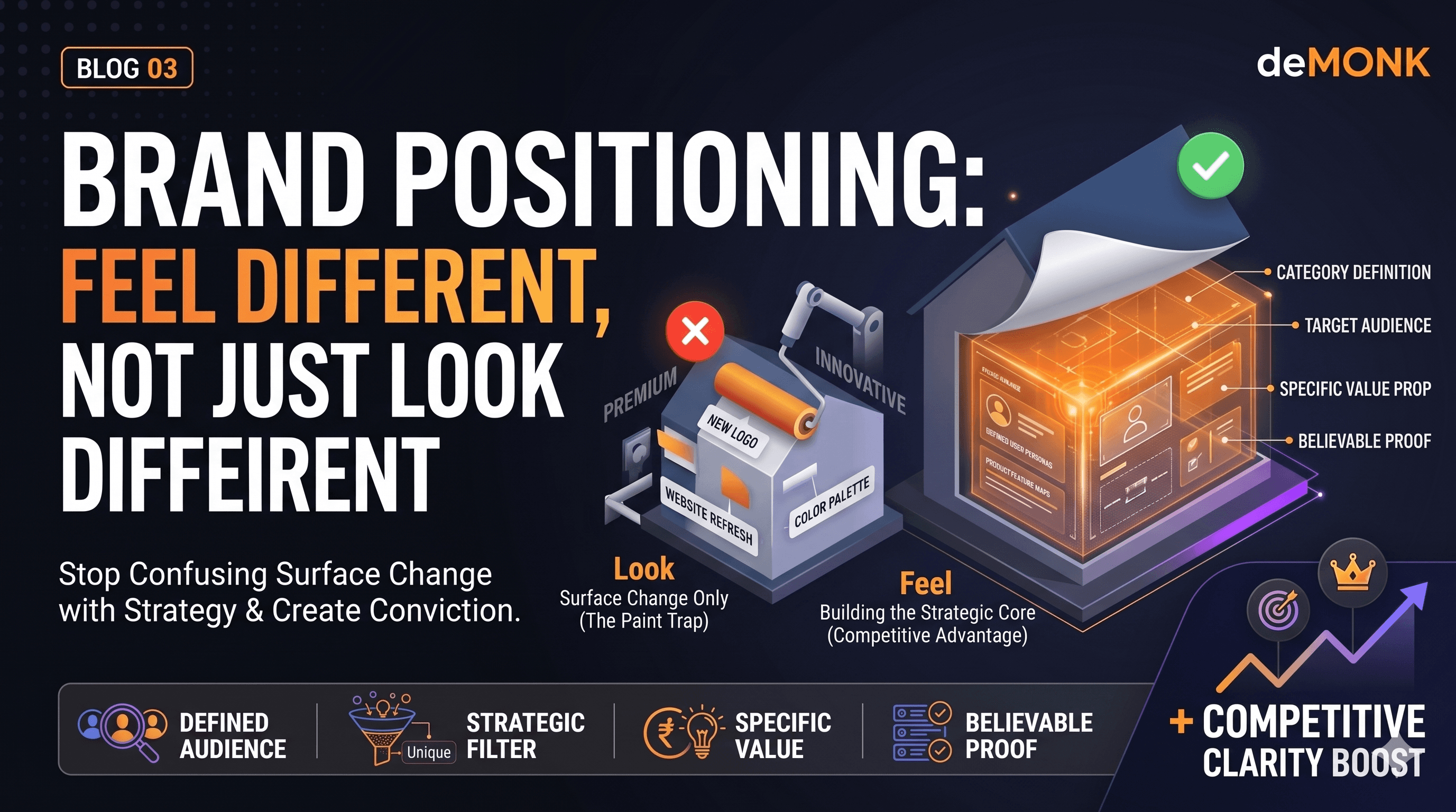
Brand Positioning: How to Make a Business Feel Different, Not Just Look Different
A lot of businesses think they have a branding problem when they actually have a positioning problem. The logo feels weak, the website feels flat, the social media looks inconsistent, and the instinct is to redesign everything. But most of the time, the real issue is not how the brand looks. It is how the brand is understood.
That distinction matters more than most founders realise. A business can look polished, expensive, and professionally designed and still feel forgettable. It can have a clean website, strong colours, a premium typeface, and a decent pitch deck, yet still fail to give people a clear reason to choose it. When that happens, the brand may look different on the surface, but it does not feel different where it counts: in the customer’s mind.
That is what brand positioning solves. Positioning is the decision about what a business should stand for, who it is really for, what specific value it wants to be known for, and why that value should feel more relevant than the alternatives. It is not branding fluff. It is competitive clarity.
For Studio deMonk, this idea is visible in the Triwise strategy process. Triwise was not treated as just another travel-tech brand that needed a logo and a UI. It was built around a sharper business position: a brand that helps users travel smarter, save wiser, and journey further through AI-driven planning and financially sustainable travel behaviour. That shift is exactly what positioning does. It moves the conversation from “how should this brand look?” to “what should this brand mean?”
If Blog 1 was about why brand strategy must come before design, and Blog 2 was about building a brand from the inside out, then Blog 3 should make the next point clear: even a well-built brand still needs a strong position. Without positioning, strategy stays broad. With positioning, it becomes sharp enough to compete.
The problem: most brands only change the paint
One of the most common mistakes in branding is confusing surface change with strategic change. A founder sees a competitor getting attention, decides the brand feels dated, and starts refreshing the obvious parts. New logo. New palette. New headline. New deck. Sometimes even a full website relaunch.
The problem is that none of that guarantees the business will feel clearer after the refresh. If the offer is still vague, if the audience is still too broad, and if the core message still sounds like everyone else in the category, the redesign only improves the packaging. It does not improve the position.
This is why so many brands end up looking better but performing roughly the same. They update the outside without changing the strategic centre. Their website becomes cleaner, but their message stays generic. Their social feed becomes more polished, but the audience still does not know exactly why the brand matters. Their pitch becomes more stylish, but not more convincing.
You can usually recognise weak positioning by a few patterns:
The brand uses the same adjectives as everyone else: innovative, seamless, customer-first, premium, smart.
Different people inside the business explain the company in different ways.
The brand tries to speak to everyone, which means it lands weakly with the people who matter most.
Marketing starts relying too heavily on tactics because there is no strong central story to build around.
The sales conversation becomes more about price than about value.
This is not a design problem. It is a positioning problem. And if you do not solve it, branding will keep feeling like maintenance instead of leverage.
A lot of businesses think they have a branding problem when they actually have a positioning problem. The logo feels weak, the website feels flat, the social media looks inconsistent, and the instinct is to redesign everything. But most of the time, the real issue is not how the brand looks. It is how the brand is understood.
That distinction matters more than most founders realise. A business can look polished, expensive, and professionally designed and still feel forgettable. It can have a clean website, strong colours, a premium typeface, and a decent pitch deck, yet still fail to give people a clear reason to choose it. When that happens, the brand may look different on the surface, but it does not feel different where it counts: in the customer’s mind.
That is what brand positioning solves. Positioning is the decision about what a business should stand for, who it is really for, what specific value it wants to be known for, and why that value should feel more relevant than the alternatives. It is not branding fluff. It is competitive clarity.
For Studio deMonk, this idea is visible in the Triwise strategy process. Triwise was not treated as just another travel-tech brand that needed a logo and a UI. It was built around a sharper business position: a brand that helps users travel smarter, save wiser, and journey further through AI-driven planning and financially sustainable travel behaviour. That shift is exactly what positioning does. It moves the conversation from “how should this brand look?” to “what should this brand mean?”
If Blog 1 was about why brand strategy must come before design, and Blog 2 was about building a brand from the inside out, then Blog 3 should make the next point clear: even a well-built brand still needs a strong position. Without positioning, strategy stays broad. With positioning, it becomes sharp enough to compete.
The problem: most brands only change the paint
One of the most common mistakes in branding is confusing surface change with strategic change. A founder sees a competitor getting attention, decides the brand feels dated, and starts refreshing the obvious parts. New logo. New palette. New headline. New deck. Sometimes even a full website relaunch.
The problem is that none of that guarantees the business will feel clearer after the refresh. If the offer is still vague, if the audience is still too broad, and if the core message still sounds like everyone else in the category, the redesign only improves the packaging. It does not improve the position.
This is why so many brands end up looking better but performing roughly the same. They update the outside without changing the strategic centre. Their website becomes cleaner, but their message stays generic. Their social feed becomes more polished, but the audience still does not know exactly why the brand matters. Their pitch becomes more stylish, but not more convincing.
You can usually recognise weak positioning by a few patterns:
The brand uses the same adjectives as everyone else: innovative, seamless, customer-first, premium, smart.
Different people inside the business explain the company in different ways.
The brand tries to speak to everyone, which means it lands weakly with the people who matter most.
Marketing starts relying too heavily on tactics because there is no strong central story to build around.
The sales conversation becomes more about price than about value.
This is not a design problem. It is a positioning problem. And if you do not solve it, branding will keep feeling like maintenance instead of leverage.
A lot of businesses think they have a branding problem when they actually have a positioning problem. The logo feels weak, the website feels flat, the social media looks inconsistent, and the instinct is to redesign everything. But most of the time, the real issue is not how the brand looks. It is how the brand is understood.
That distinction matters more than most founders realise. A business can look polished, expensive, and professionally designed and still feel forgettable. It can have a clean website, strong colours, a premium typeface, and a decent pitch deck, yet still fail to give people a clear reason to choose it. When that happens, the brand may look different on the surface, but it does not feel different where it counts: in the customer’s mind.
That is what brand positioning solves. Positioning is the decision about what a business should stand for, who it is really for, what specific value it wants to be known for, and why that value should feel more relevant than the alternatives. It is not branding fluff. It is competitive clarity.
For Studio deMonk, this idea is visible in the Triwise strategy process. Triwise was not treated as just another travel-tech brand that needed a logo and a UI. It was built around a sharper business position: a brand that helps users travel smarter, save wiser, and journey further through AI-driven planning and financially sustainable travel behaviour. That shift is exactly what positioning does. It moves the conversation from “how should this brand look?” to “what should this brand mean?”
If Blog 1 was about why brand strategy must come before design, and Blog 2 was about building a brand from the inside out, then Blog 3 should make the next point clear: even a well-built brand still needs a strong position. Without positioning, strategy stays broad. With positioning, it becomes sharp enough to compete.
The problem: most brands only change the paint
One of the most common mistakes in branding is confusing surface change with strategic change. A founder sees a competitor getting attention, decides the brand feels dated, and starts refreshing the obvious parts. New logo. New palette. New headline. New deck. Sometimes even a full website relaunch.
The problem is that none of that guarantees the business will feel clearer after the refresh. If the offer is still vague, if the audience is still too broad, and if the core message still sounds like everyone else in the category, the redesign only improves the packaging. It does not improve the position.
This is why so many brands end up looking better but performing roughly the same. They update the outside without changing the strategic centre. Their website becomes cleaner, but their message stays generic. Their social feed becomes more polished, but the audience still does not know exactly why the brand matters. Their pitch becomes more stylish, but not more convincing.
You can usually recognise weak positioning by a few patterns:
The brand uses the same adjectives as everyone else: innovative, seamless, customer-first, premium, smart.
Different people inside the business explain the company in different ways.
The brand tries to speak to everyone, which means it lands weakly with the people who matter most.
Marketing starts relying too heavily on tactics because there is no strong central story to build around.
The sales conversation becomes more about price than about value.
This is not a design problem. It is a positioning problem. And if you do not solve it, branding will keep feeling like maintenance instead of leverage.
What brand positioning actually is
Brand positioning is the space a brand chooses to occupy in the customer’s mind relative to the alternatives around it. That is the simplest way to say it.
In practice, positioning answers a few questions:
What category are we really in?
Who are we really for?
What problem or ambition are we built around?
What specific value do we want to be known for?
Why should someone believe us?
Those questions sound basic, but they force hard choices. That is why positioning is often skipped or blurred. It asks a business to define itself in a way that feels narrower than “we can do many things.” But that narrowness is where clarity comes from.
Good positioning does not try to say everything. It tries to make one strong idea stick.
It also helps to separate positioning from neighbouring terms:
Brand strategy is the broader system: purpose, audience, values, personality, growth direction.
Brand positioning is the competitive angle inside that system: what makes the brand worth choosing in a crowded space.
Branding is the expression: identity, tone, website, packaging, campaigns, and experience.
This distinction matters because many teams jump straight to branding before they have properly settled positioning. They end up trying to express a brand that has not yet chosen its strongest angle.
Why positioning matters more now
Positioning has always mattered, but it matters even more in a market where attention is fragmented, category language is repetitive, and buyers move quickly. Customers are not spending hours trying to decode what a business means. They scan a site, skim a headline, compare tabs, and decide very quickly whether a brand feels relevant or interchangeable.
That means the first layer of clarity matters more than ever. If a brand cannot signal “what this is” and “why it matters” quickly, it loses momentum before the user even reaches the deeper parts of the journey.
This is also where positioning connects to SEO in a more useful way than most people think. SEO is not only about keywords. It is also about clarity, intent, and relevance. Pages perform better when they sit on a clear topic, serve a defined audience, and present a distinct point of view. In 2026, content that builds brand recognition and citable expertise matters more than generic, keyword-stuffed writing.
A well-positioned brand naturally creates better content because it knows what territory it wants to own. It knows which questions matter, which comparisons matter, which benefits matter, and what language fits its audience. That makes the content sharper and the brand easier to remember.
So when we say positioning matters, we are not just talking about identity or perception. We are talking about growth, search visibility, content coherence, conversion quality, and pricing confidence too.
The difference between looking different and feeling different
This is where many businesses get stuck.
Looking different is visual. Feeling different is strategic.
A brand looks different when the logo, palette, photography, layout, or packaging stand apart visually. That is useful. Distinctive design helps with recognition and memorability.
But a brand feels different when people can sense a real difference in what it stands for, how it frames the problem, what it promises, and how it behaves. That is what creates preference.
A visually different brand with weak positioning creates curiosity but not conviction. A strategically positioned brand with strong expression creates both.
This is an important distinction because businesses often overestimate the power of polish. They assume a more premium look will automatically increase trust, conversion, or pricing power. But design only amplifies what is already true. If the brand message is broad, the design will simply make broadness look expensive.
Real differentiation usually comes from a few things:
a sharper audience choice,
a clearer problem definition,
a more specific promise,
a stronger point of view,
and proof that makes the promise believable.
That is the layer customers feel.
What brand positioning actually is
Brand positioning is the space a brand chooses to occupy in the customer’s mind relative to the alternatives around it. That is the simplest way to say it.
In practice, positioning answers a few questions:
What category are we really in?
Who are we really for?
What problem or ambition are we built around?
What specific value do we want to be known for?
Why should someone believe us?
Those questions sound basic, but they force hard choices. That is why positioning is often skipped or blurred. It asks a business to define itself in a way that feels narrower than “we can do many things.” But that narrowness is where clarity comes from.
Good positioning does not try to say everything. It tries to make one strong idea stick.
It also helps to separate positioning from neighbouring terms:
Brand strategy is the broader system: purpose, audience, values, personality, growth direction.
Brand positioning is the competitive angle inside that system: what makes the brand worth choosing in a crowded space.
Branding is the expression: identity, tone, website, packaging, campaigns, and experience.
This distinction matters because many teams jump straight to branding before they have properly settled positioning. They end up trying to express a brand that has not yet chosen its strongest angle.
Why positioning matters more now
Positioning has always mattered, but it matters even more in a market where attention is fragmented, category language is repetitive, and buyers move quickly. Customers are not spending hours trying to decode what a business means. They scan a site, skim a headline, compare tabs, and decide very quickly whether a brand feels relevant or interchangeable.
That means the first layer of clarity matters more than ever. If a brand cannot signal “what this is” and “why it matters” quickly, it loses momentum before the user even reaches the deeper parts of the journey.
This is also where positioning connects to SEO in a more useful way than most people think. SEO is not only about keywords. It is also about clarity, intent, and relevance. Pages perform better when they sit on a clear topic, serve a defined audience, and present a distinct point of view. In 2026, content that builds brand recognition and citable expertise matters more than generic, keyword-stuffed writing.
A well-positioned brand naturally creates better content because it knows what territory it wants to own. It knows which questions matter, which comparisons matter, which benefits matter, and what language fits its audience. That makes the content sharper and the brand easier to remember.
So when we say positioning matters, we are not just talking about identity or perception. We are talking about growth, search visibility, content coherence, conversion quality, and pricing confidence too.
The difference between looking different and feeling different
This is where many businesses get stuck.
Looking different is visual. Feeling different is strategic.
A brand looks different when the logo, palette, photography, layout, or packaging stand apart visually. That is useful. Distinctive design helps with recognition and memorability.
But a brand feels different when people can sense a real difference in what it stands for, how it frames the problem, what it promises, and how it behaves. That is what creates preference.
A visually different brand with weak positioning creates curiosity but not conviction. A strategically positioned brand with strong expression creates both.
This is an important distinction because businesses often overestimate the power of polish. They assume a more premium look will automatically increase trust, conversion, or pricing power. But design only amplifies what is already true. If the brand message is broad, the design will simply make broadness look expensive.
Real differentiation usually comes from a few things:
a sharper audience choice,
a clearer problem definition,
a more specific promise,
a stronger point of view,
and proof that makes the promise believable.
That is the layer customers feel.
What brand positioning actually is
Brand positioning is the space a brand chooses to occupy in the customer’s mind relative to the alternatives around it. That is the simplest way to say it.
In practice, positioning answers a few questions:
What category are we really in?
Who are we really for?
What problem or ambition are we built around?
What specific value do we want to be known for?
Why should someone believe us?
Those questions sound basic, but they force hard choices. That is why positioning is often skipped or blurred. It asks a business to define itself in a way that feels narrower than “we can do many things.” But that narrowness is where clarity comes from.
Good positioning does not try to say everything. It tries to make one strong idea stick.
It also helps to separate positioning from neighbouring terms:
Brand strategy is the broader system: purpose, audience, values, personality, growth direction.
Brand positioning is the competitive angle inside that system: what makes the brand worth choosing in a crowded space.
Branding is the expression: identity, tone, website, packaging, campaigns, and experience.
This distinction matters because many teams jump straight to branding before they have properly settled positioning. They end up trying to express a brand that has not yet chosen its strongest angle.
Why positioning matters more now
Positioning has always mattered, but it matters even more in a market where attention is fragmented, category language is repetitive, and buyers move quickly. Customers are not spending hours trying to decode what a business means. They scan a site, skim a headline, compare tabs, and decide very quickly whether a brand feels relevant or interchangeable.
That means the first layer of clarity matters more than ever. If a brand cannot signal “what this is” and “why it matters” quickly, it loses momentum before the user even reaches the deeper parts of the journey.
This is also where positioning connects to SEO in a more useful way than most people think. SEO is not only about keywords. It is also about clarity, intent, and relevance. Pages perform better when they sit on a clear topic, serve a defined audience, and present a distinct point of view. In 2026, content that builds brand recognition and citable expertise matters more than generic, keyword-stuffed writing.
A well-positioned brand naturally creates better content because it knows what territory it wants to own. It knows which questions matter, which comparisons matter, which benefits matter, and what language fits its audience. That makes the content sharper and the brand easier to remember.
So when we say positioning matters, we are not just talking about identity or perception. We are talking about growth, search visibility, content coherence, conversion quality, and pricing confidence too.
The difference between looking different and feeling different
This is where many businesses get stuck.
Looking different is visual. Feeling different is strategic.
A brand looks different when the logo, palette, photography, layout, or packaging stand apart visually. That is useful. Distinctive design helps with recognition and memorability.
But a brand feels different when people can sense a real difference in what it stands for, how it frames the problem, what it promises, and how it behaves. That is what creates preference.
A visually different brand with weak positioning creates curiosity but not conviction. A strategically positioned brand with strong expression creates both.
This is an important distinction because businesses often overestimate the power of polish. They assume a more premium look will automatically increase trust, conversion, or pricing power. But design only amplifies what is already true. If the brand message is broad, the design will simply make broadness look expensive.
Real differentiation usually comes from a few things:
a sharper audience choice,
a clearer problem definition,
a more specific promise,
a stronger point of view,
and proof that makes the promise believable.
That is the layer customers feel.
The Triwise case study: positioning before polish
Triwise is a useful case study because it shows what happens when positioning is treated as strategy, not as a tagline exercise.
At a glance, Triwise could easily have gone down a common path. It could have been framed as a travel app, an itinerary planner, or a booking assistant with some AI features. If that had happened, the brand would have entered a crowded category with a very familiar story. It might still have looked good, but it would have sounded like many other travel platforms.
Instead, the strategy work pushed deeper. The documents show a more deliberate position emerging: Triwise sits at the intersection of travel booking, travel planning, and travel finance management. That is not just a product description. It is a market stance.
That choice matters because it changes the whole logic of the brand.
Now the brand is not competing only on convenience or discovery. It is competing on a smarter, more financially grounded travel experience. The core line — travel smarter, save wiser, and journey further — starts working as more than copy. It becomes a positioning frame.
It tells the user:
this is for people who want more than inspiration,
this is for people who care about planning and money, not only booking,
and this is for people who want confidence, not just options.
That is a much stronger business story than “book your next trip with ease.”
Audience makes the position sharper
One reason Triwise’s positioning feels credible is because the audience is defined properly.
The strategy does not say “travelers.” It focuses on Millennials and Gen Z in the U.S. travel market, especially users who are digitally enabled, experience-driven, budget-conscious, socially influenced, and looking for authentic but manageable travel experiences.
That level of definition matters because positioning is always relative to a specific audience. A brand cannot feel different to everyone in the same way. It has to matter to a certain group first.
The Triwise audience research surfaces useful behaviour patterns:
they use Instagram, Reddit, ChatGPT, Hopper, and peer advice to plan trips,
they want good deals but not at the cost of trust,
they dislike hidden fees and middleman friction,
they want flexibility,
they care about authenticity,
and they are trying to balance aspiration with financial realism.
That is exactly the kind of insight that positioning needs. It gives the brand a real tension to solve.
Triwise is not just helping people travel. It is helping a specific generation travel with more confidence, clarity, and control.
That is a meaningful position because it ties directly to how the audience already behaves.
Positioning is not what you claim. It is what you choose.
This is where many founders get positioning wrong. They think it is about writing a bold statement. But strong positioning is less about bold language and more about disciplined choice.
You choose:
which audience matters first,
which problem matters most,
which value you want to own,
and which things you will not emphasise, even if they sound attractive.
For Triwise, this shows up in a few clear choices.
It does not try to be framed mainly as luxury travel. It does not try to be an all-purpose travel marketplace. It does not try to compete only on cheapness. It does not present itself as pure wanderlust content.
Instead, it chooses a more useful combination:
intelligent planning,
financially sustainable travel,
community-supported discovery,
and emotionally, empowered spontaneity.
That last phrase is especially strong. “Empowered spontaneity” captures a real contradiction in the audience: people want freedom, but they do not want chaos; they want spontaneity, but they still want to feel prepared.
This is a good example of positioning working on both a rational and emotional level. The rational side is planning + booking + finance. The emotional side is freedom with reassurance.
That is how a brand starts to feel distinct.
The five building blocks of a stronger position
A useful way to think about positioning is through five building blocks. You do not need a massive workshop to understand them, but you do need honesty.
1. Category
Customers need to know what kind of thing this is. If the category is too vague, the brand feels confusing. If the category is too generic, the brand becomes interchangeable.
Triwise improves category clarity by positioning itself between travel and fintech, rather than sitting as a generic travel utility.
2. Audience
The audience cannot be “everyone who might use this.” It needs to be the group that feels the problem most sharply and cares most about the value the brand offers.
Triwise focuses on younger, digitally fluent travelers with strong appetite for experience and strong sensitivity to value.
3. Problem
Strong positioning is usually anchored in a real problem, not a vague ambition. For Triwise, the problem is not just booking friction. It is also travel fragmentation, decision fatigue, and financial pressure.
4. Value
What specific value should customers remember? “Convenience” is too broad. “Smarter, more sustainable travel planning and funding” is much more ownable.
5. Proof
Without proof, positioning becomes wishful language. Proof can come from product features, workflow logic, customer experience, transparency, or strategic consistency.
In Triwise’s case, proof comes through AI-driven recommendations, transparent systems, community insights, flexible planning logic, and journey design that supports trust.
When these five pieces align, the brand stops sounding generic.
What weak positioning does to a business
Weak positioning is expensive in ways that do not always show up immediately.
At first, it feels like a messaging issue. The homepage headline is not landing. Campaigns are inconsistent. People do not “get it” fast enough.
But over time, the damage spreads further:
acquisition gets less efficient because the message is too broad,
conversion gets harder because the value is not specific,
pricing becomes harder to defend,
internal teams drift into different versions of the story,
and content starts becoming reactive rather than strategic.
This is why positioning is not just a branding task. It is a business clarity task.
A business with strong positioning usually finds it easier to make decisions. It becomes easier to say yes to the right ideas and no to the distracting ones. It becomes easier to shape the website, write the copy, brief campaigns, structure product priorities, and choose partnerships.
That is why deMonk’s broader approach — discovery, definition, and strategic clarity before expression — matters here. Positioning is one of the things that turns design into a business tool instead of just a presentation layer.
How positioning should show up on the website
If this article is meant to live on the website, then it should not stop at theory. It should help the reader see where positioning actually appears.
A strong position should show up in:
the homepage headline,
the way the offer is categorised,
the order of benefits,
the tone of the copy,
the CTA logic,
the service pages,
and the blog strategy itself.
For Triwise, that would mean the site should not read like a generic travel platform. It should make the planning + finance angle clear early. It should reflect the younger, value-aware audience. It should reduce uncertainty instead of adding hype. And it should make “smarter travel” feel like a system, not a slogan.
This is one of the best tests for positioning: can you see it in the structure of the site, not just in a brand deck?
If not, the position may still be too abstract.
The Triwise case study: positioning before polish
Triwise is a useful case study because it shows what happens when positioning is treated as strategy, not as a tagline exercise.
At a glance, Triwise could easily have gone down a common path. It could have been framed as a travel app, an itinerary planner, or a booking assistant with some AI features. If that had happened, the brand would have entered a crowded category with a very familiar story. It might still have looked good, but it would have sounded like many other travel platforms.
Instead, the strategy work pushed deeper. The documents show a more deliberate position emerging: Triwise sits at the intersection of travel booking, travel planning, and travel finance management. That is not just a product description. It is a market stance.
That choice matters because it changes the whole logic of the brand.
Now the brand is not competing only on convenience or discovery. It is competing on a smarter, more financially grounded travel experience. The core line — travel smarter, save wiser, and journey further — starts working as more than copy. It becomes a positioning frame.
It tells the user:
this is for people who want more than inspiration,
this is for people who care about planning and money, not only booking,
and this is for people who want confidence, not just options.
That is a much stronger business story than “book your next trip with ease.”
Audience makes the position sharper
One reason Triwise’s positioning feels credible is because the audience is defined properly.
The strategy does not say “travelers.” It focuses on Millennials and Gen Z in the U.S. travel market, especially users who are digitally enabled, experience-driven, budget-conscious, socially influenced, and looking for authentic but manageable travel experiences.
That level of definition matters because positioning is always relative to a specific audience. A brand cannot feel different to everyone in the same way. It has to matter to a certain group first.
The Triwise audience research surfaces useful behaviour patterns:
they use Instagram, Reddit, ChatGPT, Hopper, and peer advice to plan trips,
they want good deals but not at the cost of trust,
they dislike hidden fees and middleman friction,
they want flexibility,
they care about authenticity,
and they are trying to balance aspiration with financial realism.
That is exactly the kind of insight that positioning needs. It gives the brand a real tension to solve.
Triwise is not just helping people travel. It is helping a specific generation travel with more confidence, clarity, and control.
That is a meaningful position because it ties directly to how the audience already behaves.
Positioning is not what you claim. It is what you choose.
This is where many founders get positioning wrong. They think it is about writing a bold statement. But strong positioning is less about bold language and more about disciplined choice.
You choose:
which audience matters first,
which problem matters most,
which value you want to own,
and which things you will not emphasise, even if they sound attractive.
For Triwise, this shows up in a few clear choices.
It does not try to be framed mainly as luxury travel. It does not try to be an all-purpose travel marketplace. It does not try to compete only on cheapness. It does not present itself as pure wanderlust content.
Instead, it chooses a more useful combination:
intelligent planning,
financially sustainable travel,
community-supported discovery,
and emotionally, empowered spontaneity.
That last phrase is especially strong. “Empowered spontaneity” captures a real contradiction in the audience: people want freedom, but they do not want chaos; they want spontaneity, but they still want to feel prepared.
This is a good example of positioning working on both a rational and emotional level. The rational side is planning + booking + finance. The emotional side is freedom with reassurance.
That is how a brand starts to feel distinct.
The five building blocks of a stronger position
A useful way to think about positioning is through five building blocks. You do not need a massive workshop to understand them, but you do need honesty.
1. Category
Customers need to know what kind of thing this is. If the category is too vague, the brand feels confusing. If the category is too generic, the brand becomes interchangeable.
Triwise improves category clarity by positioning itself between travel and fintech, rather than sitting as a generic travel utility.
2. Audience
The audience cannot be “everyone who might use this.” It needs to be the group that feels the problem most sharply and cares most about the value the brand offers.
Triwise focuses on younger, digitally fluent travelers with strong appetite for experience and strong sensitivity to value.
3. Problem
Strong positioning is usually anchored in a real problem, not a vague ambition. For Triwise, the problem is not just booking friction. It is also travel fragmentation, decision fatigue, and financial pressure.
4. Value
What specific value should customers remember? “Convenience” is too broad. “Smarter, more sustainable travel planning and funding” is much more ownable.
5. Proof
Without proof, positioning becomes wishful language. Proof can come from product features, workflow logic, customer experience, transparency, or strategic consistency.
In Triwise’s case, proof comes through AI-driven recommendations, transparent systems, community insights, flexible planning logic, and journey design that supports trust.
When these five pieces align, the brand stops sounding generic.
What weak positioning does to a business
Weak positioning is expensive in ways that do not always show up immediately.
At first, it feels like a messaging issue. The homepage headline is not landing. Campaigns are inconsistent. People do not “get it” fast enough.
But over time, the damage spreads further:
acquisition gets less efficient because the message is too broad,
conversion gets harder because the value is not specific,
pricing becomes harder to defend,
internal teams drift into different versions of the story,
and content starts becoming reactive rather than strategic.
This is why positioning is not just a branding task. It is a business clarity task.
A business with strong positioning usually finds it easier to make decisions. It becomes easier to say yes to the right ideas and no to the distracting ones. It becomes easier to shape the website, write the copy, brief campaigns, structure product priorities, and choose partnerships.
That is why deMonk’s broader approach — discovery, definition, and strategic clarity before expression — matters here. Positioning is one of the things that turns design into a business tool instead of just a presentation layer.
How positioning should show up on the website
If this article is meant to live on the website, then it should not stop at theory. It should help the reader see where positioning actually appears.
A strong position should show up in:
the homepage headline,
the way the offer is categorised,
the order of benefits,
the tone of the copy,
the CTA logic,
the service pages,
and the blog strategy itself.
For Triwise, that would mean the site should not read like a generic travel platform. It should make the planning + finance angle clear early. It should reflect the younger, value-aware audience. It should reduce uncertainty instead of adding hype. And it should make “smarter travel” feel like a system, not a slogan.
This is one of the best tests for positioning: can you see it in the structure of the site, not just in a brand deck?
If not, the position may still be too abstract.
The Triwise case study: positioning before polish
Triwise is a useful case study because it shows what happens when positioning is treated as strategy, not as a tagline exercise.
At a glance, Triwise could easily have gone down a common path. It could have been framed as a travel app, an itinerary planner, or a booking assistant with some AI features. If that had happened, the brand would have entered a crowded category with a very familiar story. It might still have looked good, but it would have sounded like many other travel platforms.
Instead, the strategy work pushed deeper. The documents show a more deliberate position emerging: Triwise sits at the intersection of travel booking, travel planning, and travel finance management. That is not just a product description. It is a market stance.
That choice matters because it changes the whole logic of the brand.
Now the brand is not competing only on convenience or discovery. It is competing on a smarter, more financially grounded travel experience. The core line — travel smarter, save wiser, and journey further — starts working as more than copy. It becomes a positioning frame.
It tells the user:
this is for people who want more than inspiration,
this is for people who care about planning and money, not only booking,
and this is for people who want confidence, not just options.
That is a much stronger business story than “book your next trip with ease.”
Audience makes the position sharper
One reason Triwise’s positioning feels credible is because the audience is defined properly.
The strategy does not say “travelers.” It focuses on Millennials and Gen Z in the U.S. travel market, especially users who are digitally enabled, experience-driven, budget-conscious, socially influenced, and looking for authentic but manageable travel experiences.
That level of definition matters because positioning is always relative to a specific audience. A brand cannot feel different to everyone in the same way. It has to matter to a certain group first.
The Triwise audience research surfaces useful behaviour patterns:
they use Instagram, Reddit, ChatGPT, Hopper, and peer advice to plan trips,
they want good deals but not at the cost of trust,
they dislike hidden fees and middleman friction,
they want flexibility,
they care about authenticity,
and they are trying to balance aspiration with financial realism.
That is exactly the kind of insight that positioning needs. It gives the brand a real tension to solve.
Triwise is not just helping people travel. It is helping a specific generation travel with more confidence, clarity, and control.
That is a meaningful position because it ties directly to how the audience already behaves.
Positioning is not what you claim. It is what you choose.
This is where many founders get positioning wrong. They think it is about writing a bold statement. But strong positioning is less about bold language and more about disciplined choice.
You choose:
which audience matters first,
which problem matters most,
which value you want to own,
and which things you will not emphasise, even if they sound attractive.
For Triwise, this shows up in a few clear choices.
It does not try to be framed mainly as luxury travel. It does not try to be an all-purpose travel marketplace. It does not try to compete only on cheapness. It does not present itself as pure wanderlust content.
Instead, it chooses a more useful combination:
intelligent planning,
financially sustainable travel,
community-supported discovery,
and emotionally, empowered spontaneity.
That last phrase is especially strong. “Empowered spontaneity” captures a real contradiction in the audience: people want freedom, but they do not want chaos; they want spontaneity, but they still want to feel prepared.
This is a good example of positioning working on both a rational and emotional level. The rational side is planning + booking + finance. The emotional side is freedom with reassurance.
That is how a brand starts to feel distinct.
The five building blocks of a stronger position
A useful way to think about positioning is through five building blocks. You do not need a massive workshop to understand them, but you do need honesty.
1. Category
Customers need to know what kind of thing this is. If the category is too vague, the brand feels confusing. If the category is too generic, the brand becomes interchangeable.
Triwise improves category clarity by positioning itself between travel and fintech, rather than sitting as a generic travel utility.
2. Audience
The audience cannot be “everyone who might use this.” It needs to be the group that feels the problem most sharply and cares most about the value the brand offers.
Triwise focuses on younger, digitally fluent travelers with strong appetite for experience and strong sensitivity to value.
3. Problem
Strong positioning is usually anchored in a real problem, not a vague ambition. For Triwise, the problem is not just booking friction. It is also travel fragmentation, decision fatigue, and financial pressure.
4. Value
What specific value should customers remember? “Convenience” is too broad. “Smarter, more sustainable travel planning and funding” is much more ownable.
5. Proof
Without proof, positioning becomes wishful language. Proof can come from product features, workflow logic, customer experience, transparency, or strategic consistency.
In Triwise’s case, proof comes through AI-driven recommendations, transparent systems, community insights, flexible planning logic, and journey design that supports trust.
When these five pieces align, the brand stops sounding generic.
What weak positioning does to a business
Weak positioning is expensive in ways that do not always show up immediately.
At first, it feels like a messaging issue. The homepage headline is not landing. Campaigns are inconsistent. People do not “get it” fast enough.
But over time, the damage spreads further:
acquisition gets less efficient because the message is too broad,
conversion gets harder because the value is not specific,
pricing becomes harder to defend,
internal teams drift into different versions of the story,
and content starts becoming reactive rather than strategic.
This is why positioning is not just a branding task. It is a business clarity task.
A business with strong positioning usually finds it easier to make decisions. It becomes easier to say yes to the right ideas and no to the distracting ones. It becomes easier to shape the website, write the copy, brief campaigns, structure product priorities, and choose partnerships.
That is why deMonk’s broader approach — discovery, definition, and strategic clarity before expression — matters here. Positioning is one of the things that turns design into a business tool instead of just a presentation layer.
How positioning should show up on the website
If this article is meant to live on the website, then it should not stop at theory. It should help the reader see where positioning actually appears.
A strong position should show up in:
the homepage headline,
the way the offer is categorised,
the order of benefits,
the tone of the copy,
the CTA logic,
the service pages,
and the blog strategy itself.
For Triwise, that would mean the site should not read like a generic travel platform. It should make the planning + finance angle clear early. It should reflect the younger, value-aware audience. It should reduce uncertainty instead of adding hype. And it should make “smarter travel” feel like a system, not a slogan.
This is one of the best tests for positioning: can you see it in the structure of the site, not just in a brand deck?
If not, the position may still be too abstract.
A practical positioning exercise for founders
Founders do not need a 40-page strategy deck to start clarifying positioning. A simpler exercise can already improve things.
Try answering this sentence honestly:
For [specific audience], who [have this problem or goal], [brand] is the [category] that [delivers this value], because [proof].
Using the Triwise logic, that would roughly become:
For Millennials and Gen Z travelers who want meaningful trips without financial chaos, Triwise is the travel planning and finance platform that helps them travel smarter, save wiser, and journey further, because it combines AI-led planning, transparent decision support, and a more sustainable way to prepare for travel.
That is not copy for the homepage. It is a clarity tool. But once that sentence is strong, the rest of the brand usually gets easier to build.
Positioning and SEO should work together
If you want this blog to perform well on the website, the goal should not be to stuff keywords into it. The goal should be to make the article genuinely useful and structurally clear.
That means naturally covering search-relevant ideas like:
brand positioning,
brand differentiation,
target audience,
brand strategy,
brand messaging,
unique value proposition,
customer perception,
and SEO clarity.
But those terms should sit inside real meaning. The article should help someone understand the topic better, not just satisfy a crawler.
That is why positioning content often works well for SEO when it is written from experience. It speaks to search intent, but it also builds authority. It shows how a studio thinks. And in the current search environment, content that helps build recognition, expertise, and usable insight is more valuable than generic listicles.
Closing thought
A business does not become different because it looks different. It becomes different when it chooses a clear place to stand.
That is what brand positioning does. It gives the business a sharper role in the customer’s mind. It gives the team a stronger filter for decisions. It gives design something real to express. And it gives marketing a point of view worth repeating.
Triwise is a strong reminder of this. The brand did not become compelling because it was styled well first. It became compelling because the strategy defined a clearer market position: not just travel booking, not just trip planning, but a smarter, more financially grounded way to travel.
That is the difference between a brand that only looks modern and a brand that actually feels different.
A practical positioning exercise for founders
Founders do not need a 40-page strategy deck to start clarifying positioning. A simpler exercise can already improve things.
Try answering this sentence honestly:
For [specific audience], who [have this problem or goal], [brand] is the [category] that [delivers this value], because [proof].
Using the Triwise logic, that would roughly become:
For Millennials and Gen Z travelers who want meaningful trips without financial chaos, Triwise is the travel planning and finance platform that helps them travel smarter, save wiser, and journey further, because it combines AI-led planning, transparent decision support, and a more sustainable way to prepare for travel.
That is not copy for the homepage. It is a clarity tool. But once that sentence is strong, the rest of the brand usually gets easier to build.
Positioning and SEO should work together
If you want this blog to perform well on the website, the goal should not be to stuff keywords into it. The goal should be to make the article genuinely useful and structurally clear.
That means naturally covering search-relevant ideas like:
brand positioning,
brand differentiation,
target audience,
brand strategy,
brand messaging,
unique value proposition,
customer perception,
and SEO clarity.
But those terms should sit inside real meaning. The article should help someone understand the topic better, not just satisfy a crawler.
That is why positioning content often works well for SEO when it is written from experience. It speaks to search intent, but it also builds authority. It shows how a studio thinks. And in the current search environment, content that helps build recognition, expertise, and usable insight is more valuable than generic listicles.
Closing thought
A business does not become different because it looks different. It becomes different when it chooses a clear place to stand.
That is what brand positioning does. It gives the business a sharper role in the customer’s mind. It gives the team a stronger filter for decisions. It gives design something real to express. And it gives marketing a point of view worth repeating.
Triwise is a strong reminder of this. The brand did not become compelling because it was styled well first. It became compelling because the strategy defined a clearer market position: not just travel booking, not just trip planning, but a smarter, more financially grounded way to travel.
That is the difference between a brand that only looks modern and a brand that actually feels different.
A practical positioning exercise for founders
Founders do not need a 40-page strategy deck to start clarifying positioning. A simpler exercise can already improve things.
Try answering this sentence honestly:
For [specific audience], who [have this problem or goal], [brand] is the [category] that [delivers this value], because [proof].
Using the Triwise logic, that would roughly become:
For Millennials and Gen Z travelers who want meaningful trips without financial chaos, Triwise is the travel planning and finance platform that helps them travel smarter, save wiser, and journey further, because it combines AI-led planning, transparent decision support, and a more sustainable way to prepare for travel.
That is not copy for the homepage. It is a clarity tool. But once that sentence is strong, the rest of the brand usually gets easier to build.
Positioning and SEO should work together
If you want this blog to perform well on the website, the goal should not be to stuff keywords into it. The goal should be to make the article genuinely useful and structurally clear.
That means naturally covering search-relevant ideas like:
brand positioning,
brand differentiation,
target audience,
brand strategy,
brand messaging,
unique value proposition,
customer perception,
and SEO clarity.
But those terms should sit inside real meaning. The article should help someone understand the topic better, not just satisfy a crawler.
That is why positioning content often works well for SEO when it is written from experience. It speaks to search intent, but it also builds authority. It shows how a studio thinks. And in the current search environment, content that helps build recognition, expertise, and usable insight is more valuable than generic listicles.
Closing thought
A business does not become different because it looks different. It becomes different when it chooses a clear place to stand.
That is what brand positioning does. It gives the business a sharper role in the customer’s mind. It gives the team a stronger filter for decisions. It gives design something real to express. And it gives marketing a point of view worth repeating.
Triwise is a strong reminder of this. The brand did not become compelling because it was styled well first. It became compelling because the strategy defined a clearer market position: not just travel booking, not just trip planning, but a smarter, more financially grounded way to travel.
That is the difference between a brand that only looks modern and a brand that actually feels different.