How Brand Strategy Shapes Marketing Direction
Marketing only works when it is pulling in the same direction as the brand. If the brand is unclear, marketing becomes a series of disconnected actions—posts, campaigns, ads, emails, and offers that stay busy but do not build much momentum.
Brand strategy gives marketing a point of view. It defines who the business is for, what it stands for, and how it should feel in the market. Marketing direction then turns that strategy into channels, messages, campaigns, and content that people can actually see and respond to.
For founders and small teams, this is a practical difference, not a theoretical one. A clear brand strategy makes every rupee spent on marketing sharper, because it helps decide what to say, where to say it, and what to leave out.
The problem with random marketing
A lot of businesses do marketing in fragments. There is a reel one week, a paid campaign the next, an email blast when the team has time, and a few social posts in between. It feels active, but it does not feel connected.
That usually creates the same pattern:
The brand says one thing on the website and something else on social media.
The team keeps testing new angles because nothing feels settled.
Campaigns spike briefly, then fade because there is no common thread.
The audience sees activity, but not a clear reason to remember the brand.
The real issue is not a lack of content. It is a lack of direction. Marketing without strategy turns into motion without memory.
Brand strategy and marketing strategy
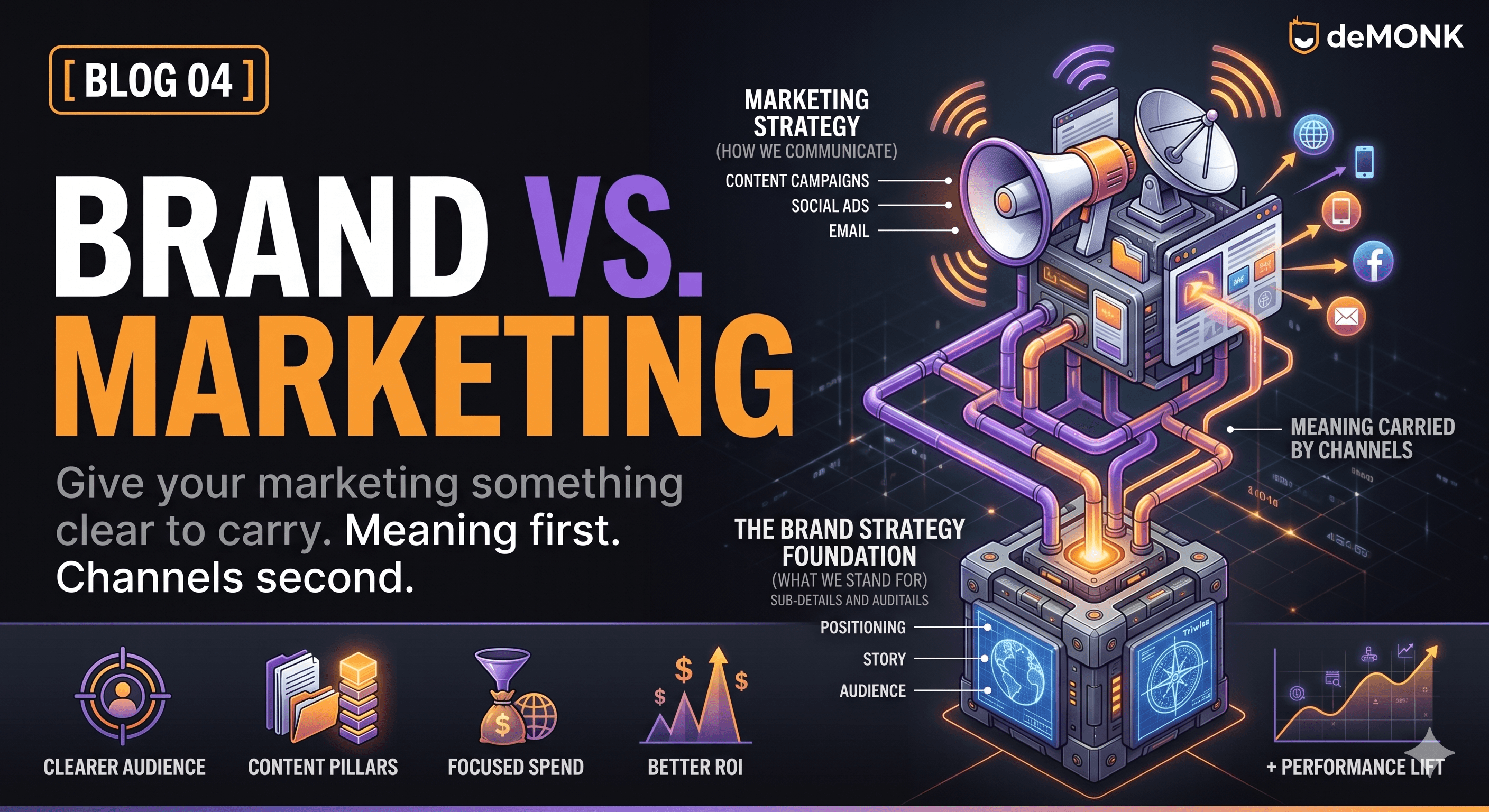
Brand strategy and marketing strategy are related, but they do different jobs. Brand strategy defines the meaning of the brand: purpose, audience, positioning, values, personality, and the emotional role it should play.
Marketing strategy defines how that meaning gets translated into growth: which channels to use, what messages to lead with, what to say to different segments, and how to measure what works.
A simple way to think about it is this: brand is the foundation; marketing is the movement. If the foundation is weak, the movement gets noisy very quickly.
Marketing only works when it is pulling in the same direction as the brand. If the brand is unclear, marketing becomes a series of disconnected actions—posts, campaigns, ads, emails, and offers that stay busy but do not build much momentum.
Brand strategy gives marketing a point of view. It defines who the business is for, what it stands for, and how it should feel in the market. Marketing direction then turns that strategy into channels, messages, campaigns, and content that people can actually see and respond to.
For founders and small teams, this is a practical difference, not a theoretical one. A clear brand strategy makes every rupee spent on marketing sharper, because it helps decide what to say, where to say it, and what to leave out.
The problem with random marketing
A lot of businesses do marketing in fragments. There is a reel one week, a paid campaign the next, an email blast when the team has time, and a few social posts in between. It feels active, but it does not feel connected.
That usually creates the same pattern:
The brand says one thing on the website and something else on social media.
The team keeps testing new angles because nothing feels settled.
Campaigns spike briefly, then fade because there is no common thread.
The audience sees activity, but not a clear reason to remember the brand.
The real issue is not a lack of content. It is a lack of direction. Marketing without strategy turns into motion without memory.
Brand strategy and marketing strategy
Brand strategy and marketing strategy are related, but they do different jobs. Brand strategy defines the meaning of the brand: purpose, audience, positioning, values, personality, and the emotional role it should play.
Marketing strategy defines how that meaning gets translated into growth: which channels to use, what messages to lead with, what to say to different segments, and how to measure what works.
A simple way to think about it is this: brand is the foundation; marketing is the movement. If the foundation is weak, the movement gets noisy very quickly.
Marketing only works when it is pulling in the same direction as the brand. If the brand is unclear, marketing becomes a series of disconnected actions—posts, campaigns, ads, emails, and offers that stay busy but do not build much momentum.
Brand strategy gives marketing a point of view. It defines who the business is for, what it stands for, and how it should feel in the market. Marketing direction then turns that strategy into channels, messages, campaigns, and content that people can actually see and respond to.
For founders and small teams, this is a practical difference, not a theoretical one. A clear brand strategy makes every rupee spent on marketing sharper, because it helps decide what to say, where to say it, and what to leave out.
The problem with random marketing
A lot of businesses do marketing in fragments. There is a reel one week, a paid campaign the next, an email blast when the team has time, and a few social posts in between. It feels active, but it does not feel connected.
That usually creates the same pattern:
The brand says one thing on the website and something else on social media.
The team keeps testing new angles because nothing feels settled.
Campaigns spike briefly, then fade because there is no common thread.
The audience sees activity, but not a clear reason to remember the brand.
The real issue is not a lack of content. It is a lack of direction. Marketing without strategy turns into motion without memory.
Brand strategy and marketing strategy
Brand strategy and marketing strategy are related, but they do different jobs. Brand strategy defines the meaning of the brand: purpose, audience, positioning, values, personality, and the emotional role it should play.
Marketing strategy defines how that meaning gets translated into growth: which channels to use, what messages to lead with, what to say to different segments, and how to measure what works.
A simple way to think about it is this: brand is the foundation; marketing is the movement. If the foundation is weak, the movement gets noisy very quickly.
How strategy shapes marketing
Audience first
Brand strategy helps define the primary audience instead of trying to speak to everyone. That matters because marketing is more effective when it is aimed at a specific group with specific habits, fears, and triggers.
Once the audience is clear, the marketing team can make better choices:
which platforms to focus on.
what kind of content the audience actually wants.
what language feels natural to them.
what offers are worth promoting.
Positioning to messaging
Positioning decides how the brand should be understood relative to competitors. Marketing then turns that position into messages that are clear, repeatable, and believable.
If positioning is strong, messaging becomes easier:
the core promise is clearer,
the proof points are easier to choose,
the homepage copy gets sharper,
the ads feel more consistent,
and the sales conversation is easier to hold.
Without that, each campaign starts inventing a new version of the brand.
Story to campaigns
Brand strategy usually contains a bigger narrative: why the brand exists, what change it wants to make, and what it believes about the world.
Marketing direction turns that story into campaigns:
brand campaigns that reinforce the point of view,
product campaigns that connect features to the larger story,
and always-on content that keeps retelling the same idea in different formats.
The goal is not to create a new story every month. It is to tell the same true story in ways that stay useful and fresh.
Pillars to content
A good brand strategy usually has a few clear pillars. Those pillars should become the backbone of the content plan.
For example:
If the brand pillar is fairness, content can focus on trust, clarity, and user rights.
If the brand pillar is self-expression, content can focus on identity, style, and individuality.
If the brand pillar is spiritual modernity, content can focus on meaning, symbols, and modern usage.
When content follows the brand pillars, the blog, social feed, and email output all start reinforcing the same memory instead of creating random noise.
Tone of voice to channel behaviour
Tone of voice is one of the most underrated parts of marketing direction. It decides how the brand should sound in each channel and how it should behave when speaking to customers.
That matters because the same brand should feel like the same entity whether it is writing a landing page, a support email, an Instagram caption, or a case study. If the tone shifts too much, the brand feels fragmented.
Studio deMonk’s own positioning—bold, fearless, disruptive, and multi-disciplinary—naturally supports a tone that is practical, sharp, and purpose-led rather than decorative.
The Triwise example
Triwise is a strong example of how brand strategy shapes marketing direction in a real business context.
The strategy did not position Triwise as just another travel app. It positioned the brand at the intersection of travel booking, travel planning, and travel finance management. That one choice changes the entire marketing system.
Now the brand is not trying to sell only convenience. It is selling a smarter travel behaviour: planning better, saving better, and travelling with more confidence.
That gives marketing a much clearer job. The content, campaigns, and website do not need to keep guessing what the brand stands for. They can keep returning to a core idea: travel should feel more informed, more flexible, and more financially sustainable.
Audience in marketing
The Triwise audience is not broad. It focuses on Millennials and Gen Z in the U.S. travel market—people who are digitally fluent, experience-driven, budget-conscious, and influenced by social media, peer recommendations, and flexible planning.
That audience definition gives marketing a much better starting point:
Use channels they already trust.
Use formats they already consume.
Use messages that reflect how they actually make travel decisions.
Messaging in marketing
Because the positioning is clear, marketing can talk about:
AI-driven planning.
transparent pricing.
community-driven recommendations.
flexible travel behaviour.
and the balance between aspiration and financial control.
That is much stronger than generic travel marketing. It sounds specific because the strategy is specific.
Campaign direction in marketing
A brand like Triwise does not need to invent random campaigns. It can build them from the same strategic spine:
travel planning content,
save-wise education,
AI-assisted itinerary content,
trust and transparency content,
and community-led travel inspiration.
Each of those campaign types supports the same brand position. That is how brand strategy creates marketing consistency.
How strategy shapes marketing
Audience first
Brand strategy helps define the primary audience instead of trying to speak to everyone. That matters because marketing is more effective when it is aimed at a specific group with specific habits, fears, and triggers.
Once the audience is clear, the marketing team can make better choices:
which platforms to focus on.
what kind of content the audience actually wants.
what language feels natural to them.
what offers are worth promoting.
Positioning to messaging
Positioning decides how the brand should be understood relative to competitors. Marketing then turns that position into messages that are clear, repeatable, and believable.
If positioning is strong, messaging becomes easier:
the core promise is clearer,
the proof points are easier to choose,
the homepage copy gets sharper,
the ads feel more consistent,
and the sales conversation is easier to hold.
Without that, each campaign starts inventing a new version of the brand.
Story to campaigns
Brand strategy usually contains a bigger narrative: why the brand exists, what change it wants to make, and what it believes about the world.
Marketing direction turns that story into campaigns:
brand campaigns that reinforce the point of view,
product campaigns that connect features to the larger story,
and always-on content that keeps retelling the same idea in different formats.
The goal is not to create a new story every month. It is to tell the same true story in ways that stay useful and fresh.
Pillars to content
A good brand strategy usually has a few clear pillars. Those pillars should become the backbone of the content plan.
For example:
If the brand pillar is fairness, content can focus on trust, clarity, and user rights.
If the brand pillar is self-expression, content can focus on identity, style, and individuality.
If the brand pillar is spiritual modernity, content can focus on meaning, symbols, and modern usage.
When content follows the brand pillars, the blog, social feed, and email output all start reinforcing the same memory instead of creating random noise.
Tone of voice to channel behaviour
Tone of voice is one of the most underrated parts of marketing direction. It decides how the brand should sound in each channel and how it should behave when speaking to customers.
That matters because the same brand should feel like the same entity whether it is writing a landing page, a support email, an Instagram caption, or a case study. If the tone shifts too much, the brand feels fragmented.
Studio deMonk’s own positioning—bold, fearless, disruptive, and multi-disciplinary—naturally supports a tone that is practical, sharp, and purpose-led rather than decorative.
The Triwise example
Triwise is a strong example of how brand strategy shapes marketing direction in a real business context.
The strategy did not position Triwise as just another travel app. It positioned the brand at the intersection of travel booking, travel planning, and travel finance management. That one choice changes the entire marketing system.
Now the brand is not trying to sell only convenience. It is selling a smarter travel behaviour: planning better, saving better, and travelling with more confidence.
That gives marketing a much clearer job. The content, campaigns, and website do not need to keep guessing what the brand stands for. They can keep returning to a core idea: travel should feel more informed, more flexible, and more financially sustainable.
Audience in marketing
The Triwise audience is not broad. It focuses on Millennials and Gen Z in the U.S. travel market—people who are digitally fluent, experience-driven, budget-conscious, and influenced by social media, peer recommendations, and flexible planning.
That audience definition gives marketing a much better starting point:
Use channels they already trust.
Use formats they already consume.
Use messages that reflect how they actually make travel decisions.
Messaging in marketing
Because the positioning is clear, marketing can talk about:
AI-driven planning.
transparent pricing.
community-driven recommendations.
flexible travel behaviour.
and the balance between aspiration and financial control.
That is much stronger than generic travel marketing. It sounds specific because the strategy is specific.
Campaign direction in marketing
A brand like Triwise does not need to invent random campaigns. It can build them from the same strategic spine:
travel planning content,
save-wise education,
AI-assisted itinerary content,
trust and transparency content,
and community-led travel inspiration.
Each of those campaign types supports the same brand position. That is how brand strategy creates marketing consistency.
How strategy shapes marketing
Audience first
Brand strategy helps define the primary audience instead of trying to speak to everyone. That matters because marketing is more effective when it is aimed at a specific group with specific habits, fears, and triggers.
Once the audience is clear, the marketing team can make better choices:
which platforms to focus on.
what kind of content the audience actually wants.
what language feels natural to them.
what offers are worth promoting.
Positioning to messaging
Positioning decides how the brand should be understood relative to competitors. Marketing then turns that position into messages that are clear, repeatable, and believable.
If positioning is strong, messaging becomes easier:
the core promise is clearer,
the proof points are easier to choose,
the homepage copy gets sharper,
the ads feel more consistent,
and the sales conversation is easier to hold.
Without that, each campaign starts inventing a new version of the brand.
Story to campaigns
Brand strategy usually contains a bigger narrative: why the brand exists, what change it wants to make, and what it believes about the world.
Marketing direction turns that story into campaigns:
brand campaigns that reinforce the point of view,
product campaigns that connect features to the larger story,
and always-on content that keeps retelling the same idea in different formats.
The goal is not to create a new story every month. It is to tell the same true story in ways that stay useful and fresh.
Pillars to content
A good brand strategy usually has a few clear pillars. Those pillars should become the backbone of the content plan.
For example:
If the brand pillar is fairness, content can focus on trust, clarity, and user rights.
If the brand pillar is self-expression, content can focus on identity, style, and individuality.
If the brand pillar is spiritual modernity, content can focus on meaning, symbols, and modern usage.
When content follows the brand pillars, the blog, social feed, and email output all start reinforcing the same memory instead of creating random noise.
Tone of voice to channel behaviour
Tone of voice is one of the most underrated parts of marketing direction. It decides how the brand should sound in each channel and how it should behave when speaking to customers.
That matters because the same brand should feel like the same entity whether it is writing a landing page, a support email, an Instagram caption, or a case study. If the tone shifts too much, the brand feels fragmented.
Studio deMonk’s own positioning—bold, fearless, disruptive, and multi-disciplinary—naturally supports a tone that is practical, sharp, and purpose-led rather than decorative.
The Triwise example
Triwise is a strong example of how brand strategy shapes marketing direction in a real business context.
The strategy did not position Triwise as just another travel app. It positioned the brand at the intersection of travel booking, travel planning, and travel finance management. That one choice changes the entire marketing system.
Now the brand is not trying to sell only convenience. It is selling a smarter travel behaviour: planning better, saving better, and travelling with more confidence.
That gives marketing a much clearer job. The content, campaigns, and website do not need to keep guessing what the brand stands for. They can keep returning to a core idea: travel should feel more informed, more flexible, and more financially sustainable.
Audience in marketing
The Triwise audience is not broad. It focuses on Millennials and Gen Z in the U.S. travel market—people who are digitally fluent, experience-driven, budget-conscious, and influenced by social media, peer recommendations, and flexible planning.
That audience definition gives marketing a much better starting point:
Use channels they already trust.
Use formats they already consume.
Use messages that reflect how they actually make travel decisions.
Messaging in marketing
Because the positioning is clear, marketing can talk about:
AI-driven planning.
transparent pricing.
community-driven recommendations.
flexible travel behaviour.
and the balance between aspiration and financial control.
That is much stronger than generic travel marketing. It sounds specific because the strategy is specific.
Campaign direction in marketing
A brand like Triwise does not need to invent random campaigns. It can build them from the same strategic spine:
travel planning content,
save-wise education,
AI-assisted itinerary content,
trust and transparency content,
and community-led travel inspiration.
Each of those campaign types supports the same brand position. That is how brand strategy creates marketing consistency.
Studio deMonk’s angle
Studio deMonk is already built for this kind of work. The studio describes itself as a multi-disciplinary design agency helping brands make a lasting impression from day one, and its published work shows a consistent link between strategy, design, and business impact.
The AI-powered design article makes the studio’s point of view even clearer: design should help small and medium businesses grow, convert, and reduce churn, not just look better. That is exactly what it means for brand strategy to shape marketing direction.
If the brand is clear, the marketing gets sharper. If the marketing is sharp, the brand gets remembered.
Practical framework
A founder or small team can use this simple flow:
Define the brand core.
Purpose.
Audience.
Positioning.
Values.
Personality.
Turn that core into a messaging system.
Core promise.
Proof points.
Key themes.
Tone of voice.
Build content pillars.
What topics should always show up?
What should the brand keep repeating?
Map the channels.
Which channel is for awareness?
Which channel is for trust?
Which channel is for conversion?
Track the right metrics.
Recall.
Branded search.
Conversion.
Retention.
Channel efficiency.
This is how marketing becomes a system instead of a set of random tasks.
What breaks when strategy is missing
Without brand strategy, marketing usually falls into one of these traps:
too many messages,
too many audiences,
too many channels,
too many creative directions,
and too little consistency.
That creates confusion inside the team and weak recognition outside it. People may see your posts, but they do not build a strong mental link to the brand.
The fix is not more content. The fix is a clearer strategy behind the content.
Studio deMonk’s angle
Studio deMonk is already built for this kind of work. The studio describes itself as a multi-disciplinary design agency helping brands make a lasting impression from day one, and its published work shows a consistent link between strategy, design, and business impact.
The AI-powered design article makes the studio’s point of view even clearer: design should help small and medium businesses grow, convert, and reduce churn, not just look better. That is exactly what it means for brand strategy to shape marketing direction.
If the brand is clear, the marketing gets sharper. If the marketing is sharp, the brand gets remembered.
Practical framework
A founder or small team can use this simple flow:
Define the brand core.
Purpose.
Audience.
Positioning.
Values.
Personality.
Turn that core into a messaging system.
Core promise.
Proof points.
Key themes.
Tone of voice.
Build content pillars.
What topics should always show up?
What should the brand keep repeating?
Map the channels.
Which channel is for awareness?
Which channel is for trust?
Which channel is for conversion?
Track the right metrics.
Recall.
Branded search.
Conversion.
Retention.
Channel efficiency.
This is how marketing becomes a system instead of a set of random tasks.
What breaks when strategy is missing
Without brand strategy, marketing usually falls into one of these traps:
too many messages,
too many audiences,
too many channels,
too many creative directions,
and too little consistency.
That creates confusion inside the team and weak recognition outside it. People may see your posts, but they do not build a strong mental link to the brand.
The fix is not more content. The fix is a clearer strategy behind the content.
Studio deMonk’s angle
Studio deMonk is already built for this kind of work. The studio describes itself as a multi-disciplinary design agency helping brands make a lasting impression from day one, and its published work shows a consistent link between strategy, design, and business impact.
The AI-powered design article makes the studio’s point of view even clearer: design should help small and medium businesses grow, convert, and reduce churn, not just look better. That is exactly what it means for brand strategy to shape marketing direction.
If the brand is clear, the marketing gets sharper. If the marketing is sharp, the brand gets remembered.
Practical framework
A founder or small team can use this simple flow:
Define the brand core.
Purpose.
Audience.
Positioning.
Values.
Personality.
Turn that core into a messaging system.
Core promise.
Proof points.
Key themes.
Tone of voice.
Build content pillars.
What topics should always show up?
What should the brand keep repeating?
Map the channels.
Which channel is for awareness?
Which channel is for trust?
Which channel is for conversion?
Track the right metrics.
Recall.
Branded search.
Conversion.
Retention.
Channel efficiency.
This is how marketing becomes a system instead of a set of random tasks.
What breaks when strategy is missing
Without brand strategy, marketing usually falls into one of these traps:
too many messages,
too many audiences,
too many channels,
too many creative directions,
and too little consistency.
That creates confusion inside the team and weak recognition outside it. People may see your posts, but they do not build a strong mental link to the brand.
The fix is not more content. The fix is a clearer strategy behind the content.
FAQ
What is the difference between brand strategy and marketing strategy?
Brand strategy defines what the brand means. Marketing strategy defines how that meaning is communicated through channels, messages, and campaigns.
Why does marketing need brand strategy?
Because marketing performs better when it has a clear story, audience, and point of view to work from.
How does brand strategy help with content?
It gives the content direction. Instead of posting random topics, the brand can build content around a few strategic pillars.
How does this apply to small teams?
Small teams need it even more. Strategy helps them spend time and money on the right things instead of trying everything.
How is Triwise a good example?
Triwise was positioned at the intersection of travel, planning, and finance, which gave the marketing a sharper story, clearer audience, and stronger message direction.
Closing thought
Marketing only works when it is carrying something clear. Brand strategy gives it that clarity. It tells the business what to stand for, who to speak to, and what to repeat until the market starts to remember it.
For Triwise, that clarity came from strategy first. The marketing direction then followed naturally: more focused, more useful, and more aligned with the business the brand was actually trying to build.
FAQ
What is the difference between brand strategy and marketing strategy?
Brand strategy defines what the brand means. Marketing strategy defines how that meaning is communicated through channels, messages, and campaigns.
Why does marketing need brand strategy?
Because marketing performs better when it has a clear story, audience, and point of view to work from.
How does brand strategy help with content?
It gives the content direction. Instead of posting random topics, the brand can build content around a few strategic pillars.
How does this apply to small teams?
Small teams need it even more. Strategy helps them spend time and money on the right things instead of trying everything.
How is Triwise a good example?
Triwise was positioned at the intersection of travel, planning, and finance, which gave the marketing a sharper story, clearer audience, and stronger message direction.
Closing thought
Marketing only works when it is carrying something clear. Brand strategy gives it that clarity. It tells the business what to stand for, who to speak to, and what to repeat until the market starts to remember it.
For Triwise, that clarity came from strategy first. The marketing direction then followed naturally: more focused, more useful, and more aligned with the business the brand was actually trying to build.
FAQ
What is the difference between brand strategy and marketing strategy?
Brand strategy defines what the brand means. Marketing strategy defines how that meaning is communicated through channels, messages, and campaigns.
Why does marketing need brand strategy?
Because marketing performs better when it has a clear story, audience, and point of view to work from.
How does brand strategy help with content?
It gives the content direction. Instead of posting random topics, the brand can build content around a few strategic pillars.
How does this apply to small teams?
Small teams need it even more. Strategy helps them spend time and money on the right things instead of trying everything.
How is Triwise a good example?
Triwise was positioned at the intersection of travel, planning, and finance, which gave the marketing a sharper story, clearer audience, and stronger message direction.
Closing thought
Marketing only works when it is carrying something clear. Brand strategy gives it that clarity. It tells the business what to stand for, who to speak to, and what to repeat until the market starts to remember it.
For Triwise, that clarity came from strategy first. The marketing direction then followed naturally: more focused, more useful, and more aligned with the business the brand was actually trying to build.