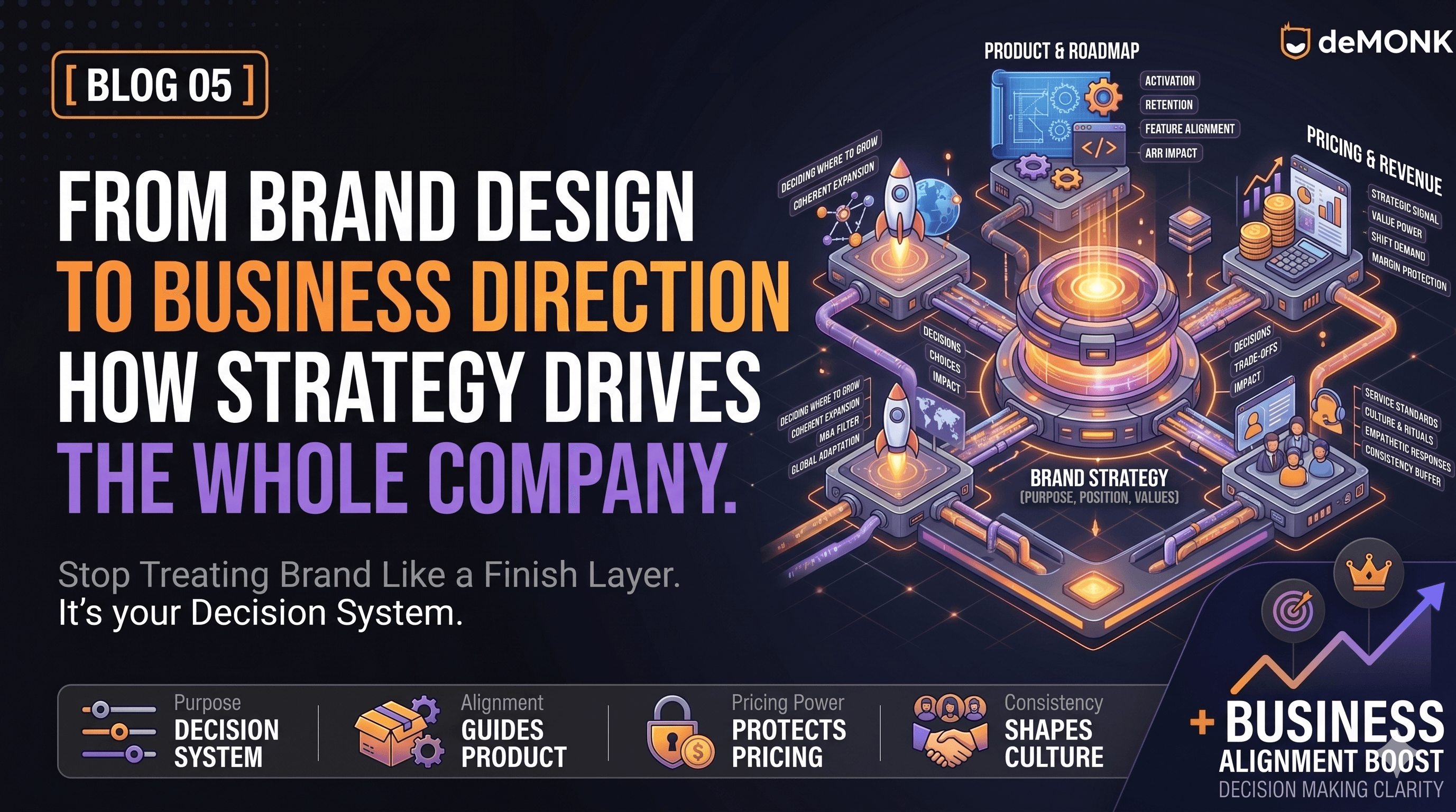
From Brand Design to Business Direction: How Strategy Drives the Whole Company
Brand strategy is often introduced as a design or marketing exercise. That is how many founders first encounter it: a logo gets refreshed, the website gets cleaned up, the messaging becomes tighter, and the brand starts to look more serious. But that is only the surface. The real value of brand strategy appears when it begins to shape how the whole company makes decisions.
That is where the work becomes useful. A strong brand strategy does not only influence how a business looks. It influences what gets built, how pricing works, what kind of customer the brand attracts, how the team behaves, and what kind of experience the company delivers at every touchpoint. In other words, brand strategy stops being a communication layer and becomes a business direction tool.
That shift matters because most companies do not have a branding problem. They have a consistency problem. The product team is moving in one direction, the marketing team is telling another story, the pricing structure is sending a third message, and the customer experience is doing something else entirely. When that happens, the brand may look good, but the business still feels fragmented.
For Studio deMonk, this is exactly where strategy matters. The studio’s work and positioning show that design is not being treated as decoration. It is being used as a system that helps brands make stronger decisions and build more resilient businesses.
The problem with surface-only brand work
One of the most common mistakes companies make is treating brand work as a finish line. The redesign gets approved, the website goes live, the presentation deck looks cleaner, and everyone feels like the brand has been upgraded. But after the launch, the business goes back to operating exactly the same way it did before.
That is where surface-only brand work starts to break down. The logo may be stronger, but the roadmap is still driven by internal opinions instead of brand logic. The homepage may look more refined, but the pricing still copies competitors. The company may talk about customer-centricity, but the actual service experience is inconsistent or difficult to trust.
This kind of mismatch creates a quiet but serious problem. Customers begin to feel that the brand is saying one thing and doing another. Employees also feel it, even if they do not name it directly. Teams start making their own interpretations of what the brand means, and that creates different versions of the company inside the same organisation.
In practice, surface-only brand work usually produces the same outcome: better presentation, little strategic movement. The company looks more polished, but the business still behaves like an unconnected collection of functions.
Brand strategy is often introduced as a design or marketing exercise. That is how many founders first encounter it: a logo gets refreshed, the website gets cleaned up, the messaging becomes tighter, and the brand starts to look more serious. But that is only the surface. The real value of brand strategy appears when it begins to shape how the whole company makes decisions.
That is where the work becomes useful. A strong brand strategy does not only influence how a business looks. It influences what gets built, how pricing works, what kind of customer the brand attracts, how the team behaves, and what kind of experience the company delivers at every touchpoint. In other words, brand strategy stops being a communication layer and becomes a business direction tool.
That shift matters because most companies do not have a branding problem. They have a consistency problem. The product team is moving in one direction, the marketing team is telling another story, the pricing structure is sending a third message, and the customer experience is doing something else entirely. When that happens, the brand may look good, but the business still feels fragmented.
For Studio deMonk, this is exactly where strategy matters. The studio’s work and positioning show that design is not being treated as decoration. It is being used as a system that helps brands make stronger decisions and build more resilient businesses.
The problem with surface-only brand work
One of the most common mistakes companies make is treating brand work as a finish line. The redesign gets approved, the website goes live, the presentation deck looks cleaner, and everyone feels like the brand has been upgraded. But after the launch, the business goes back to operating exactly the same way it did before.
That is where surface-only brand work starts to break down. The logo may be stronger, but the roadmap is still driven by internal opinions instead of brand logic. The homepage may look more refined, but the pricing still copies competitors. The company may talk about customer-centricity, but the actual service experience is inconsistent or difficult to trust.
This kind of mismatch creates a quiet but serious problem. Customers begin to feel that the brand is saying one thing and doing another. Employees also feel it, even if they do not name it directly. Teams start making their own interpretations of what the brand means, and that creates different versions of the company inside the same organisation.
In practice, surface-only brand work usually produces the same outcome: better presentation, little strategic movement. The company looks more polished, but the business still behaves like an unconnected collection of functions.
Brand strategy is often introduced as a design or marketing exercise. That is how many founders first encounter it: a logo gets refreshed, the website gets cleaned up, the messaging becomes tighter, and the brand starts to look more serious. But that is only the surface. The real value of brand strategy appears when it begins to shape how the whole company makes decisions.
That is where the work becomes useful. A strong brand strategy does not only influence how a business looks. It influences what gets built, how pricing works, what kind of customer the brand attracts, how the team behaves, and what kind of experience the company delivers at every touchpoint. In other words, brand strategy stops being a communication layer and becomes a business direction tool.
That shift matters because most companies do not have a branding problem. They have a consistency problem. The product team is moving in one direction, the marketing team is telling another story, the pricing structure is sending a third message, and the customer experience is doing something else entirely. When that happens, the brand may look good, but the business still feels fragmented.
For Studio deMonk, this is exactly where strategy matters. The studio’s work and positioning show that design is not being treated as decoration. It is being used as a system that helps brands make stronger decisions and build more resilient businesses.
The problem with surface-only brand work
One of the most common mistakes companies make is treating brand work as a finish line. The redesign gets approved, the website goes live, the presentation deck looks cleaner, and everyone feels like the brand has been upgraded. But after the launch, the business goes back to operating exactly the same way it did before.
That is where surface-only brand work starts to break down. The logo may be stronger, but the roadmap is still driven by internal opinions instead of brand logic. The homepage may look more refined, but the pricing still copies competitors. The company may talk about customer-centricity, but the actual service experience is inconsistent or difficult to trust.
This kind of mismatch creates a quiet but serious problem. Customers begin to feel that the brand is saying one thing and doing another. Employees also feel it, even if they do not name it directly. Teams start making their own interpretations of what the brand means, and that creates different versions of the company inside the same organisation.
In practice, surface-only brand work usually produces the same outcome: better presentation, little strategic movement. The company looks more polished, but the business still behaves like an unconnected collection of functions.
Brand strategy as a decision system
Brand strategy becomes powerful when it is treated as a decision system. That means it is not just a statement of identity. It is a framework that helps the company choose between options, especially when the options are all valid on the surface.
The core pieces are usually the same: purpose, positioning, values, and personality. Purpose explains why the company exists beyond profit. Positioning explains where the company stands in the market and who it is for. Values explain how the company should behave. Personality explains how it should feel when people encounter it.
When those elements are clear, they stop being abstract and start acting like filters. The product team can ask whether a feature supports the brand promise. The marketing team can ask whether a campaign reinforces the position. The operations team can ask whether a policy feels consistent with the values. The leadership team can ask whether a growth move fits the brand or dilutes it.
That is the real advantage of strategy. It removes guesswork. It does not eliminate judgement, but it gives judgement a clearer frame. A brand with strong strategy still has to make hard choices, but those choices are easier to defend because they come from a coherent point of view.
How strategy shapes product decisions
The product is often the first place where brand strategy becomes visible in a practical way. Product roadmaps are full of opportunities: new features, better flows, more integrations, minor upgrades, experiments, and requests from customers or internal teams. Without a strong brand filter, it becomes easy to chase everything and build a product that feels busy but not focused.
A clear brand strategy helps the team choose what to build and, just as importantly, what not to build. If the brand promise is about simplicity, then every product decision should move toward reducing friction. If the brand promise is about trust, then the product has to make transparency visible. If the brand promise is about empowerment, then the product should help users make better decisions instead of just giving them more information.
Triwise is a good example of this kind of thinking. The brand was not positioned as a generic travel app. It was built at the intersection of travel booking, travel planning, and travel finance management. That positioning changes the product logic immediately. The product cannot just help users book a trip. It has to help them travel smarter, save wiser, and journey further.
That means product choices should support a very specific experience. The flow should reduce decision fatigue. The planning should feel intelligent. The financial layer should feel useful, not hidden. The user should feel that the product is helping them travel with more confidence, not just giving them another booking interface.
This is the difference between a product feature list and a product philosophy. A feature list tells you what exists. A product philosophy tells you why it exists and how it should behave.
Product experience as brand proof
Customers do not only evaluate brands through campaigns. They evaluate them through how the product behaves in real use. If the brand claims to be simple, the interface has to be simple. If it claims to be premium, the product needs to feel refined. If it claims to be human, the experience cannot feel cold or mechanical.
This is where brand strategy becomes proof, not promise. A brand promise only has value if the product experience delivers on it. That means onboarding, empty states, support interactions, error handling, search behaviour, and even loading moments matter more than most teams realise.
BlueCollar Log shows this clearly. The brand is built around fairness and dignity, and that idea does not live only in the story or the brand language. It is embedded into the product logic through transparent contracts, clearer rights, and trust-oriented features. In that case, the product becomes the brand’s behaviour in the real world.
That is the standard strong brands should aim for. The product should not merely support the brand. It should prove it. When customers experience consistency between the promise and the product, trust grows faster and the brand feels more believable.
Brand strategy as a decision system
Brand strategy becomes powerful when it is treated as a decision system. That means it is not just a statement of identity. It is a framework that helps the company choose between options, especially when the options are all valid on the surface.
The core pieces are usually the same: purpose, positioning, values, and personality. Purpose explains why the company exists beyond profit. Positioning explains where the company stands in the market and who it is for. Values explain how the company should behave. Personality explains how it should feel when people encounter it.
When those elements are clear, they stop being abstract and start acting like filters. The product team can ask whether a feature supports the brand promise. The marketing team can ask whether a campaign reinforces the position. The operations team can ask whether a policy feels consistent with the values. The leadership team can ask whether a growth move fits the brand or dilutes it.
That is the real advantage of strategy. It removes guesswork. It does not eliminate judgement, but it gives judgement a clearer frame. A brand with strong strategy still has to make hard choices, but those choices are easier to defend because they come from a coherent point of view.
How strategy shapes product decisions
The product is often the first place where brand strategy becomes visible in a practical way. Product roadmaps are full of opportunities: new features, better flows, more integrations, minor upgrades, experiments, and requests from customers or internal teams. Without a strong brand filter, it becomes easy to chase everything and build a product that feels busy but not focused.
A clear brand strategy helps the team choose what to build and, just as importantly, what not to build. If the brand promise is about simplicity, then every product decision should move toward reducing friction. If the brand promise is about trust, then the product has to make transparency visible. If the brand promise is about empowerment, then the product should help users make better decisions instead of just giving them more information.
Triwise is a good example of this kind of thinking. The brand was not positioned as a generic travel app. It was built at the intersection of travel booking, travel planning, and travel finance management. That positioning changes the product logic immediately. The product cannot just help users book a trip. It has to help them travel smarter, save wiser, and journey further.
That means product choices should support a very specific experience. The flow should reduce decision fatigue. The planning should feel intelligent. The financial layer should feel useful, not hidden. The user should feel that the product is helping them travel with more confidence, not just giving them another booking interface.
This is the difference between a product feature list and a product philosophy. A feature list tells you what exists. A product philosophy tells you why it exists and how it should behave.
Product experience as brand proof
Customers do not only evaluate brands through campaigns. They evaluate them through how the product behaves in real use. If the brand claims to be simple, the interface has to be simple. If it claims to be premium, the product needs to feel refined. If it claims to be human, the experience cannot feel cold or mechanical.
This is where brand strategy becomes proof, not promise. A brand promise only has value if the product experience delivers on it. That means onboarding, empty states, support interactions, error handling, search behaviour, and even loading moments matter more than most teams realise.
BlueCollar Log shows this clearly. The brand is built around fairness and dignity, and that idea does not live only in the story or the brand language. It is embedded into the product logic through transparent contracts, clearer rights, and trust-oriented features. In that case, the product becomes the brand’s behaviour in the real world.
That is the standard strong brands should aim for. The product should not merely support the brand. It should prove it. When customers experience consistency between the promise and the product, trust grows faster and the brand feels more believable.
Brand strategy as a decision system
Brand strategy becomes powerful when it is treated as a decision system. That means it is not just a statement of identity. It is a framework that helps the company choose between options, especially when the options are all valid on the surface.
The core pieces are usually the same: purpose, positioning, values, and personality. Purpose explains why the company exists beyond profit. Positioning explains where the company stands in the market and who it is for. Values explain how the company should behave. Personality explains how it should feel when people encounter it.
When those elements are clear, they stop being abstract and start acting like filters. The product team can ask whether a feature supports the brand promise. The marketing team can ask whether a campaign reinforces the position. The operations team can ask whether a policy feels consistent with the values. The leadership team can ask whether a growth move fits the brand or dilutes it.
That is the real advantage of strategy. It removes guesswork. It does not eliminate judgement, but it gives judgement a clearer frame. A brand with strong strategy still has to make hard choices, but those choices are easier to defend because they come from a coherent point of view.
How strategy shapes product decisions
The product is often the first place where brand strategy becomes visible in a practical way. Product roadmaps are full of opportunities: new features, better flows, more integrations, minor upgrades, experiments, and requests from customers or internal teams. Without a strong brand filter, it becomes easy to chase everything and build a product that feels busy but not focused.
A clear brand strategy helps the team choose what to build and, just as importantly, what not to build. If the brand promise is about simplicity, then every product decision should move toward reducing friction. If the brand promise is about trust, then the product has to make transparency visible. If the brand promise is about empowerment, then the product should help users make better decisions instead of just giving them more information.
Triwise is a good example of this kind of thinking. The brand was not positioned as a generic travel app. It was built at the intersection of travel booking, travel planning, and travel finance management. That positioning changes the product logic immediately. The product cannot just help users book a trip. It has to help them travel smarter, save wiser, and journey further.
That means product choices should support a very specific experience. The flow should reduce decision fatigue. The planning should feel intelligent. The financial layer should feel useful, not hidden. The user should feel that the product is helping them travel with more confidence, not just giving them another booking interface.
This is the difference between a product feature list and a product philosophy. A feature list tells you what exists. A product philosophy tells you why it exists and how it should behave.
Product experience as brand proof
Customers do not only evaluate brands through campaigns. They evaluate them through how the product behaves in real use. If the brand claims to be simple, the interface has to be simple. If it claims to be premium, the product needs to feel refined. If it claims to be human, the experience cannot feel cold or mechanical.
This is where brand strategy becomes proof, not promise. A brand promise only has value if the product experience delivers on it. That means onboarding, empty states, support interactions, error handling, search behaviour, and even loading moments matter more than most teams realise.
BlueCollar Log shows this clearly. The brand is built around fairness and dignity, and that idea does not live only in the story or the brand language. It is embedded into the product logic through transparent contracts, clearer rights, and trust-oriented features. In that case, the product becomes the brand’s behaviour in the real world.
That is the standard strong brands should aim for. The product should not merely support the brand. It should prove it. When customers experience consistency between the promise and the product, trust grows faster and the brand feels more believable.
Design systems that scale brand thinking
As businesses grow, a major challenge appears: inconsistency. One team creates a deck one way, another team builds a webpage another way, and a third team publishes social content in a tone that feels slightly different again. The result is a brand that keeps changing shape depending on who is touching it.
Design systems are one of the best ways to solve that. They create reusable components, patterns, and rules that let teams ship faster without losing coherence. Typography, spacing, interface patterns, colour use, copy tone, and layout logic all become part of a system rather than one-off decisions.
But design systems are not only technical tools. They are also strategic tools. The decisions inside them reflect brand priorities. A minimalist system supports clarity and restraint. A more expressive system supports energy and personality. A structured system supports trust and consistency. In that sense, the design system is not just how the brand looks. It is how the brand scales.
Studio deMonk’s multi-disciplinary approach makes this especially relevant. The studio works across branding, digital design, and product design, which means brand principles can be carried into both physical and digital expressions of the company. That is exactly what a business needs if it wants the brand to influence more than communication.
How strategy affects pricing
Pricing is one of the clearest places where brand strategy becomes visible. A company’s price is never only about cost. It is also a signal. It tells customers how the company sees itself, who it is for, and what kind of value it believes it provides.
A brand with a clear position usually has a clearer pricing story. If the brand is specialist, it can defend expertise-based pricing. If the brand is premium, it can defend margin through perceived value and trust. If the brand is value-led, it has to justify volume and accessibility. What matters is not choosing the right price in isolation. It is choosing a price that matches the brand’s identity and market role.
When the price and the brand do not match, customers feel friction. A premium-looking brand with a cheap-feeling experience creates doubt. A transparency-led brand with hidden fees creates distrust. A fairness-led brand with confusing pricing creates confusion.
Triwise again is a useful example. Because the brand is positioned around smarter, more sustainable travel behaviour, the pricing should feel aligned with that promise. The customer is not simply paying for booking access. They are paying for a clearer, more intelligent travel experience that helps them make better decisions.
That is what strategy does to pricing. It moves it from a spreadsheet decision to a brand signal.
Revenue models should match the promise
Brand strategy also affects the revenue model. This is often overlooked, but it matters a great deal. A business built around empowerment and accessibility will usually feel more coherent with a model that keeps value visible and understandable. A business built around exclusivity may feel better with invite-only access, premium pricing, or limited access structures.
The important question is whether the payment model reinforces or contradicts the brand promise. If the company says it is transparent, then the payment structure should be easy to understand. If it says it is fair, then the revenue logic should not rely on hidden extras. If it says it is supportive, then the customer should not feel trapped in a system that only extracts value without creating clarity.
For a brand like BlueCollar Log, the emphasis on fairness and clarity naturally points toward pricing and revenue choices that reinforce trust. For a brand like Triwise, the emphasis on travel intelligence and financial sustainability suggests a model that feels helpful, practical, and aligned with long-term user value.
This matters because customers do not separate the price from the brand. They experience them together.
How strategy affects customer experience
Customer experience is where brand strategy becomes lived reality. It is the daily expression of the brand’s values in moments that often look small from the outside but feel large to the customer. Response time, clarity of instructions, support tone, error handling, onboarding, policy enforcement, and follow-up all shape how the brand is remembered.
If a brand says it is human, its systems must allow human responses. If it says it is premium, the experience must feel carefully considered. If it says it is supportive, the customer should not need to fight for basic clarity. CX is not an add-on to brand. It is the place where the brand either proves itself or loses credibility.
This is why consistency matters so much. The brand promise cannot live only on the homepage. It has to show up in the dashboard, the support inbox, the FAQ, the cancellation policy, the onboarding flow, and the handoff between teams.
BlueCollar Log is again a strong reference point because the brand’s value of fairness is translated into actual product structure. The experience is designed to reduce ambiguity, not create more of it. That is what makes the brand believable.
How strategy affects culture
Brand strategy also shapes the inside of the company. It influences the kind of people the company hires, what behaviours get rewarded, how leadership speaks, and what stories become part of the internal culture.
This matters because culture is where the brand either becomes real or becomes performative. A company that talks about creativity but punishes experimentation sends a mixed signal. A company that claims to value empathy but runs rigid systems creates internal tension. A company that wants to be innovative but rewards only safety will eventually feel stuck.
The strongest brands tend to have internal coherence. People inside the business understand what the company is trying to do, and they understand how to make decisions in ways that support it. That reduces friction. It also makes growth easier because the company does not need to explain itself from scratch every time a new situation appears.
This is especially important when a company scales. The bigger the team gets, the more necessary it becomes to have a shared strategic language. Otherwise, the brand becomes too dependent on a few people’s taste or memory.
How strategy affects growth and expansion
Growth looks attractive from the outside, but without brand strategy it can become a distraction. New products, new segments, new partnerships, new markets, and new channels all create pressure to expand. The question is not whether a business can grow. The question is whether that growth still fits the brand.
Brand strategy acts like a filter. It helps leadership decide whether an opportunity is a real extension of the company or just an attractive distraction. If the opportunity fits the purpose, positioning, and audience, it may strengthen the brand. If it pulls the company into a completely different story, it may create fragmentation.
Triwise’s audience focus is a good example. The brand is built for Millennials and Gen Z travelers who are digitally fluent, value-aware, and socially influenced. That gives growth a natural boundary. The company can expand within that logic, but it should not drift into completely unrelated territory just because a new opportunity appears.
The same principle applies across Studio deMonk’s broader work. Turtyle, Vedsutra, BlueCollar Log, and Lumasphere are different categories, but each one still shows a clear strategy-first approach. That is how a studio can work across sectors without losing strategic discipline.
Why brand-led business direction matters now
In a market where AI can produce endless content, and where design tools can make almost anything look polished quickly, the real advantage is not surface quality. The real advantage is strategic clarity.
This is why brand strategy matters even more now than before. AI can help with speed. Templates can help with output. But neither one can decide what the company should stand for, who it should serve, or what kind of business it wants to become. That decision still has to be made deliberately.
Studio deMonk’s own AI-powered design thinking supports this. The studio frames design as a growth engine that helps small and medium businesses move toward measurable outcomes like conversion, loyalty, and resilience, not just visual improvement. That is exactly the kind of philosophy that makes brand strategy useful across the whole company.
Because once the strategy is clear, every team can use it.
Product uses it to decide what to build.
Marketing uses it to decide what to say.
Operations uses it to decide how to serve.
Leadership uses it to decide where the company is going.
That is when brand becomes business direction.
Design systems that scale brand thinking
As businesses grow, a major challenge appears: inconsistency. One team creates a deck one way, another team builds a webpage another way, and a third team publishes social content in a tone that feels slightly different again. The result is a brand that keeps changing shape depending on who is touching it.
Design systems are one of the best ways to solve that. They create reusable components, patterns, and rules that let teams ship faster without losing coherence. Typography, spacing, interface patterns, colour use, copy tone, and layout logic all become part of a system rather than one-off decisions.
But design systems are not only technical tools. They are also strategic tools. The decisions inside them reflect brand priorities. A minimalist system supports clarity and restraint. A more expressive system supports energy and personality. A structured system supports trust and consistency. In that sense, the design system is not just how the brand looks. It is how the brand scales.
Studio deMonk’s multi-disciplinary approach makes this especially relevant. The studio works across branding, digital design, and product design, which means brand principles can be carried into both physical and digital expressions of the company. That is exactly what a business needs if it wants the brand to influence more than communication.
How strategy affects pricing
Pricing is one of the clearest places where brand strategy becomes visible. A company’s price is never only about cost. It is also a signal. It tells customers how the company sees itself, who it is for, and what kind of value it believes it provides.
A brand with a clear position usually has a clearer pricing story. If the brand is specialist, it can defend expertise-based pricing. If the brand is premium, it can defend margin through perceived value and trust. If the brand is value-led, it has to justify volume and accessibility. What matters is not choosing the right price in isolation. It is choosing a price that matches the brand’s identity and market role.
When the price and the brand do not match, customers feel friction. A premium-looking brand with a cheap-feeling experience creates doubt. A transparency-led brand with hidden fees creates distrust. A fairness-led brand with confusing pricing creates confusion.
Triwise again is a useful example. Because the brand is positioned around smarter, more sustainable travel behaviour, the pricing should feel aligned with that promise. The customer is not simply paying for booking access. They are paying for a clearer, more intelligent travel experience that helps them make better decisions.
That is what strategy does to pricing. It moves it from a spreadsheet decision to a brand signal.
Revenue models should match the promise
Brand strategy also affects the revenue model. This is often overlooked, but it matters a great deal. A business built around empowerment and accessibility will usually feel more coherent with a model that keeps value visible and understandable. A business built around exclusivity may feel better with invite-only access, premium pricing, or limited access structures.
The important question is whether the payment model reinforces or contradicts the brand promise. If the company says it is transparent, then the payment structure should be easy to understand. If it says it is fair, then the revenue logic should not rely on hidden extras. If it says it is supportive, then the customer should not feel trapped in a system that only extracts value without creating clarity.
For a brand like BlueCollar Log, the emphasis on fairness and clarity naturally points toward pricing and revenue choices that reinforce trust. For a brand like Triwise, the emphasis on travel intelligence and financial sustainability suggests a model that feels helpful, practical, and aligned with long-term user value.
This matters because customers do not separate the price from the brand. They experience them together.
How strategy affects customer experience
Customer experience is where brand strategy becomes lived reality. It is the daily expression of the brand’s values in moments that often look small from the outside but feel large to the customer. Response time, clarity of instructions, support tone, error handling, onboarding, policy enforcement, and follow-up all shape how the brand is remembered.
If a brand says it is human, its systems must allow human responses. If it says it is premium, the experience must feel carefully considered. If it says it is supportive, the customer should not need to fight for basic clarity. CX is not an add-on to brand. It is the place where the brand either proves itself or loses credibility.
This is why consistency matters so much. The brand promise cannot live only on the homepage. It has to show up in the dashboard, the support inbox, the FAQ, the cancellation policy, the onboarding flow, and the handoff between teams.
BlueCollar Log is again a strong reference point because the brand’s value of fairness is translated into actual product structure. The experience is designed to reduce ambiguity, not create more of it. That is what makes the brand believable.
How strategy affects culture
Brand strategy also shapes the inside of the company. It influences the kind of people the company hires, what behaviours get rewarded, how leadership speaks, and what stories become part of the internal culture.
This matters because culture is where the brand either becomes real or becomes performative. A company that talks about creativity but punishes experimentation sends a mixed signal. A company that claims to value empathy but runs rigid systems creates internal tension. A company that wants to be innovative but rewards only safety will eventually feel stuck.
The strongest brands tend to have internal coherence. People inside the business understand what the company is trying to do, and they understand how to make decisions in ways that support it. That reduces friction. It also makes growth easier because the company does not need to explain itself from scratch every time a new situation appears.
This is especially important when a company scales. The bigger the team gets, the more necessary it becomes to have a shared strategic language. Otherwise, the brand becomes too dependent on a few people’s taste or memory.
How strategy affects growth and expansion
Growth looks attractive from the outside, but without brand strategy it can become a distraction. New products, new segments, new partnerships, new markets, and new channels all create pressure to expand. The question is not whether a business can grow. The question is whether that growth still fits the brand.
Brand strategy acts like a filter. It helps leadership decide whether an opportunity is a real extension of the company or just an attractive distraction. If the opportunity fits the purpose, positioning, and audience, it may strengthen the brand. If it pulls the company into a completely different story, it may create fragmentation.
Triwise’s audience focus is a good example. The brand is built for Millennials and Gen Z travelers who are digitally fluent, value-aware, and socially influenced. That gives growth a natural boundary. The company can expand within that logic, but it should not drift into completely unrelated territory just because a new opportunity appears.
The same principle applies across Studio deMonk’s broader work. Turtyle, Vedsutra, BlueCollar Log, and Lumasphere are different categories, but each one still shows a clear strategy-first approach. That is how a studio can work across sectors without losing strategic discipline.
Why brand-led business direction matters now
In a market where AI can produce endless content, and where design tools can make almost anything look polished quickly, the real advantage is not surface quality. The real advantage is strategic clarity.
This is why brand strategy matters even more now than before. AI can help with speed. Templates can help with output. But neither one can decide what the company should stand for, who it should serve, or what kind of business it wants to become. That decision still has to be made deliberately.
Studio deMonk’s own AI-powered design thinking supports this. The studio frames design as a growth engine that helps small and medium businesses move toward measurable outcomes like conversion, loyalty, and resilience, not just visual improvement. That is exactly the kind of philosophy that makes brand strategy useful across the whole company.
Because once the strategy is clear, every team can use it.
Product uses it to decide what to build.
Marketing uses it to decide what to say.
Operations uses it to decide how to serve.
Leadership uses it to decide where the company is going.
That is when brand becomes business direction.
Design systems that scale brand thinking
As businesses grow, a major challenge appears: inconsistency. One team creates a deck one way, another team builds a webpage another way, and a third team publishes social content in a tone that feels slightly different again. The result is a brand that keeps changing shape depending on who is touching it.
Design systems are one of the best ways to solve that. They create reusable components, patterns, and rules that let teams ship faster without losing coherence. Typography, spacing, interface patterns, colour use, copy tone, and layout logic all become part of a system rather than one-off decisions.
But design systems are not only technical tools. They are also strategic tools. The decisions inside them reflect brand priorities. A minimalist system supports clarity and restraint. A more expressive system supports energy and personality. A structured system supports trust and consistency. In that sense, the design system is not just how the brand looks. It is how the brand scales.
Studio deMonk’s multi-disciplinary approach makes this especially relevant. The studio works across branding, digital design, and product design, which means brand principles can be carried into both physical and digital expressions of the company. That is exactly what a business needs if it wants the brand to influence more than communication.
How strategy affects pricing
Pricing is one of the clearest places where brand strategy becomes visible. A company’s price is never only about cost. It is also a signal. It tells customers how the company sees itself, who it is for, and what kind of value it believes it provides.
A brand with a clear position usually has a clearer pricing story. If the brand is specialist, it can defend expertise-based pricing. If the brand is premium, it can defend margin through perceived value and trust. If the brand is value-led, it has to justify volume and accessibility. What matters is not choosing the right price in isolation. It is choosing a price that matches the brand’s identity and market role.
When the price and the brand do not match, customers feel friction. A premium-looking brand with a cheap-feeling experience creates doubt. A transparency-led brand with hidden fees creates distrust. A fairness-led brand with confusing pricing creates confusion.
Triwise again is a useful example. Because the brand is positioned around smarter, more sustainable travel behaviour, the pricing should feel aligned with that promise. The customer is not simply paying for booking access. They are paying for a clearer, more intelligent travel experience that helps them make better decisions.
That is what strategy does to pricing. It moves it from a spreadsheet decision to a brand signal.
Revenue models should match the promise
Brand strategy also affects the revenue model. This is often overlooked, but it matters a great deal. A business built around empowerment and accessibility will usually feel more coherent with a model that keeps value visible and understandable. A business built around exclusivity may feel better with invite-only access, premium pricing, or limited access structures.
The important question is whether the payment model reinforces or contradicts the brand promise. If the company says it is transparent, then the payment structure should be easy to understand. If it says it is fair, then the revenue logic should not rely on hidden extras. If it says it is supportive, then the customer should not feel trapped in a system that only extracts value without creating clarity.
For a brand like BlueCollar Log, the emphasis on fairness and clarity naturally points toward pricing and revenue choices that reinforce trust. For a brand like Triwise, the emphasis on travel intelligence and financial sustainability suggests a model that feels helpful, practical, and aligned with long-term user value.
This matters because customers do not separate the price from the brand. They experience them together.
How strategy affects customer experience
Customer experience is where brand strategy becomes lived reality. It is the daily expression of the brand’s values in moments that often look small from the outside but feel large to the customer. Response time, clarity of instructions, support tone, error handling, onboarding, policy enforcement, and follow-up all shape how the brand is remembered.
If a brand says it is human, its systems must allow human responses. If it says it is premium, the experience must feel carefully considered. If it says it is supportive, the customer should not need to fight for basic clarity. CX is not an add-on to brand. It is the place where the brand either proves itself or loses credibility.
This is why consistency matters so much. The brand promise cannot live only on the homepage. It has to show up in the dashboard, the support inbox, the FAQ, the cancellation policy, the onboarding flow, and the handoff between teams.
BlueCollar Log is again a strong reference point because the brand’s value of fairness is translated into actual product structure. The experience is designed to reduce ambiguity, not create more of it. That is what makes the brand believable.
How strategy affects culture
Brand strategy also shapes the inside of the company. It influences the kind of people the company hires, what behaviours get rewarded, how leadership speaks, and what stories become part of the internal culture.
This matters because culture is where the brand either becomes real or becomes performative. A company that talks about creativity but punishes experimentation sends a mixed signal. A company that claims to value empathy but runs rigid systems creates internal tension. A company that wants to be innovative but rewards only safety will eventually feel stuck.
The strongest brands tend to have internal coherence. People inside the business understand what the company is trying to do, and they understand how to make decisions in ways that support it. That reduces friction. It also makes growth easier because the company does not need to explain itself from scratch every time a new situation appears.
This is especially important when a company scales. The bigger the team gets, the more necessary it becomes to have a shared strategic language. Otherwise, the brand becomes too dependent on a few people’s taste or memory.
How strategy affects growth and expansion
Growth looks attractive from the outside, but without brand strategy it can become a distraction. New products, new segments, new partnerships, new markets, and new channels all create pressure to expand. The question is not whether a business can grow. The question is whether that growth still fits the brand.
Brand strategy acts like a filter. It helps leadership decide whether an opportunity is a real extension of the company or just an attractive distraction. If the opportunity fits the purpose, positioning, and audience, it may strengthen the brand. If it pulls the company into a completely different story, it may create fragmentation.
Triwise’s audience focus is a good example. The brand is built for Millennials and Gen Z travelers who are digitally fluent, value-aware, and socially influenced. That gives growth a natural boundary. The company can expand within that logic, but it should not drift into completely unrelated territory just because a new opportunity appears.
The same principle applies across Studio deMonk’s broader work. Turtyle, Vedsutra, BlueCollar Log, and Lumasphere are different categories, but each one still shows a clear strategy-first approach. That is how a studio can work across sectors without losing strategic discipline.
Why brand-led business direction matters now
In a market where AI can produce endless content, and where design tools can make almost anything look polished quickly, the real advantage is not surface quality. The real advantage is strategic clarity.
This is why brand strategy matters even more now than before. AI can help with speed. Templates can help with output. But neither one can decide what the company should stand for, who it should serve, or what kind of business it wants to become. That decision still has to be made deliberately.
Studio deMonk’s own AI-powered design thinking supports this. The studio frames design as a growth engine that helps small and medium businesses move toward measurable outcomes like conversion, loyalty, and resilience, not just visual improvement. That is exactly the kind of philosophy that makes brand strategy useful across the whole company.
Because once the strategy is clear, every team can use it.
Product uses it to decide what to build.
Marketing uses it to decide what to say.
Operations uses it to decide how to serve.
Leadership uses it to decide where the company is going.
That is when brand becomes business direction.
What founders should do next
Founders do not need to wait for a full rebrand to start using brand strategy better. They can start by asking a more useful set of questions:
What does this brand really stand for?
Who is it for, and who is it not for?
Does the product reflect the promise?
Does the price reflect the position?
Does the customer experience feel like the brand we say we are?
Does the team know how to make decisions that support the brand?
If those answers are unclear, the brand probably still lives mostly in marketing assets. That is a missed opportunity. Strategy should be helping the company move, not just helping it look better.
Closing thought
Brand strategy is not just about how a business presents itself. It is about how the business thinks, chooses, builds, serves, and grows. When it is strong, it gives the whole company a shared direction. When it is weak, every department starts improvising its own version of the brand.
That is why design, branding, product, pricing, operations, and culture should not be treated as separate silos. They are all expressions of the same strategic idea. And when that idea is clear, the company becomes easier to build, easier to trust, and easier to scale.
For Studio deMonk, this is the real value of brand-led design. It is not decoration. It is direction.
What founders should do next
Founders do not need to wait for a full rebrand to start using brand strategy better. They can start by asking a more useful set of questions:
What does this brand really stand for?
Who is it for, and who is it not for?
Does the product reflect the promise?
Does the price reflect the position?
Does the customer experience feel like the brand we say we are?
Does the team know how to make decisions that support the brand?
If those answers are unclear, the brand probably still lives mostly in marketing assets. That is a missed opportunity. Strategy should be helping the company move, not just helping it look better.
Closing thought
Brand strategy is not just about how a business presents itself. It is about how the business thinks, chooses, builds, serves, and grows. When it is strong, it gives the whole company a shared direction. When it is weak, every department starts improvising its own version of the brand.
That is why design, branding, product, pricing, operations, and culture should not be treated as separate silos. They are all expressions of the same strategic idea. And when that idea is clear, the company becomes easier to build, easier to trust, and easier to scale.
For Studio deMonk, this is the real value of brand-led design. It is not decoration. It is direction.
What founders should do next
Founders do not need to wait for a full rebrand to start using brand strategy better. They can start by asking a more useful set of questions:
What does this brand really stand for?
Who is it for, and who is it not for?
Does the product reflect the promise?
Does the price reflect the position?
Does the customer experience feel like the brand we say we are?
Does the team know how to make decisions that support the brand?
If those answers are unclear, the brand probably still lives mostly in marketing assets. That is a missed opportunity. Strategy should be helping the company move, not just helping it look better.
Closing thought
Brand strategy is not just about how a business presents itself. It is about how the business thinks, chooses, builds, serves, and grows. When it is strong, it gives the whole company a shared direction. When it is weak, every department starts improvising its own version of the brand.
That is why design, branding, product, pricing, operations, and culture should not be treated as separate silos. They are all expressions of the same strategic idea. And when that idea is clear, the company becomes easier to build, easier to trust, and easier to scale.
For Studio deMonk, this is the real value of brand-led design. It is not decoration. It is direction.