How to Build a Brand from the Inside Out
Brands that scale with less friction are rarely born from a moodboard or a logo. They are built from a clear internal core that people can explain, defend, and use every day. That core—purpose, audience, positioning, values, voice, and personality—turns branding from decoration into direction.
For founders and teams, “inside out” means the brand is defined first as an operating system on the inside, then expressed outside through design, marketing, and experience. When the centre is weak or undefined, even strong creative work struggles to hold everything together.
The problem with surface-first branding
Many startups rush into visual identity, campaigns, and content before answering the basic question: who are we, and why should anyone care? The result is usually a brand that looks polished but feels vague, because the external layer is carrying the weight of an unfinished internal story.
The symptoms are easy to spot. Campaigns perform for a while, then stall because the message keeps shifting. A website looks sharp but fails to convert because it tries to speak to everyone. Teams describe the brand differently depending on their function, which creates friction inside the business and confusion outside it.
Why the internal core matters now
Markets are crowded, digital-first, and unforgiving. Customers meet a brand through product, support, social content, referrals, and search long before they experience a formal launch message. If those moments do not agree with one another, a good logo cannot save the experience.
Inside-out brand building aligns leadership, teams, and operations around one clear centre, so each touchpoint reinforces the same story. That makes brand less like a marketing layer and more like a decision-making system for the whole business.
Build the operating system
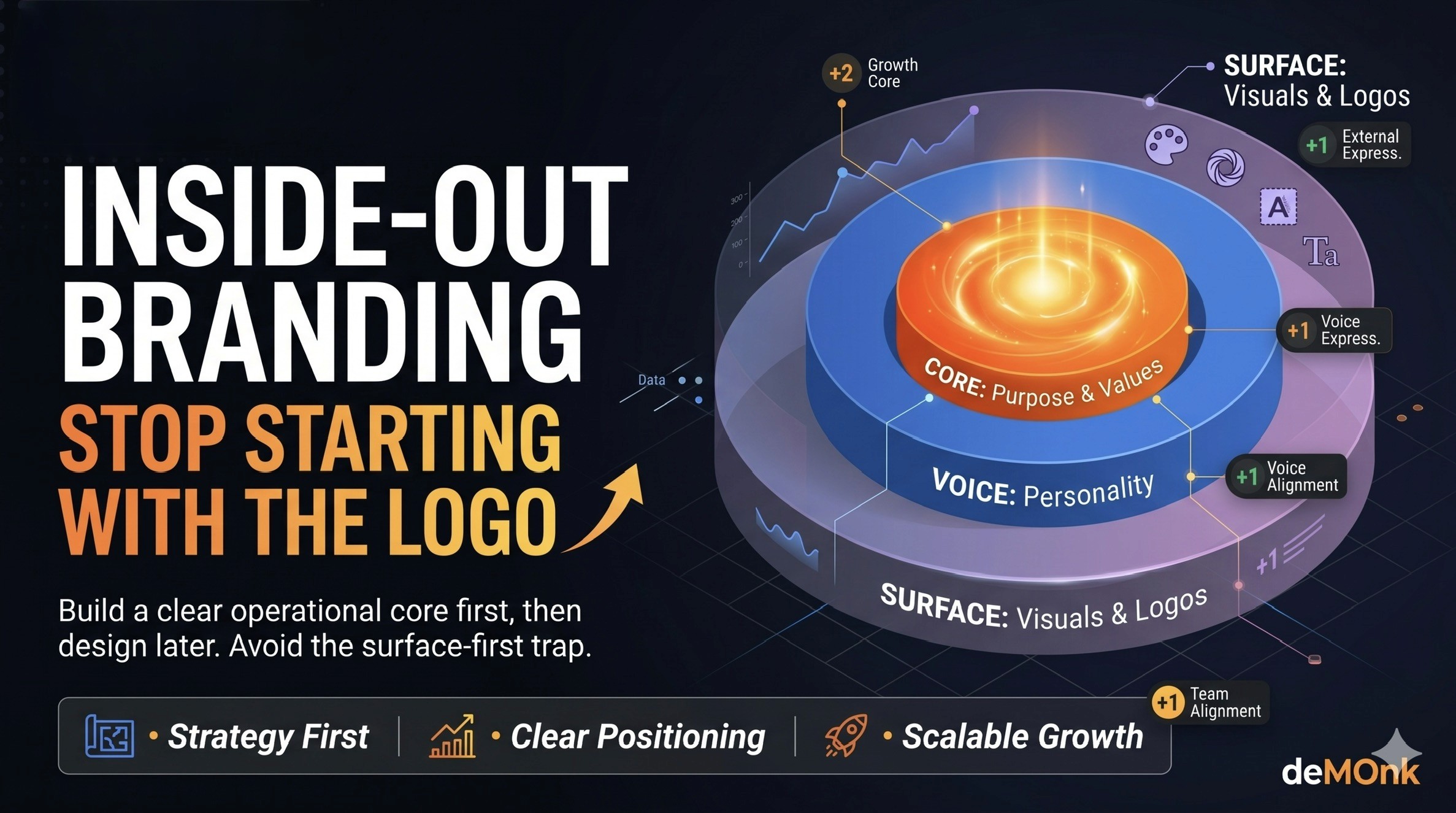
An inside-out brand works in layers. At the centre sit purpose, values, and positioning. Around that sit story, promise, voice, and personality. Outside those layers sit the team, partners, customers, and community.
Most weak brands jump straight to the outer circle: campaigns, social content, and visuals. Strong brands reverse the order. They define the core first, then articulate it clearly, then embed it internally, then amplify it externally.
Brands that scale with less friction are rarely born from a moodboard or a logo. They are built from a clear internal core that people can explain, defend, and use every day. That core—purpose, audience, positioning, values, voice, and personality—turns branding from decoration into direction.
For founders and teams, “inside out” means the brand is defined first as an operating system on the inside, then expressed outside through design, marketing, and experience. When the centre is weak or undefined, even strong creative work struggles to hold everything together.
The problem with surface-first branding
Many startups rush into visual identity, campaigns, and content before answering the basic question: who are we, and why should anyone care? The result is usually a brand that looks polished but feels vague, because the external layer is carrying the weight of an unfinished internal story.
The symptoms are easy to spot. Campaigns perform for a while, then stall because the message keeps shifting. A website looks sharp but fails to convert because it tries to speak to everyone. Teams describe the brand differently depending on their function, which creates friction inside the business and confusion outside it.
Why the internal core matters now
Markets are crowded, digital-first, and unforgiving. Customers meet a brand through product, support, social content, referrals, and search long before they experience a formal launch message. If those moments do not agree with one another, a good logo cannot save the experience.
Inside-out brand building aligns leadership, teams, and operations around one clear centre, so each touchpoint reinforces the same story. That makes brand less like a marketing layer and more like a decision-making system for the whole business.
Build the operating system
An inside-out brand works in layers. At the centre sit purpose, values, and positioning. Around that sit story, promise, voice, and personality. Outside those layers sit the team, partners, customers, and community.
Most weak brands jump straight to the outer circle: campaigns, social content, and visuals. Strong brands reverse the order. They define the core first, then articulate it clearly, then embed it internally, then amplify it externally.
Brands that scale with less friction are rarely born from a moodboard or a logo. They are built from a clear internal core that people can explain, defend, and use every day. That core—purpose, audience, positioning, values, voice, and personality—turns branding from decoration into direction.
For founders and teams, “inside out” means the brand is defined first as an operating system on the inside, then expressed outside through design, marketing, and experience. When the centre is weak or undefined, even strong creative work struggles to hold everything together.
The problem with surface-first branding
Many startups rush into visual identity, campaigns, and content before answering the basic question: who are we, and why should anyone care? The result is usually a brand that looks polished but feels vague, because the external layer is carrying the weight of an unfinished internal story.
The symptoms are easy to spot. Campaigns perform for a while, then stall because the message keeps shifting. A website looks sharp but fails to convert because it tries to speak to everyone. Teams describe the brand differently depending on their function, which creates friction inside the business and confusion outside it.
Why the internal core matters now
Markets are crowded, digital-first, and unforgiving. Customers meet a brand through product, support, social content, referrals, and search long before they experience a formal launch message. If those moments do not agree with one another, a good logo cannot save the experience.
Inside-out brand building aligns leadership, teams, and operations around one clear centre, so each touchpoint reinforces the same story. That makes brand less like a marketing layer and more like a decision-making system for the whole business.
Build the operating system
An inside-out brand works in layers. At the centre sit purpose, values, and positioning. Around that sit story, promise, voice, and personality. Outside those layers sit the team, partners, customers, and community.
Most weak brands jump straight to the outer circle: campaigns, social content, and visuals. Strong brands reverse the order. They define the core first, then articulate it clearly, then embed it internally, then amplify it externally.
Start with purpose
Purpose is the answer to a simple question: why does this business exist beyond profit? It is not a slogan, and it is not a vague statement about quality. It is the reason the brand deserves attention in the first place.
A strong purpose helps the business filter opportunities, make trade-offs under pressure, and attract people who believe in the same direction. For a design studio, that might mean being clear that the work is not about making things “look nice,” but about making businesses clearer, more credible, and easier to trust.
Design for a real audience
Inside-out brand building does not start with “everyone.” It starts with one priority audience whose needs, language, and constraints shape the rest of the system.
That is exactly what makes the Triwise work useful as a reference. The strategy did not define the audience vaguely; it focused on Millennials and Gen Z, then backed that up with behavior, spending patterns, planning habits, trust concerns, and travel motivations. The brand was built around real user pressure, not assumptions.
Positioning with teeth
Positioning is where the brand decides where it fits and why someone should choose it over alternatives. Good positioning is clear enough for a non-marketer to repeat, and grounded enough for the business to actually deliver.
Triwise is a strong example of this discipline. The brand sits at the intersection of travel booking, travel planning, and travel finance management, which gives it a distinct market shape. That category overlap is not an accident; it is the strategic foundation of the brand itself.
Make values behave
Values only matter when they affect what the company does next. If a value cannot influence hiring, product decisions, service standards, or partnerships, it is just wall art.
The Triwise strategy handles this well. Its values around freedom, flexibility, trust, transparency, community, and value are not decorative words. They tie directly to the experience the brand needs to create, especially in a category where hidden fees, unclear policies, and financial anxiety can break trust fast.
Give the brand a voice
Personality is the human character of the brand. Voice is how that character sounds. Together, they shape whether the brand feels credible, warm, sharp, calm, or aspirational.
For Triwise, the internal work pushes toward smart, reliable, and adaptive, with a tone that feels conversational yet knowledgeable. That matters because the brand has to carry both spontaneity and trust. It cannot sound cold and transactional, but it also cannot sound vague or poetic in a category where money and travel decisions are involved.
Align the experience
Once the internal foundation is clear, the next step is alignment. The outside world should experience what the inside believes. That means checking journeys, touchpoints, and service moments against the brand promise.
Triwise goes beyond strategy statements and maps the brand across discovery, website engagement, how-it-works education, and booking confidence. That is the difference between a brand document and a brand system. One describes intent. The other shapes real behavior.
Start with purpose
Purpose is the answer to a simple question: why does this business exist beyond profit? It is not a slogan, and it is not a vague statement about quality. It is the reason the brand deserves attention in the first place.
A strong purpose helps the business filter opportunities, make trade-offs under pressure, and attract people who believe in the same direction. For a design studio, that might mean being clear that the work is not about making things “look nice,” but about making businesses clearer, more credible, and easier to trust.
Design for a real audience
Inside-out brand building does not start with “everyone.” It starts with one priority audience whose needs, language, and constraints shape the rest of the system.
That is exactly what makes the Triwise work useful as a reference. The strategy did not define the audience vaguely; it focused on Millennials and Gen Z, then backed that up with behavior, spending patterns, planning habits, trust concerns, and travel motivations. The brand was built around real user pressure, not assumptions.
Positioning with teeth
Positioning is where the brand decides where it fits and why someone should choose it over alternatives. Good positioning is clear enough for a non-marketer to repeat, and grounded enough for the business to actually deliver.
Triwise is a strong example of this discipline. The brand sits at the intersection of travel booking, travel planning, and travel finance management, which gives it a distinct market shape. That category overlap is not an accident; it is the strategic foundation of the brand itself.
Make values behave
Values only matter when they affect what the company does next. If a value cannot influence hiring, product decisions, service standards, or partnerships, it is just wall art.
The Triwise strategy handles this well. Its values around freedom, flexibility, trust, transparency, community, and value are not decorative words. They tie directly to the experience the brand needs to create, especially in a category where hidden fees, unclear policies, and financial anxiety can break trust fast.
Give the brand a voice
Personality is the human character of the brand. Voice is how that character sounds. Together, they shape whether the brand feels credible, warm, sharp, calm, or aspirational.
For Triwise, the internal work pushes toward smart, reliable, and adaptive, with a tone that feels conversational yet knowledgeable. That matters because the brand has to carry both spontaneity and trust. It cannot sound cold and transactional, but it also cannot sound vague or poetic in a category where money and travel decisions are involved.
Align the experience
Once the internal foundation is clear, the next step is alignment. The outside world should experience what the inside believes. That means checking journeys, touchpoints, and service moments against the brand promise.
Triwise goes beyond strategy statements and maps the brand across discovery, website engagement, how-it-works education, and booking confidence. That is the difference between a brand document and a brand system. One describes intent. The other shapes real behavior.
Start with purpose
Purpose is the answer to a simple question: why does this business exist beyond profit? It is not a slogan, and it is not a vague statement about quality. It is the reason the brand deserves attention in the first place.
A strong purpose helps the business filter opportunities, make trade-offs under pressure, and attract people who believe in the same direction. For a design studio, that might mean being clear that the work is not about making things “look nice,” but about making businesses clearer, more credible, and easier to trust.
Design for a real audience
Inside-out brand building does not start with “everyone.” It starts with one priority audience whose needs, language, and constraints shape the rest of the system.
That is exactly what makes the Triwise work useful as a reference. The strategy did not define the audience vaguely; it focused on Millennials and Gen Z, then backed that up with behavior, spending patterns, planning habits, trust concerns, and travel motivations. The brand was built around real user pressure, not assumptions.
Positioning with teeth
Positioning is where the brand decides where it fits and why someone should choose it over alternatives. Good positioning is clear enough for a non-marketer to repeat, and grounded enough for the business to actually deliver.
Triwise is a strong example of this discipline. The brand sits at the intersection of travel booking, travel planning, and travel finance management, which gives it a distinct market shape. That category overlap is not an accident; it is the strategic foundation of the brand itself.
Make values behave
Values only matter when they affect what the company does next. If a value cannot influence hiring, product decisions, service standards, or partnerships, it is just wall art.
The Triwise strategy handles this well. Its values around freedom, flexibility, trust, transparency, community, and value are not decorative words. They tie directly to the experience the brand needs to create, especially in a category where hidden fees, unclear policies, and financial anxiety can break trust fast.
Give the brand a voice
Personality is the human character of the brand. Voice is how that character sounds. Together, they shape whether the brand feels credible, warm, sharp, calm, or aspirational.
For Triwise, the internal work pushes toward smart, reliable, and adaptive, with a tone that feels conversational yet knowledgeable. That matters because the brand has to carry both spontaneity and trust. It cannot sound cold and transactional, but it also cannot sound vague or poetic in a category where money and travel decisions are involved.
Align the experience
Once the internal foundation is clear, the next step is alignment. The outside world should experience what the inside believes. That means checking journeys, touchpoints, and service moments against the brand promise.
Triwise goes beyond strategy statements and maps the brand across discovery, website engagement, how-it-works education, and booking confidence. That is the difference between a brand document and a brand system. One describes intent. The other shapes real behavior.
Why the Triwise example works
Triwise is useful because the strategy is detailed enough to show the full chain: research, audience definition, pain points, brand essence, personality, values, tone, and customer journey. It proves that brand strategy becomes stronger when it is treated as a business system, not a naming exercise.
The logic is simple. If the audience is clear, the positioning becomes sharper. If the pain points are real, the value proposition gets stronger. If the voice is defined, the team communicates more consistently. If the journey is mapped, the brand promise becomes visible in the product and service experience.
How deMonk would run it
A studio working this way would typically move from discovery to foundation, then narrative, then identity, then rollout. The order matters. Strategy comes before expression, because expression without a core usually turns into style without direction.
That approach also fits deMonk’s tone: purposeful, sharp, and commercially aware. The point is not to decorate the business. The point is to make the business easier to understand, easier to trust, and easier to grow.
Build it from the inside
If the brand feels stuck, the answer is usually not another visual refresh. It is a stronger internal core. That is the part that holds the rest together when the market changes, the team grows, or the product evolves.
Start with the hard questions. Why does the business exist? Who is it really for? What does it refuse to be? What must never change, even when the market does? Those answers create the spine of the brand and make every outward decision easier.
Inside-out branding is not slower. It is cleaner. It removes guesswork early, so design and marketing have something solid to express later. The result is a brand that feels deliberate in public because it was disciplined in private.
Practical checklist
A founder can start with a short internal exercise:
Write one page on why the business exists, who it serves, what problem it solves, and why it is different.
Define three to five values and attach one observable behavior to each.
Choose three personality traits and test them against the website, pitch deck, and support tone.
Ask customers how they would describe the brand in one sentence.
Redesign one key touchpoint so it reflects the brand core instead of just looking polished.
Why the Triwise example works
Triwise is useful because the strategy is detailed enough to show the full chain: research, audience definition, pain points, brand essence, personality, values, tone, and customer journey. It proves that brand strategy becomes stronger when it is treated as a business system, not a naming exercise.
The logic is simple. If the audience is clear, the positioning becomes sharper. If the pain points are real, the value proposition gets stronger. If the voice is defined, the team communicates more consistently. If the journey is mapped, the brand promise becomes visible in the product and service experience.
How deMonk would run it
A studio working this way would typically move from discovery to foundation, then narrative, then identity, then rollout. The order matters. Strategy comes before expression, because expression without a core usually turns into style without direction.
That approach also fits deMonk’s tone: purposeful, sharp, and commercially aware. The point is not to decorate the business. The point is to make the business easier to understand, easier to trust, and easier to grow.
Build it from the inside
If the brand feels stuck, the answer is usually not another visual refresh. It is a stronger internal core. That is the part that holds the rest together when the market changes, the team grows, or the product evolves.
Start with the hard questions. Why does the business exist? Who is it really for? What does it refuse to be? What must never change, even when the market does? Those answers create the spine of the brand and make every outward decision easier.
Inside-out branding is not slower. It is cleaner. It removes guesswork early, so design and marketing have something solid to express later. The result is a brand that feels deliberate in public because it was disciplined in private.
Practical checklist
A founder can start with a short internal exercise:
Write one page on why the business exists, who it serves, what problem it solves, and why it is different.
Define three to five values and attach one observable behavior to each.
Choose three personality traits and test them against the website, pitch deck, and support tone.
Ask customers how they would describe the brand in one sentence.
Redesign one key touchpoint so it reflects the brand core instead of just looking polished.
Why the Triwise example works
Triwise is useful because the strategy is detailed enough to show the full chain: research, audience definition, pain points, brand essence, personality, values, tone, and customer journey. It proves that brand strategy becomes stronger when it is treated as a business system, not a naming exercise.
The logic is simple. If the audience is clear, the positioning becomes sharper. If the pain points are real, the value proposition gets stronger. If the voice is defined, the team communicates more consistently. If the journey is mapped, the brand promise becomes visible in the product and service experience.
How deMonk would run it
A studio working this way would typically move from discovery to foundation, then narrative, then identity, then rollout. The order matters. Strategy comes before expression, because expression without a core usually turns into style without direction.
That approach also fits deMonk’s tone: purposeful, sharp, and commercially aware. The point is not to decorate the business. The point is to make the business easier to understand, easier to trust, and easier to grow.
Build it from the inside
If the brand feels stuck, the answer is usually not another visual refresh. It is a stronger internal core. That is the part that holds the rest together when the market changes, the team grows, or the product evolves.
Start with the hard questions. Why does the business exist? Who is it really for? What does it refuse to be? What must never change, even when the market does? Those answers create the spine of the brand and make every outward decision easier.
Inside-out branding is not slower. It is cleaner. It removes guesswork early, so design and marketing have something solid to express later. The result is a brand that feels deliberate in public because it was disciplined in private.
Practical checklist
A founder can start with a short internal exercise:
Write one page on why the business exists, who it serves, what problem it solves, and why it is different.
Define three to five values and attach one observable behavior to each.
Choose three personality traits and test them against the website, pitch deck, and support tone.
Ask customers how they would describe the brand in one sentence.
Redesign one key touchpoint so it reflects the brand core instead of just looking polished.
FAQ
What does inside-out branding mean?
It means building the brand from internal clarity first—purpose, audience, positioning, values, and voice—then expressing that clarity through visuals, content, and customer experience.
Is this only useful for bigger companies?
No. Smaller teams often need it more, because they cannot afford repeated rebrands, mixed signals, or wasted marketing effort. A clear core saves time and money.
How does this help growth?
When the core is clear, the team makes better decisions, the message stays consistent, and the customer experience feels more coherent. That improves trust, recall, and conversion over time.
Does every brand need a full rebrand?
Not always. Sometimes the system needs refinement, not replacement. The key is that any design change should follow the strategy, not the other way around.
Closing thought
A brand built from the inside out is easier to scale because it starts with something real. When a business knows who it is, who it serves, what it stands for, and how it should sound, design stops being guesswork and starts becoming a growth tool.
Studio deMonk can help
Brand strategy is not a presentation layer. It is the foundation that makes every other brand decision easier. When the internal core is clear, identity, messaging, and customer experience stop pulling in different directions.
That is where Studio deMonk works best: turning scattered brand signals into one sharp, usable system. If the goal is a brand that feels credible, commercial, and built to last, the work starts inside.
FAQ
What does inside-out branding mean?
It means building the brand from internal clarity first—purpose, audience, positioning, values, and voice—then expressing that clarity through visuals, content, and customer experience.
Is this only useful for bigger companies?
No. Smaller teams often need it more, because they cannot afford repeated rebrands, mixed signals, or wasted marketing effort. A clear core saves time and money.
How does this help growth?
When the core is clear, the team makes better decisions, the message stays consistent, and the customer experience feels more coherent. That improves trust, recall, and conversion over time.
Does every brand need a full rebrand?
Not always. Sometimes the system needs refinement, not replacement. The key is that any design change should follow the strategy, not the other way around.
Closing thought
A brand built from the inside out is easier to scale because it starts with something real. When a business knows who it is, who it serves, what it stands for, and how it should sound, design stops being guesswork and starts becoming a growth tool.
Studio deMonk can help
Brand strategy is not a presentation layer. It is the foundation that makes every other brand decision easier. When the internal core is clear, identity, messaging, and customer experience stop pulling in different directions.
That is where Studio deMonk works best: turning scattered brand signals into one sharp, usable system. If the goal is a brand that feels credible, commercial, and built to last, the work starts inside.
FAQ
What does inside-out branding mean?
It means building the brand from internal clarity first—purpose, audience, positioning, values, and voice—then expressing that clarity through visuals, content, and customer experience.
Is this only useful for bigger companies?
No. Smaller teams often need it more, because they cannot afford repeated rebrands, mixed signals, or wasted marketing effort. A clear core saves time and money.
How does this help growth?
When the core is clear, the team makes better decisions, the message stays consistent, and the customer experience feels more coherent. That improves trust, recall, and conversion over time.
Does every brand need a full rebrand?
Not always. Sometimes the system needs refinement, not replacement. The key is that any design change should follow the strategy, not the other way around.
Closing thought
A brand built from the inside out is easier to scale because it starts with something real. When a business knows who it is, who it serves, what it stands for, and how it should sound, design stops being guesswork and starts becoming a growth tool.
Studio deMonk can help
Brand strategy is not a presentation layer. It is the foundation that makes every other brand decision easier. When the internal core is clear, identity, messaging, and customer experience stop pulling in different directions.
That is where Studio deMonk works best: turning scattered brand signals into one sharp, usable system. If the goal is a brand that feels credible, commercial, and built to last, the work starts inside.