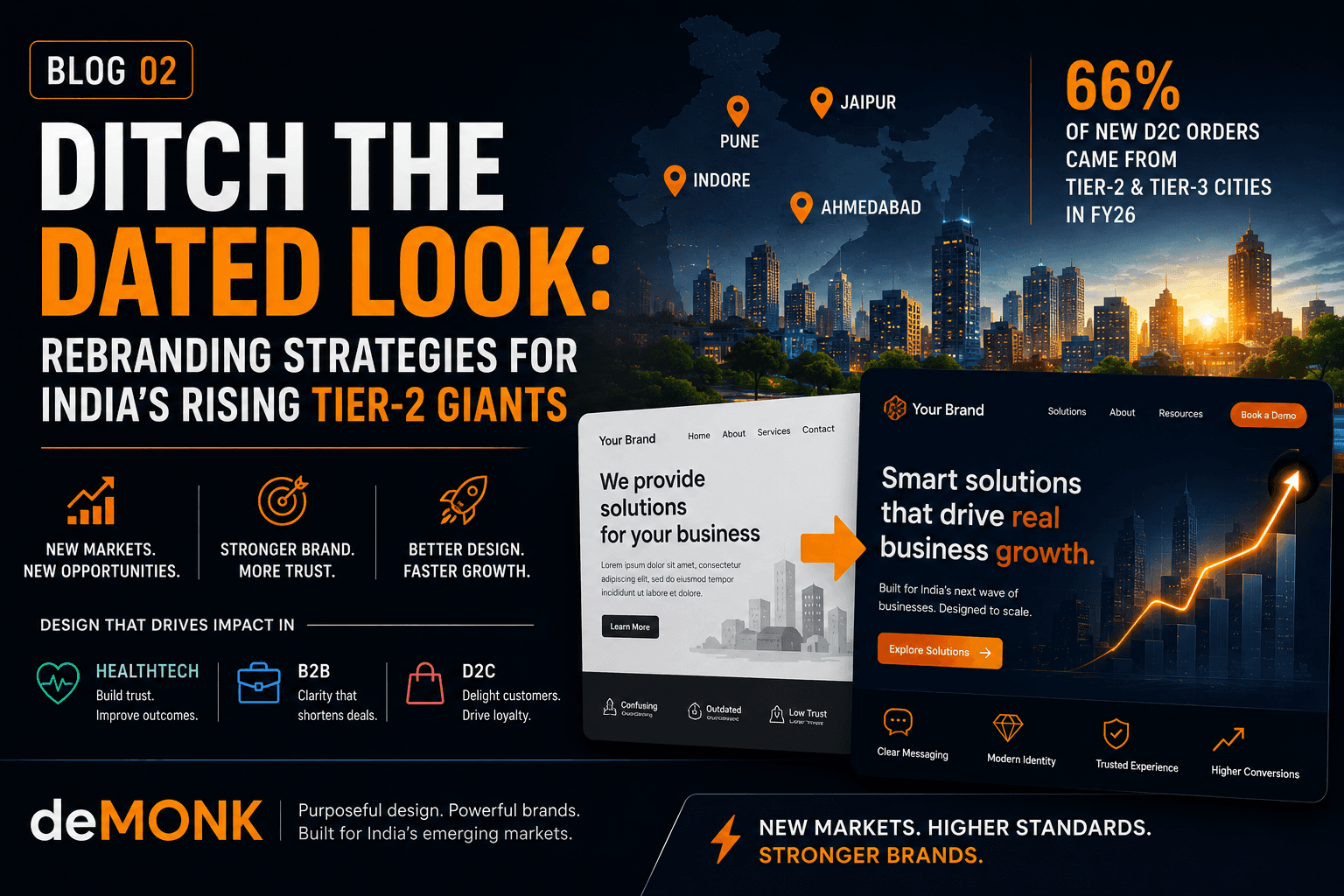
Ditch the Dated Look: Rebranding Strategies for India’s Rising Tier-2 Giants
Forget everything thought to be true about building a startup in India. The game has changed, and the real disruption is happening in Tier-2 cities across the country.
While founders in Bengaluru and Mumbai still dominate headlines, the real momentum is building in cities like Pune, Jaipur, Indore, and Ahmedabad, where startup activity is accelerating and new market demand is rising. In FY26, 66% of new D2C orders came from Tier-2 and Tier-3 cities, which signals a major shift in where India’s next wave of digital growth is coming from.
That shift creates opportunity, but it also raises the bar. Early traction is no longer enough. Rising customer acquisition costs, maturing consumer expectations, and stronger competition mean brands can no longer survive with weak storytelling, outdated interfaces, or forgettable positioning.
For startups in healthcare, B2B, and D2C, rebranding and product design are no longer optional upgrades. They are survival tools. The brands that win in 2026 will be the ones that build trust fast, simplify decisions, and create digital experiences that feel clear, confident, and valuable from the first click.
Forget everything thought to be true about building a startup in India. The game has changed, and the real disruption is happening in Tier-2 cities across the country.
While founders in Bengaluru and Mumbai still dominate headlines, the real momentum is building in cities like Pune, Jaipur, Indore, and Ahmedabad, where startup activity is accelerating and new market demand is rising. In FY26, 66% of new D2C orders came from Tier-2 and Tier-3 cities, which signals a major shift in where India’s next wave of digital growth is coming from.
That shift creates opportunity, but it also raises the bar. Early traction is no longer enough. Rising customer acquisition costs, maturing consumer expectations, and stronger competition mean brands can no longer survive with weak storytelling, outdated interfaces, or forgettable positioning.
For startups in healthcare, B2B, and D2C, rebranding and product design are no longer optional upgrades. They are survival tools. The brands that win in 2026 will be the ones that build trust fast, simplify decisions, and create digital experiences that feel clear, confident, and valuable from the first click.
Forget everything thought to be true about building a startup in India. The game has changed, and the real disruption is happening in Tier-2 cities across the country.
While founders in Bengaluru and Mumbai still dominate headlines, the real momentum is building in cities like Pune, Jaipur, Indore, and Ahmedabad, where startup activity is accelerating and new market demand is rising. In FY26, 66% of new D2C orders came from Tier-2 and Tier-3 cities, which signals a major shift in where India’s next wave of digital growth is coming from.
That shift creates opportunity, but it also raises the bar. Early traction is no longer enough. Rising customer acquisition costs, maturing consumer expectations, and stronger competition mean brands can no longer survive with weak storytelling, outdated interfaces, or forgettable positioning.
For startups in healthcare, B2B, and D2C, rebranding and product design are no longer optional upgrades. They are survival tools. The brands that win in 2026 will be the ones that build trust fast, simplify decisions, and create digital experiences that feel clear, confident, and valuable from the first click.
Why Tier-2 Cities Matter Now
India’s startup landscape is no longer concentrated in only a few metro cities. Tier-2 hubs are gaining momentum because they combine lower operating costs, rising digital adoption, local entrepreneurial energy, and growing customer demand.
This matters for one simple reason: markets outside the metros are no longer secondary. They are becoming primary growth engines. Brands that still design only for metro assumptions will struggle to connect with customers and business buyers in these emerging ecosystems.
For a studio like deMonk, this shift is a perfect match. The brand voice is bold, direct, and built to challenge the ordinary, and the content strategy already emphasizes fearless innovation, impactful creativity, and purpose-driven design. That positioning is highly relevant for founders in Tier-2 cities who need to stand out fast without wasting budget on slow, outdated brand thinking.
The HealthTech Trust Problem
Healthcare products live or die on trust. In HealthTech, users are not just evaluating features. They are deciding whether the product feels safe, credible, and simple enough to use when the stakes are high.
India’s HealthTech ecosystem in 2026 is moving beyond basic teleconsultation into AI-enabled diagnostics, more specialized care journeys, and digital products that support deeper healthcare decision-making. That means user expectations are rising fast, especially when people are comparing platforms that claim to improve outcomes, reduce friction, and simplify access to care.
For Tier-2 healthcare startups, poor product design creates an immediate trust gap. A confusing interface, unclear onboarding flow, weak typography, or generic visual identity can make a platform feel unreliable even if the underlying service is strong. In healthcare, that kind of hesitation is expensive because it damages adoption, repeat use, and referrals.
This is exactly why rebranding matters in HealthTech. A strong rebrand is not about making the interface prettier. It is about building confidence through clarity. It is about designing every interaction so users feel guided, informed, and respected.
For deMonk, this creates a strong editorial angle. A blog that explains how trust-driven product design improves healthcare adoption will directly speak to startup founders, product teams, and operators trying to grow in emerging Indian markets.
B2B Buyers Need Clarity, Not Clutter
B2B founders often assume branding matters less because decisions are rational and feature-driven. That is a mistake. In B2B, design shapes credibility, reduces confusion, and helps buyers understand whether a company feels modern, dependable, and worth the risk.
This matters even more in Tier-2 markets, where many B2B businesses are modernizing operations, adopting digital tools, and evaluating new vendors for the first time. A legacy-looking website or a product dashboard full of friction sends the wrong signal immediately.
Good B2B product design shortens the distance between interest and action. It helps users understand value faster, reduces friction in demos or onboarding, and turns complex services into simpler experiences. Good rebranding does the same thing at a strategic level by aligning messaging, identity, interface, and sales storytelling into one clear promise.
This topic fits deMonk especially well because the studio’s content guidelines explicitly call for website content that makes bold declarations, showcases real business impact, and challenges conventional thinking in the design space. A B2B-focused blog can do exactly that while attracting founders who are actively rethinking how their business is presented online.
Why Tier-2 Cities Matter Now
India’s startup landscape is no longer concentrated in only a few metro cities. Tier-2 hubs are gaining momentum because they combine lower operating costs, rising digital adoption, local entrepreneurial energy, and growing customer demand.
This matters for one simple reason: markets outside the metros are no longer secondary. They are becoming primary growth engines. Brands that still design only for metro assumptions will struggle to connect with customers and business buyers in these emerging ecosystems.
For a studio like deMonk, this shift is a perfect match. The brand voice is bold, direct, and built to challenge the ordinary, and the content strategy already emphasizes fearless innovation, impactful creativity, and purpose-driven design. That positioning is highly relevant for founders in Tier-2 cities who need to stand out fast without wasting budget on slow, outdated brand thinking.
The HealthTech Trust Problem
Healthcare products live or die on trust. In HealthTech, users are not just evaluating features. They are deciding whether the product feels safe, credible, and simple enough to use when the stakes are high.
India’s HealthTech ecosystem in 2026 is moving beyond basic teleconsultation into AI-enabled diagnostics, more specialized care journeys, and digital products that support deeper healthcare decision-making. That means user expectations are rising fast, especially when people are comparing platforms that claim to improve outcomes, reduce friction, and simplify access to care.
For Tier-2 healthcare startups, poor product design creates an immediate trust gap. A confusing interface, unclear onboarding flow, weak typography, or generic visual identity can make a platform feel unreliable even if the underlying service is strong. In healthcare, that kind of hesitation is expensive because it damages adoption, repeat use, and referrals.
This is exactly why rebranding matters in HealthTech. A strong rebrand is not about making the interface prettier. It is about building confidence through clarity. It is about designing every interaction so users feel guided, informed, and respected.
For deMonk, this creates a strong editorial angle. A blog that explains how trust-driven product design improves healthcare adoption will directly speak to startup founders, product teams, and operators trying to grow in emerging Indian markets.
B2B Buyers Need Clarity, Not Clutter
B2B founders often assume branding matters less because decisions are rational and feature-driven. That is a mistake. In B2B, design shapes credibility, reduces confusion, and helps buyers understand whether a company feels modern, dependable, and worth the risk.
This matters even more in Tier-2 markets, where many B2B businesses are modernizing operations, adopting digital tools, and evaluating new vendors for the first time. A legacy-looking website or a product dashboard full of friction sends the wrong signal immediately.
Good B2B product design shortens the distance between interest and action. It helps users understand value faster, reduces friction in demos or onboarding, and turns complex services into simpler experiences. Good rebranding does the same thing at a strategic level by aligning messaging, identity, interface, and sales storytelling into one clear promise.
This topic fits deMonk especially well because the studio’s content guidelines explicitly call for website content that makes bold declarations, showcases real business impact, and challenges conventional thinking in the design space. A B2B-focused blog can do exactly that while attracting founders who are actively rethinking how their business is presented online.
Why Tier-2 Cities Matter Now
India’s startup landscape is no longer concentrated in only a few metro cities. Tier-2 hubs are gaining momentum because they combine lower operating costs, rising digital adoption, local entrepreneurial energy, and growing customer demand.
This matters for one simple reason: markets outside the metros are no longer secondary. They are becoming primary growth engines. Brands that still design only for metro assumptions will struggle to connect with customers and business buyers in these emerging ecosystems.
For a studio like deMonk, this shift is a perfect match. The brand voice is bold, direct, and built to challenge the ordinary, and the content strategy already emphasizes fearless innovation, impactful creativity, and purpose-driven design. That positioning is highly relevant for founders in Tier-2 cities who need to stand out fast without wasting budget on slow, outdated brand thinking.
The HealthTech Trust Problem
Healthcare products live or die on trust. In HealthTech, users are not just evaluating features. They are deciding whether the product feels safe, credible, and simple enough to use when the stakes are high.
India’s HealthTech ecosystem in 2026 is moving beyond basic teleconsultation into AI-enabled diagnostics, more specialized care journeys, and digital products that support deeper healthcare decision-making. That means user expectations are rising fast, especially when people are comparing platforms that claim to improve outcomes, reduce friction, and simplify access to care.
For Tier-2 healthcare startups, poor product design creates an immediate trust gap. A confusing interface, unclear onboarding flow, weak typography, or generic visual identity can make a platform feel unreliable even if the underlying service is strong. In healthcare, that kind of hesitation is expensive because it damages adoption, repeat use, and referrals.
This is exactly why rebranding matters in HealthTech. A strong rebrand is not about making the interface prettier. It is about building confidence through clarity. It is about designing every interaction so users feel guided, informed, and respected.
For deMonk, this creates a strong editorial angle. A blog that explains how trust-driven product design improves healthcare adoption will directly speak to startup founders, product teams, and operators trying to grow in emerging Indian markets.
B2B Buyers Need Clarity, Not Clutter
B2B founders often assume branding matters less because decisions are rational and feature-driven. That is a mistake. In B2B, design shapes credibility, reduces confusion, and helps buyers understand whether a company feels modern, dependable, and worth the risk.
This matters even more in Tier-2 markets, where many B2B businesses are modernizing operations, adopting digital tools, and evaluating new vendors for the first time. A legacy-looking website or a product dashboard full of friction sends the wrong signal immediately.
Good B2B product design shortens the distance between interest and action. It helps users understand value faster, reduces friction in demos or onboarding, and turns complex services into simpler experiences. Good rebranding does the same thing at a strategic level by aligning messaging, identity, interface, and sales storytelling into one clear promise.
This topic fits deMonk especially well because the studio’s content guidelines explicitly call for website content that makes bold declarations, showcases real business impact, and challenges conventional thinking in the design space. A B2B-focused blog can do exactly that while attracting founders who are actively rethinking how their business is presented online.
D2C Growth Has Changed the Rules
D2C growth in India is being powered heavily by non-metro demand. New orders are increasingly coming from Tier-2 and Tier-3 cities, which means these markets are not just future potential; they are current growth drivers.
That growth also changes what D2C brands need to win. A product page alone is not enough. A checkout flow alone is not enough. Today’s customers expect a brand to feel intentional, memorable, and easy to trust.
In practice, this means rebranding becomes a growth lever. It sharpens positioning, improves perceived value, and helps a brand escape pure price competition. Product design supports that by reducing cart friction, improving mobile usability, and making every touchpoint feel cohesive.
For Tier-2 D2C brands, this is a huge opportunity. Many are competing in categories where the products themselves are becoming easier to replicate. Brand trust, digital clarity, and overall customer experience become the real differentiators.
A deMonk blog on this topic would work well because it connects business reality with design execution. It does not sell design as decoration. It shows design as a direct growth tool, which is exactly the kind of argument startup founders and medium businesses respond to.
Rebranding Is Not Just a New Look
A lot of founders think rebranding means a new logo, a new color palette, and a new homepage. That is only the surface. A real rebrand changes how the business is understood, experienced, and remembered.
For startups in Tier-2 hubs, that matters because they are often competing against larger, better-funded players. They cannot always outspend competitors, but they can absolutely out-position them. Clearer messaging, stronger visual systems, and more intuitive product journeys can create a much stronger first impression.
The strongest rebrands usually solve five problems at once:
Weak market positioning.
Inconsistent brand identity.
Confusing user journeys.
Low trust at first interaction.
Poor conversion from interest to action.
When those issues are fixed together, the result is not just a cleaner brand. The result is a business that feels more credible, more valuable, and easier to buy from.
Product Design Is the Business Advantage
Product design is often misunderstood as the final polish added after strategy, engineering, or marketing. In reality, product design sits in the middle of all three. It shapes how people understand value, how they complete actions, and how they judge the quality of the business behind the product.
That is especially true in healthcare, B2B, and D2C because each category depends on trust and decision speed. HealthTech users want confidence. B2B buyers want clarity. D2C customers want ease and emotional connection. Product design supports all three.
This is why deMonk should continue publishing content that treats design as a business lever rather than a creative add-on. The studio’s own positioning already emphasizes purposeful, progressive, and customer-centric communication, which gives it strong credibility in this conversation. The blog should reflect that same mindset by explaining design through outcomes, not just aesthetics.
D2C Growth Has Changed the Rules
D2C growth in India is being powered heavily by non-metro demand. New orders are increasingly coming from Tier-2 and Tier-3 cities, which means these markets are not just future potential; they are current growth drivers.
That growth also changes what D2C brands need to win. A product page alone is not enough. A checkout flow alone is not enough. Today’s customers expect a brand to feel intentional, memorable, and easy to trust.
In practice, this means rebranding becomes a growth lever. It sharpens positioning, improves perceived value, and helps a brand escape pure price competition. Product design supports that by reducing cart friction, improving mobile usability, and making every touchpoint feel cohesive.
For Tier-2 D2C brands, this is a huge opportunity. Many are competing in categories where the products themselves are becoming easier to replicate. Brand trust, digital clarity, and overall customer experience become the real differentiators.
A deMonk blog on this topic would work well because it connects business reality with design execution. It does not sell design as decoration. It shows design as a direct growth tool, which is exactly the kind of argument startup founders and medium businesses respond to.
Rebranding Is Not Just a New Look
A lot of founders think rebranding means a new logo, a new color palette, and a new homepage. That is only the surface. A real rebrand changes how the business is understood, experienced, and remembered.
For startups in Tier-2 hubs, that matters because they are often competing against larger, better-funded players. They cannot always outspend competitors, but they can absolutely out-position them. Clearer messaging, stronger visual systems, and more intuitive product journeys can create a much stronger first impression.
The strongest rebrands usually solve five problems at once:
Weak market positioning.
Inconsistent brand identity.
Confusing user journeys.
Low trust at first interaction.
Poor conversion from interest to action.
When those issues are fixed together, the result is not just a cleaner brand. The result is a business that feels more credible, more valuable, and easier to buy from.
Product Design Is the Business Advantage
Product design is often misunderstood as the final polish added after strategy, engineering, or marketing. In reality, product design sits in the middle of all three. It shapes how people understand value, how they complete actions, and how they judge the quality of the business behind the product.
That is especially true in healthcare, B2B, and D2C because each category depends on trust and decision speed. HealthTech users want confidence. B2B buyers want clarity. D2C customers want ease and emotional connection. Product design supports all three.
This is why deMonk should continue publishing content that treats design as a business lever rather than a creative add-on. The studio’s own positioning already emphasizes purposeful, progressive, and customer-centric communication, which gives it strong credibility in this conversation. The blog should reflect that same mindset by explaining design through outcomes, not just aesthetics.
D2C Growth Has Changed the Rules
D2C growth in India is being powered heavily by non-metro demand. New orders are increasingly coming from Tier-2 and Tier-3 cities, which means these markets are not just future potential; they are current growth drivers.
That growth also changes what D2C brands need to win. A product page alone is not enough. A checkout flow alone is not enough. Today’s customers expect a brand to feel intentional, memorable, and easy to trust.
In practice, this means rebranding becomes a growth lever. It sharpens positioning, improves perceived value, and helps a brand escape pure price competition. Product design supports that by reducing cart friction, improving mobile usability, and making every touchpoint feel cohesive.
For Tier-2 D2C brands, this is a huge opportunity. Many are competing in categories where the products themselves are becoming easier to replicate. Brand trust, digital clarity, and overall customer experience become the real differentiators.
A deMonk blog on this topic would work well because it connects business reality with design execution. It does not sell design as decoration. It shows design as a direct growth tool, which is exactly the kind of argument startup founders and medium businesses respond to.
Rebranding Is Not Just a New Look
A lot of founders think rebranding means a new logo, a new color palette, and a new homepage. That is only the surface. A real rebrand changes how the business is understood, experienced, and remembered.
For startups in Tier-2 hubs, that matters because they are often competing against larger, better-funded players. They cannot always outspend competitors, but they can absolutely out-position them. Clearer messaging, stronger visual systems, and more intuitive product journeys can create a much stronger first impression.
The strongest rebrands usually solve five problems at once:
Weak market positioning.
Inconsistent brand identity.
Confusing user journeys.
Low trust at first interaction.
Poor conversion from interest to action.
When those issues are fixed together, the result is not just a cleaner brand. The result is a business that feels more credible, more valuable, and easier to buy from.
Product Design Is the Business Advantage
Product design is often misunderstood as the final polish added after strategy, engineering, or marketing. In reality, product design sits in the middle of all three. It shapes how people understand value, how they complete actions, and how they judge the quality of the business behind the product.
That is especially true in healthcare, B2B, and D2C because each category depends on trust and decision speed. HealthTech users want confidence. B2B buyers want clarity. D2C customers want ease and emotional connection. Product design supports all three.
This is why deMonk should continue publishing content that treats design as a business lever rather than a creative add-on. The studio’s own positioning already emphasizes purposeful, progressive, and customer-centric communication, which gives it strong credibility in this conversation. The blog should reflect that same mindset by explaining design through outcomes, not just aesthetics.